 |
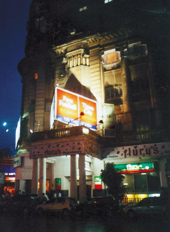
| Leading lights of Park Street |
The day I saw a terrace restaurant flaunting itself in the familiar surroundings of busy Khardah bazaar, the belated realisation sank into me that in this state that finds it hard to feed itself, eating is the only business that can possibly thrive.
This truth was re-confirmed this morning when I happened to tune into an FM radio programme sponsored by Satyendra Sattoo, whose stickers were first seen on rickshaw seats. Then this branded chickpea flour went progressively upscale with posters appearing in mini-buses, followed by private and state buses. And now it sponsors a radio programme with top billing. In a sudden flash I distinctly saw Rabri Devi doling out sattoo ghol by the glass in the Shrabasti food court of a five-star hotel.
The point I am trying to drive is that in a little over a decade, the business of dining has spread from the confines of Park Street and Chowringhee to practically every other street of Calcutta. Maddeningly diverse varieties of cuisine are being dished out by superchefs, but most of the fancy new places in which they are served have given Park Street a wide berth. In this respect, Park Street lags behind others.
Pole dance is a big draw at the disco Tantra now, but would today’s politically-correct world be able to stomach cabaret and striptease, often by cross-dressers, who were regular items in Park Street restaurants?
Oh yes, perennial favourites like Peter Cat and Mocambo still attract a steady stream of clientele, and as their owner Nitin Kothari was quick to point out, he is quite happy to cater to the middle class. He admits earlier these restaurants were more select.
Park Street joints have their old faithful. Jayatsen Bhattacharjee is a third-generation habitue of Olypub, officially Olympia, now owned by an employees’ cooperative. It has looked the same since the Sixties. Unescorted women are still not served. They say the Olypub steak is a class apart. Bhattacharjee says his grand-uncle, filmmaker Harisadhan Dasupta was such a familiar face he was the only client to be given credit. “I was given my first taste of beer here. The crowd is still of a controllable nature. It is meant for serious drinkers. The bathroom is unspeakable. But the bearers are solicitous. This, however, may not be good for business.”
Old world. Old school. Old faithful. Service before business and a certain sense of dignity and decorum that mean nothing today are some of the sterling values by which Park Street is still defined. Skyroom did not have to thump its chest to declare its greatness.
I have it from the horse’s mouth that when Satyajit Ray wanted to shoot in Skyroom, he was politely denied permission for the simple reason that the owner was not interested in films.
It is hard to believe today, but all the service from the tea pots to the goblets were silver and the stewards wore gold buttons. Skyroom served its own ice cream and aerated water, and another story goes that a cloth mill owner would make sure that he never flew down to Calcutta from Bombay on a Tuesday for Skyroom used to be closed that day. It shut down forever in 1993.
This Park Street exists in the formaldehyde of memories. French commercial attache Marie Claude Olivier was a young woman when she came to live in Park Mansion where the verandahs were large enough to play cricket on. “On Saturdays and Sundays people sauntered down Park Street. I went for music and tea at Mag’s. It was all very proper. Young girls and boys didn’t mix much. But Pam Crain was different from what I was seeing around. She was a woman standing on her own feet,” she says.
Sitting in her flat in Hastings, Pam Crain tries to pin down the words that could define the magic attributed to the night life of Park Street in the Fifties and the Seventies. Still lithe, Pam is Calcutta’s best known chanteuse, even though entertainment tax slapped on restaurants, and the subsequent ban on cabaret stifled the bands and live music in the Eighties. Pam exclaims: “Park Street was…I am looking for a flashy phrase…I can put in a cliché but I don’t want to. It just came into people’s heads…like an electric bulb…That’s entertainment.”
Blue Fox was where she would perform long, long before it was appropriated by Munna Maharaj, its present owner, to whom goes the credit of turning a palace in France into adarsh Hindu hotel.
Easily identifiable till recently by its neon Reynard, today the walls inside the restaurant depict bucolic India in low relief. It is difficult to imagine a caterwaul inside this tame, staid eatery. Yet Pam says: “Blue Fox was famous for dancing. It used to be jam-packed. People stayed on till they were thrown out. The band could make a lot of noise. People talked loud. They wanted excitement. Now managers would say: `Don’t annoy customers. Sing softly.’”
In his minuscule flat in Alimuddin Street, guitarist Carlton Kitto is all togged up to face the day. Kitto reels off an honours list of Anglo-Indians and Goans who had become household names by virtue of performing in restaurants. The only non-AI of the Sixties’ set was Usha Uthup, then Iyer.
The entertainment tax of 1978 served the quietus. Retrenchment followed. Says Kitto: “A lot of musicians became jobless. Louis Banks hit the commercial scene. I survived because I was a teacher. The crooners took out jobs as secretaries. Many of the crooners married and settled down.” Nobody knows what happened to the rest. Reality sucked them in. Night clubs became eateries.
Youth culture was born in Park Street. Calcutta’s first discotheque In & Out opened in Park Hotel in 1975. Even before that, jam sessions used to be held at Madhouse where the chairs were stuck upside down on the ceiling. Musician Nondon Bagchi has been in the thick of it all from his teens, and he believes that neither politics nor the power cuts of the Seventies killed night life in Park Street. The balloon burst with the exodus of the fun-loving Anglo-Indians. They were the life and soul of the party. Their departure signalled the end of it.
(To be concluded)