
April 4: A dreaded disease has been stalking Minakhan, about 45km from Calcutta, for five years, claiming lives and scarring villages.
Goaldaha and Debitala villages of Minakhan have lost 20 of men to silicosis, a lung disease, or conditions similar to it, since 2012. All the victims, most of them in their 20s and 30s, had worked for different durations at stone-crushing units in Asansol, Burdwan.
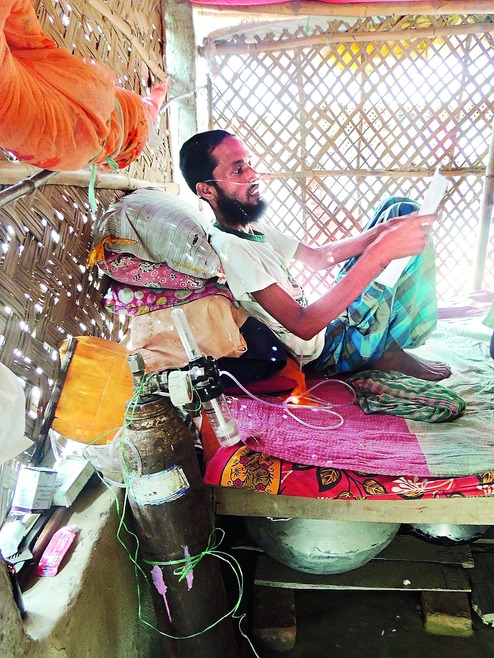
Silicosis, a severe and often-fatal lung disease, is caused by the inhalation of silica dust produced in stone-crushing units. More than a hundred young men from the area are still suffering from silicosis or similar severe lung diseases. Many of them are critically ill.
The villagers allege that the state government has refused to acknowledge the disease or to pay compensation to the families of the deceased, as directed by the National Human Rights Commission (NHRC).
"The saddest part is that doctors are not stating silicosis as the cause of death despite saying so verbally after seeing the X-ray and other reports," said Nasiruddin Mollah, who has been affected with the disease.
Sahidul Mollah, who died this March, has left behind a two-and-a-half-year-old son and a five-month-old daughter. Sahidul's father feels helpless. "I don't know how I will be able to look after the children," he said.
Those battling the disease are as helpless. "I can barely walk but do nothing else, and have become a liability for my family. I don't know how long I can survive like this," said a young man.
Most of the men who have contracted lung diseases had left the village to work in the stone-crushing units of Asansol after Cyclone Aila devastated parts of south Bengal in 2009. Between 2012 and 2014, Minakhan recorded eight deaths because of silicosis. The toll rose steadily after that, touching 20 last month. The most recent death was in the first week of March.
Section 21 of the Air (Prevention and Control of Pollution) Act asks the state pollution control board to give consent to only those factories that follow environmental norms. These have been clearly violated in the Minakhan case, as was pointed out by the National Human Rights Commission. Along with the air pollution act, the Factories Act of 1948 should also ensure that factory workers work in a non-polluted environment and feel protected.
A state police inquiry report of 2015, a copy of which is with The Telegraph , states that "already 10 persons have expired due to this silicosis (and) more than 100 people have been suffering from the fatal disease" almost two years ago. The report, memo no 251/15 dated 7.2.15, also included a list of persons who died of silicosis.
The five victims of silicosis named in the NHRC order also find mention in the police report.
In June 2016, the NHRC had issued a directive to the state government to pay Rs 4 lakh as compensation to the families of each of five persons. In December, the commission issued a stern reminder to the state chief secretary, asking him to respond to the earlier directive. There has been no response till date.
"It is prima facie a case of violation of human rights of the victims and the next of kin of the deceased are entitled to monetary compensation," said the human rights commission in an order delivered on June 6, 2016, in response to separate petitions filed by two NGOs, OSHAJ from Jharkhand and Nagarik Mancha, Calcutta.
"The state has no option other than agreeing to compensate as the Supreme Court in 2009 has mandated that the National Human Rights Commission will decide silicosis-related compensations. Earlier when the Gujarat government had refused to pay the compensation decided by the commission, the apex court had intervened and ensured full payment," said a senior official of the commission.
"The state government has done nothing to protect these people even after they contracted silicosis. We demand that compensation should be provided to all the Minakhan patients, dead or alive, who have been affected with silicosis," said environment activist Naba Dutta.
Former chief law officer of the state pollution control board, Biswajit Mukherjee, had earlier moved the high court on the silicosis deaths. He demanded that a detailed health study be carried out among the affected people of the area.