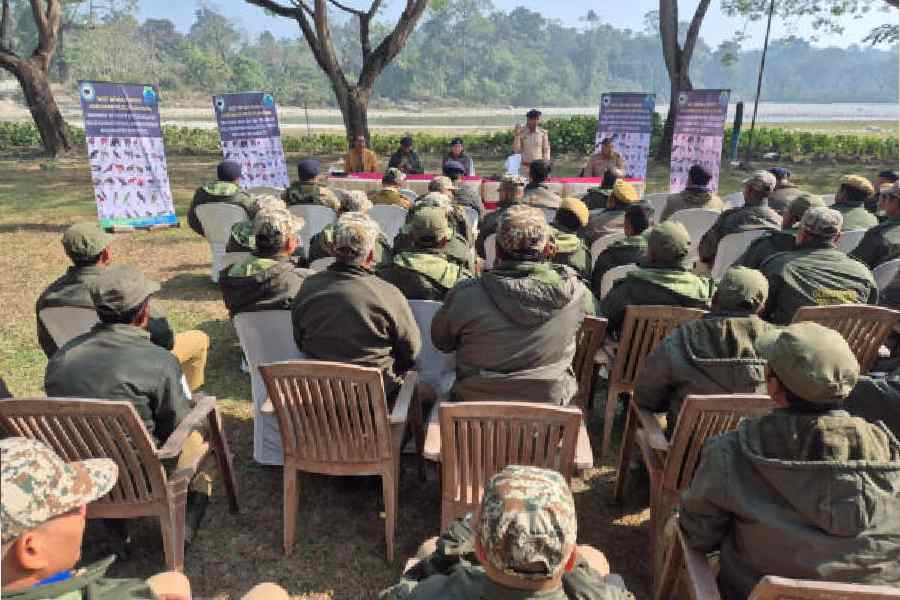
The Bengal forest department will conduct a tiger census in the Gorumara National Park and the Chapramari Wildlife Sanctuary in Jalpaiguri district simultaneously for the first time from January 18 to 20.
The tiger will be counted in the Neora Valley National Park in Kalimpong district once the extreme cold subsides.
Senior foresters announced on Friday that the census would be conducted in collaboration with the National Tiger Conservation Authority (NTCA) and the Wildlife Institute of India (WII).
Dwijapratim Sen, the divisional forest officer of the Gorumara wildlife division, said the division had recently become a member of the Global Tiger Forum, a status granted only to forest divisions that have confirmed tiger presence.
“The evidence of tiger’s presence in Neora Valley, including photographs, claw marks, and scat samples, had already been submitted to the WII. The temperature in Neora Valley is currently too low. Besides, the area faces significant risks because of the presence of the Himalayan black bear, which makes the fieldwork hazardous. Therefore, tiger census in Neora Valley will begin once the weather improves, probably next month,” said Sen.
The Gorumara, Champramari and Neora Valley forests are under the jurisdiction of the Gorumara division.
“We will engage around 250 surveyors for the census in Gorumara and Chapramari. In Neora Valley, around 200 surveyors will be fielded,” Sen said.
The census, he said, will follow multiple scientific methods, including camera trapping, foot patrol surveys using the polygon method, direct visual observations, the identification of claw marks on trees, the collection of tiger scat samples, and the analysis of pugmarks.
Ahead of the census, training for forest personnel in Gorumara and Chapramari was completed on Thursday.
The last official mention of a tiger sighting in the Buxa Tiger Reserve appeared in the 2022 All-India Tiger Estimation Report, which confirmed the presence of one
big cat.
However, despite multiple photographic records of tigers in Neora Valley through cell phones and camera traps since 2017, and even after sending scat samples to the WII for analysis, the national tiger census report of 2022 did not record the presence of the animal in Neora Valley.
During the census, the surveyors will assess the status of tiger habitats and the prey population, which is considered crucial for sustaining tigers in the region.
The survey will also focus on identifying tiger habitats within Neora Valley and tracking tiger movement corridors, particularly in the tri-junction forest corridor connecting Neora Valley with Bhutan and Sikkim.
“Ahead of the winter, 80 trap cameras were installed in the dense mountainous forests of Neora Valley. In Gorumara and Chapramari, installation of 60 trap cameras is underway,” said Sen.
“Additionally, 45 more trap cameras will be brought from the Jaldapara National Park and installed in Neora Valley by the end of January,” the forester added.
Once the census begins, the camera traps will remain operational continuously for 45 days.
“The images captured will be analysed at the research laboratory of the WII, where experts will estimate the tiger population based on unique stripe patterns,” said
a forester.