 |
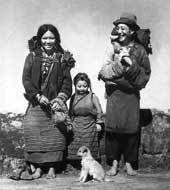
| A Tibetan family in Darjeeling in 1940. Picture by Parimal Goswami |
If you were to ask Chetan Yanggon-Sherpa where her home is, chances are that she will first look at you, surprised, and then throw up her hands in despair. “This is my home”, she would say, and then chuckle as you try and make sense of her words.
“This tiny, cluttered shop? Really?” is what you would probably ask, incredulous. The old woman would smile and nod gently.
Chetan, a third-generation Tibetan woman, owns a curio shop in New Market. She was born in what she fondly calls the Bhutia basti in Darjeeling in 1937. Tibetans have been living in India since the late 1800s, she says, much before Dalai Lama and his entourage fled to India in 1959.
Chetan remembers that year well: for it was close to the time when she set up her curio shop — her home — in Calcutta. In Chetan’s mind, the shop and the city are interchangeable entities. She draws her comfort from both: the bustling city and her quiet shop have given her shelter and an identity. She knows them to be home, and not the distant land that lies cradled in the mountains.
Chetan, denied an education by her authoritarian father, made sure that she wouldn’t make the same mistake with her own children. She sent her daughter, Tsering Yanjki-Sherpa, to a reputed school in Darjeeling, while her son, Sonam Thundup, was educated at an Irish convent. The brother and sister, who run the shop themselves now, remember that they were not surprised to have Nepali, and not Tibetan, as their second language in school.
Even today, they cannot read Tibetan texts unless they have been translated. Chetan herself loves preparing the traditional thukpa, but insists that the Indian ingredients that go into the preparation, especially the spices, make it tastier than what she remembers was available in Lhasa.
In 1954, Chetan had travelled to Lhasa with her parents and spent over three weeks there. The journey had started from Darjeeling (not on mules, she insists), and they had stopped at Gangtok briefly before reaching Lhasa, covering 15 miles every day.
To Chetan, Lhasa, with its near-empty roads, rugged barley fields, chogans and monasteries, resembled the landscape of a Western, the kind of films she loved watching at Darjeeling’s Capitol cinema. She even met the Dalai Lama, as he passed them by in an old vehicle, smiling and blessing the people on the road. In Lhasa, she had been shocked to see that there were few schools, and that the students were being taught Chinese, and not Tibetan, history.
Potala palace shone clear, horse bells tinkled during quiet afternoons and the trees were in bloom. But she also remembers the floods in Gangze in central Tibet, Chinese soldiers busy building roads for a war that was to come and the absence of local police. For Chetan, it was a fabled, exotic land. It didn’t feel like home at all.
But then it isn’t quite easy to efface quiescent ties that have been passed down unseen across generations. They still bind her to that near-mythical land, which, some say, is her real home, one that she has never seen but cannot quite forget. She wears this past like an invisible scarf, and can feel its light touch sometimes.
For instance, when her daughter’s marriage fell apart, she found the strength to conquer her own pain by turning to traditional Tibetan religion, its values and ethics that her grandparents had taught her. She is still tethered, she knows, to that knowledge and way of life, and her curio shop — full of Tibetan handicrafts, trinkets, and jewellery — is proof of an ineffable and enduring legacy.
But she knows the world is changing, even from inside her curio shop. There are young voices that she hears, on television and radio, which promise a new path to freedom. She wonders whether patience has given way to a candour that chills.
But, even the rumblings of change do not perturb the old woman. She has heard that a new railway line would soon connect Lhasa to many other places. Sitting inside her cosy shop, she dreams of returning to Lhasa some day, not as a citizen, but just as any other wide-eyed, excited tourist.