

The small room on the first floor is stacked with masks. There are two racks full of them, a dozen on the ground and some more wrapped in newspapers on a table. We are in the office of the West Bengal State Academy of Dance, Drama, Music and Visual Arts in the Jorasanko Thakurbari campus of Rabindra Bharati University in north Calcutta.
"We have taken up the task of tracing all the masks of Bengal's tribal communities and preserving them," says Haimanti Chattopadhyay, secretary of the academy and the face behind the masks. She says further, "These masks are integral to the lives of the tribals and are part of the tribal identity."
According to Chattopadhyay, it all started with a book she was reading on folklore. "From it, I learnt about masks in Bishnupur." Thereafter, she went to Bishnupur in Bankura district, on a whim, to locate tribe and lore.
Once there, Chattopadhyay learnt that the king of the area, Maharaja Birhambir, was the one who initiated the tradition of masks, sometime in the 16th century. The tribals make these masks, modelled on characters from the Ramayana, out of gamhar wood or gmelina, also known as white teak. The masks, collectively called Ravan Kata Mukhosh, are used as part of an autumnal performance held over three days - Navami, Dashami and Ekadashi.
There are curious caste rituals associated with them. It seems, the masks of Indrajit, Kumbhakarna and Ravan remain in the safekeeping of Brahmins the entire year and those of the monkey gods in the safekeeping of villagers from lower castes. "It is from a performer that we got the story behind these masks," says Chattopadhyay.
The entire performance is structured like an elaborate game of hide-and-seek that plays out in the open. The monkey gods move from one house to another, as if in search of asuras or demons. This is Phase I. In Phase II, they find and vanquish the demons. In Phase III, always on Ekadashi, a local artiste builds a clay statue of Ravan, affixes a mask on it and sets it aflame.
The thing to note is that the masks in use are all copies of the 16th century impressions. Chattopadhyay tells us that the mask of Vibhishan was damaged beyond recognition and couldn't be recreated since.
Chattopadhyay adds, "There are a number of superstitions attached to these masks. One of them is that people wearing them assume healing powers. And that is why locals allow them to cuddle their babies and bless them."
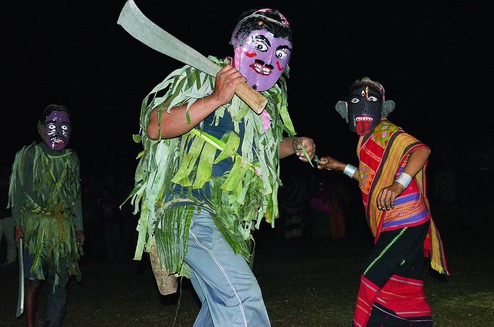
After Bishnupur, Chattopadhyay went to Kalchini, a village in Alipurduar, North Bengal. Here she came across the masks of the Tamang community. She says, "Whenever there is a death in the community, the Tamangs wear these masks and perform a ritual dance while reciting from the holy scriptures. It is meant to urge the dead to leave their earthly shells and proceed for the other world."
The masks of the Rabha community living in different pockets of North Bengal - Alipurduar, Jalpaiguri, Mainaguri, Dhupguri and Kachi Daina - were added next. Unlike the Tamang masks, which are also made out of the soft gamhar, these are fashioned out of bamboo and bottle gourd rind. The masks bear names such as Chor Pagol, Chor Pigli and Mapor Chor.
One story runs thus. Chor Pagol is an unemployed drunkard who goes around begging people for a loan to tank up his alcohol supply. Chor Pigli is his better half. While Chor Pagol and Chor Pigli are at loggerheads, Mapor Chor makes a sly entry and helps himself to Chor Pagol's alcohol stock. It is obvious, this performance is meant to raise awareness about the problems of alcoholism even as it entertains.
Apart from all these masks, the academy has in its collection masks of the Mech, Rajbanshi and Dhimal tribes. Extensive travels in search of these masks have meant varied experiences, having tea made out of fresh green cardamom plucked from the wilderness and another time, a dish made of nettle leaves. But perhaps, most importantly, Chattopadhyay has learnt that the men behind the masks take their roles very seriously and after a swig or two of desi alcohol, tend to get a tad too deep into the skin of the characters. One time, a masked Kali with a raised scimitar chased her and her colleague through paddy fields.
The perils of some pursuits.