
“In the golden age of Asia
Korea was one of its lamp-bearers,
And that lamp is waiting to be lit once again
For the illumination in the east”
Santiniketan, June 14: Rabindranath Tagore had never travelled to Korea but he wrote these lines about the country a century ago.
Tagore’s poetry is now taught in South Korean schools. And, now, Visva-Bharati would have a Korea Bhavana funded by a South Korean Tagore-lover named Kim Yang-shik.
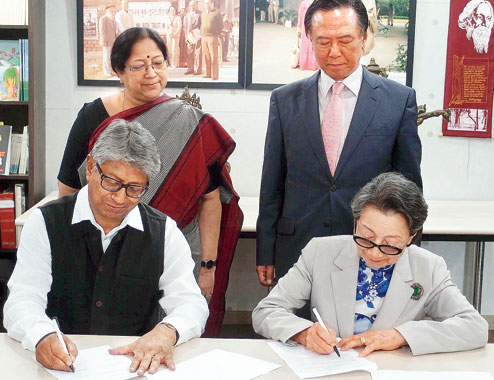
The 85-year-old lady, who is the president of the Tagore Society of Korea and director of the Indian Art Museum in Seoul, has signed a memorandum of understanding with Visva-Bharati on June 1.
Korea Bhavana would be a centre for Korean language and would be the first such centre of study in eastern India. In Visva-Bharati, Tagore started the university’s first foreign language course — Chinese — in 1935.
China Bhavana offers degrees in the language. Today, six foreign languages are taught — Chinese, Japanese, Tibetan, French, German, Russian.
Varsity sources said Kim Yang-shik and her Tagore society would primarily provide Rs 4 crore to start the work.
The Bhavana would initially offer certificate and diploma courses and later a degree course in the Korean language. The bhavana is expected to start functioning in the next six months.
In May-end, Visva-Bharati vice-chancellor Sushanta Dattagupta and one of the varsity’s directors, Sabujkoli Sen, travelled to Seoul where they signed the MoU with Kim Yang-shik to set up the Bhavana.
Kim Yang-shik has translated the Gitanjali in Korean and had been studying Tagore from her childhood and translated several of Tagore’s poems in the Korean language.
She had a dream to set up a Korea Bhavana in Visva-Bharati to offer it as a gift for her “Gurudev” from early 1990s. Last year, Visva-Bharati communicated with her and the matter was discussed.
Yang-shik told The Telegraph over phone from Seoul: “My dream is likely to be fulfilled. I am so happy that the MoU has been signed. I love Gurudev from my childhood when I read his poetry first. Later, I translated several of Tagore’s poems, novels, and plays. I would expect that the centre would help build a good relationship between South Korea and India and students in India would learn Korean.”
Though Yang-shik has travelled to India several times, she has visited Santiniketan only once in 1982. “My love for Gurudev’s works has brought me to India several times but I spent time in Santiniketan only once in 1982.” Yang-shik has received Padmashree from government of India in 2002 for her work on Tagore.