|
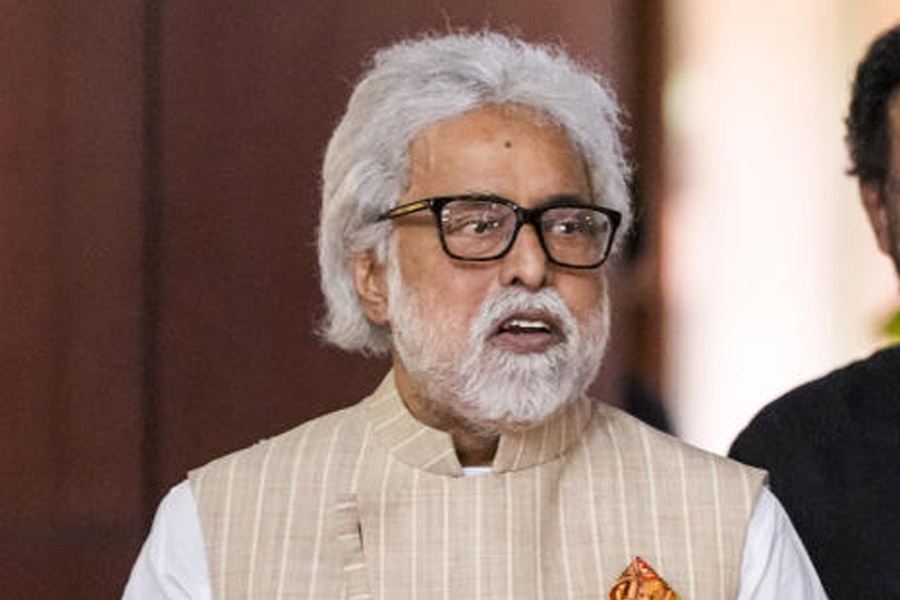
| Manas Bhuniya (left) and Pranab Mukherjee at Siddhartha Shankar Ray’s condolence meeting at the University Institute Hall in Calcutta on Sunday. Picture by Bishwaroop Dutta |
Calcutta, Nov. 21: Pranab Mukherjee today hit out at the state government for not having accorded Siddhartha Shankar Ray a state funeral and treating him differently from Jyoti Basu, who was given such an honour.
“I cannot but mention a controversial issue centring on the funeral of our dead leader. Siddharthababu was not given a state funeral despite being the chief minister of Bengal for five years. But the late Kamalapati Tripathi was given the state funeral by the Uttar Pradesh government even though he was chief minister for only one and a half years,” the Union finance minister said.
Mukherjee, speaking at a condolence meeting for Ray organised by the Congress, recalled that two other former chief ministers — Prafulla Chandra Sen and Ajoy Mukherjee — had also not been given a state funeral. Both Sen, from the Congress, and Ajoy Mukherjee, from the erstwhile Bangla Congress, died after the Left came to power in 1977.
“It hardly mattered to our late leaders whether gun carriages and pall bearers from the army (part of the state funeral) were used during their last journeys. But it betrays the fact that we had failed in our duty to the late chief ministers,” the finance minister said.
The CPM reacted to the remarks by asserting that one “cannot impose” the manner in which tributes should be offered to departed leaders. “We had done what was required to show respect to Ray. You cannot impose in what way one should show respect to a departed leader,” state secretariat member Rabin Deb said.
Asked why Basu was given a state funeral while others weren’t, Deb appeared to suggest that the term in office made a difference. “Respect is given to a person as much as it is due. Jyotibabu was chief minister for a long, long period.”
The funeral of Ray, who died on November 6 this year, took place without the ceremonial grandeur that had marked Basu’s last journey. In the case of Basu, the Bengal government had written to the Centre within a couple of hours of the leader’s death in January last year for a two-day state mourning and a military funeral.
No such request was made in the case of Ray, who was chief minister between 1972 and 1977, Punjab governor between 1986 and 1989 and India’s ambassador to the US between 1992 and 1996. Ray’s body was not draped in the national flag, nor did a gun carriage and pallbearers accompany his cortege.
Although the government declared a holiday as a mark of respect to Ray, it did not declare state mourning or lower the Tricolour atop government buildings — other key gestures of official tribute made in the case of Basu.
Pradip Bhattacharya, who was a minister in Ray’s cabinet, said: “ We shall certainly make an issue out of the government’s dual treatment. If Jyotibabu could get it (state funeral), why not Manuda (as Ray was called)?” he asked.
In his speech, the finance minister also touched upon a matter of immediate concern: the Naxalite menace. Mukherjee said Ray had been misunderstood for “effectively combating the Naxalites” in the seventies but suggested that his strategies were still relevant. “Siddharthababu had effectively tackled the Naxalites. If the rebels use guns against an elected government, they have to be firmly dealt with.”