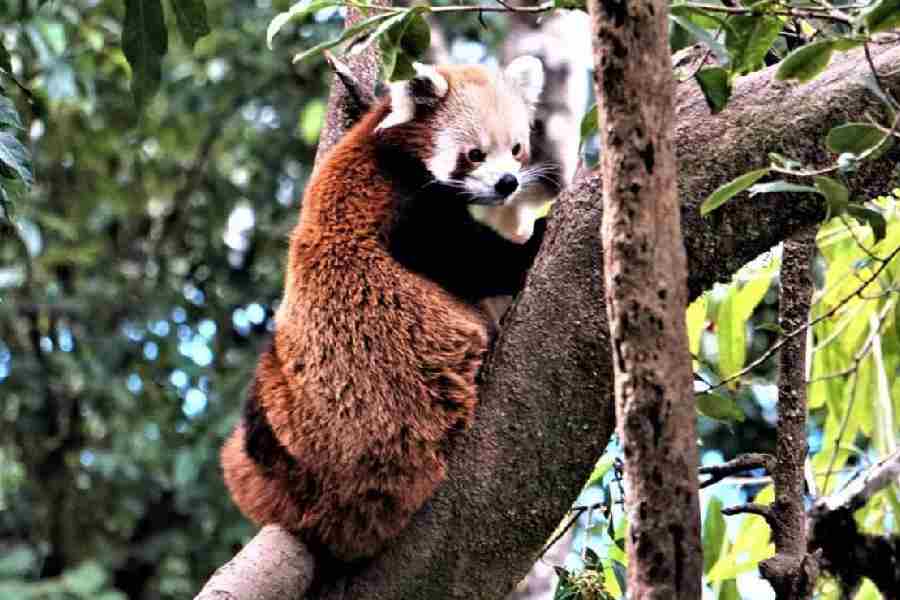
The Bengal forest department has decided to conduct a census of the red panda at the Neora Valley National Park in Kalimpong district after the monsoon, following frequent sightings of the species during a recent exercise there to track the Bengal tiger.
“In March and April, we carried out an estimation of tigers in Neora Valley as tigers had been sighted in and around the park earlier. During the exercise, our personnel came across a significant number of red pandas,” said Rajib De, the additional divisional forest officer of the Gorumara wildlife division.
“Although the recent endeavour did not yield any sightings of tigers, our teams have reported encouraging signs of an increase in the red panda population. To determine the exact population and assess the condition of the animal’s habitat, it has been decided to conduct a comprehensive survey of the species after the monsoon,” he added.
Sources said the survey would examine the availability and quality of red panda habitat and food resources across Neora Valley.
“Teams will also collect scat samples for DNA analysis, and they will be sent to a laboratory in Hyderabad to estimate the species’ actual population more accurately,” said a source.
According to the last census conducted in 2021–22, the Singalila National Park in Darjeeling was home to 35-38 red pandas, while Neora Valley had around 32.
The red panda is classified as an endangered species on the Red Data List of
the International Union for Conservation of Nature (IUCN).
The field survey will involve trekking through mountainous terrain ranging from approximately 600 feet to over 10,500 feet above sea level.
Wildlife experts and forest department staff will reach remote locations, including Rachela Danda and Hati Danda, both situated at elevations exceeding 10,000 feet.
“A key focus of the study will be the spread of the invasive Malinga bamboo species and its impact on red panda habitat,” a forester said.
While red pandas depend on bamboo for shelter and feed on its tender leaves, the Malinga species has become increasingly dominant in large areas of Neora Valley.
Its thin stems cannot support the weight of red pandas, its leaves are too small to serve as an adequate food source, and its dense growth suppresses other vegetation by preventing grasses and native plants from growing beneath it.
“The survey will assess the number of red pandas, and also the overall condition of their habitat and identify any emerging threats. We will closely monitor whether the rapid spread of Malinga bamboo is affecting the species’ habitat and long-term survival, said De.