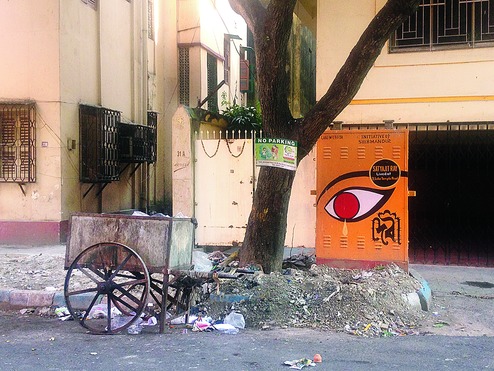


Urban spaces are full of utilitarian constructs. So necessary that they have been subsumed by the mundane. So mundane that we see and unsee them. Blind spots of eye and mind, alike. Power distribution boxes are some such. That's why, when you notice one staring back at you, you know something is different.
The box on south Calcutta's Sarat Chatterjee Avenue, running parallel to the Lakes, has been painted a deep tree-brown. On it, in white, is a pair of binoculars and in bold Bengali ochre, the word Charulata. The legend on the box reads - Satyajit Ray lived at 3 Lake Temple Road when he made this film.
Further down, towards the main road, there is a midnight blue box with a lamp post, a white moon, musical notes floating up and the lyrics of a popular Bengali number from the 1950s - Ei Raat Tomar Amar. And the legend - Hemanta Mukherjee lived at 6 Sarat Chatterjee Avenue.
The entire neighbourhood - Rabindra Sarovar - is dotted with more of these. An old song comes to mind. Little boxes on the hillside.../Little boxes made of ticky tacky,/There's a green one and a pink one/And a blue one and a yellow one...
There are 13 boxes in all. There is an agency behind this initiative - Trisys Communications Pvt. Ltd - and a man behind the agency - Mudar Patherya.
"I wouldn't say it was my idea," says Patherya, who is somewhat of a public space activist. The idea, he says, came to him in July, when he noticed a box, right next to his office, painted over with cartoon characters.
The idea stuck, but not the theme. Patherya and his design team spent the month of August discussing a possible theme. By September, it was Durga Puja time and Patherya got involved with the neighbourhood puja. As someone associated with heritage walks in the city, he pitched an idea to the organisers - why not float a heritage walk in the para during the Pujas?
It was while researching for the walk that he gleaned neighbourhood nuggets - well-known, little-known and forgotten. And that's how Patherya found his theme - neighbourhood lore.
Next, he approached the power suppliers, CESC, to obtain permission. It was warmly received with a single caveat - every box has a unique number and that should not be obliterated by this art wave.
What about the locals? After all, this very neighbourhood hosts two of Calcutta's biggest Pujas - Mudiali and Shib Mandir. Says Patherya, "The neighbourhood was not very enthusiastic. They (the people) tolerated me. So I said I will pay for it. It is neighbourhood pride. I will commission a painter. The artwork will come out of my office." And so it did.
Walking around the area one comes across two boxes with the same legend. It seems both Satyajit Ray and Soumitra Chatterjee stayed at the same address. Research error?
Apparently not. Patherya points out that Satyajit Ray lived on Lake Road between 1948 and 1959 and subsequently, on the adjoining Lake Temple Road from 1959 to 1970. It was only later that he moved to his residence on Bishop Lefroy Road, now called Satyajit Ray Dharani.
He adds, "Once Ray moved out of the Lake Temple Road house, Soumitra Chatterjee, moved in and stayed till 1986. I realised that when Ray made Apur Sansar, Aparajito, Goopy Gayen Bagha Bayen, Charulata, it was all from this residence. He became Satyajit Ray in this very neighbourhood."
With more research, new names emerged. Debaki Bose, pioneering filmmaker whose 1931 film, Aparadhi, was the first Indian film to use artificial lighting and 1932 film, Chandidas, the first to have background music. Hemanta Mukhopadhyay, playback singer, music director and film producer...
Six of the boxes were painted before Durga Puja. Five more were painted in early November. But blind spots will be blind spots, layers of paint and history notwithstanding.
A man is walking past the box on Lake Temple Road, bag on back. Shyamal Ray is a salesman. So what does he think of the colourful electric box? Huh! He has not noticed it until now.
In these times, often, the virtual world comes to the rescue of the real. The boxes did not become talking points until some Facebook noise. And then, apart from likes and shares, requests started pouring in. Singer Rupam Islam's wife, Rupsha, got in touch with a request for her neighbourhood - South End Park. Legendary composer and singer S.D. Burman lived there and so did his equally illustrious son, R.D. Burman. The request has been executed since.
Says Patherya, "From the permission perspective we are sorted, from a design perspective we are more or less sorted, from a heritage or neighbourhood pride aspect, we are getting sorted. But I can't say if every neighbourhood has a story."
And so the story hunt has been outsourced to the community. "We are now asking people, if you want us to do it [electric box makeover] in your neighbourhood, then tell us your story and we will work out content."
The old song goes, " Little boxes, little boxes..." But these ones don't look just the same.