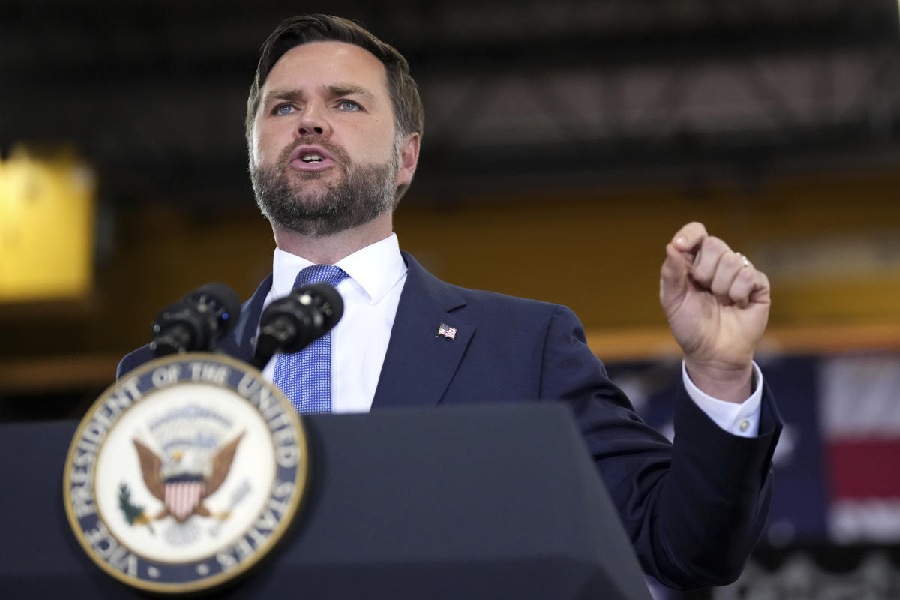
US Vice President J.D. Vance will travel to Islamabad for talks later this week in a bid to salvage a Middle East ceasefire that is already in danger of collapse. Vance will be “leading this new phase of negotiations”, joined by special envoy Steve Witkoff and Trump’s son-in-law Jared Kushner, the White House says.
Iran has threatened to withdraw from the ceasefire if Israel does not stop its devastating bombardment of Lebanon. It’s also refusing to reopen the Strait of Hormuz, the key waterway for global oil supplies, until Israel ends its attacks.
“A ceasefire is the first step. But our destination is lasting peace… Day after tomorrow at my invitation a US delegation is coming to Pakistan. In the same way an Iranian delegation is also coming to Pakistan,” said Pakistan Prime Minister Shehbaz Sharif said Wednesday.
The push to turn the fragile two-week truce with Iran into a lasting agreement comes as the Financial Times reported that US President Donald Trump, alarmed by surging oil prices and Iran’s surprise military resilience, had been pressing Pakistan to arrange the ceasefire since March 21.
Pakistan has emerged as the unexpected hub of peace efforts, with the White House believing that as a Muslim neighbour with good ties with Tehran, Islamabad could persuade Iran to accept a pause in fighting tied to reopening the Strait of Hormuz.
Despite Iran’s repeated strikes on Saudi targets, Pakistan, which signed a mutual defence pact with Riyadh last year, has maintained neutrality throughout the conflict, a position that bolstered its role as an intermediary. Islamabad is also keen not to see the conflict escalate so it can keep out of the war,
At the centre of the back-channel efforts has been Field Marshal Asim Munir, relaying messages between Tehran and Washington, the newspaper Dawn says.
The US and Pakistan believed Iran would be more likely to accept a US-backed proposal if it came via Islamabad rather than directly from Washington.
Just hours after Trump warned he would destroy Iran’s “whole civilisation”, Sharif made the plan public, mistakenly posting it with the heading “draft – Pakistan’s PM message on X”, the FT said.
If Pakistan can hold together the shaky peace, Munir might yet become “the first military man to win a Nobel Peace Prize”, quipped one analyst.
“Pakistan has really come up trumps,” said a former Indian diplomat. “We mustn’t be churlish about it and should give them credit,” he said.
At the heart of this moment lies a simple fact: Pakistan has advantages no other would-be mediator can match.
It’s on friendly terms with all the key players – it’s close to the US, a neighbour to Iran with which it shares a 900-km border, and enjoys warm ties with China, which lent weight to the negotiations from offstage, pushing Iran to accept a truce.
Islamabad has “strong ties with all the key players, trust from the White House, ongoing direct engagements with Iran and buy-in from Pakistan ally, China,” says South Asia analyst Michael Kugelman.
Beijing “has more leverage over Iran than does Pakistan,” he adds.
Pakistan has also been able to bring together Saudi Arabia, Egypt and Turkiye, three countries with significant clout in the Islamic world.
“Heck, its ties with Russia are good too,” notes Kugelman. This gives “Pakistan diplomatic alignments that line up well to position itself as facilitator.”
Sharif called on all sides on Wednesday to “respect” the ceasefire even as Israel staged massive attacks on Beirut and across Lebanon that claimed more than 250 lives, according to Lebanese officials.
Israel and Vance say Lebanon is not covered by the deal, though Sharif posted on X that Iran and the US had “agreed to an immediate ceasefire everywhere, including Lebanon … EFFECTIVE IMMEDIATELY.”
Vance describes it as a “legitimate misunderstanding.”
Israel is doing its level best to derail the peace efforts. Prime Minister Benjamin Netanyahu is said to be livid that Israel was not included in the ceasefire discussions and has vowed the war will not end until Israel achieves its objectives. “We are ready to resume the fighting at any moment… Our finger is on the trigger,” he declared at a news conference.
There are fault lines on the other side too. Hardliners in Tehran believe Iran has the upper hand militarily and are reluctant to stop. The United Arab Emirates says it intercepted 17 ballistic missiles and 35 drones in a single day, underlining how volatile the situation remains.
More ominously, Iran has struck the Saudi east-west pipeline to Yanbu on the Red Sea used to reroute exports after Iran shut the Strait of Hormuz.
Behind the scenes, Islamabad appears to have been deeply engaged from the outset of the conflict. Within hours of the first missile exchanges, Sharif was on the phone to Iranian President Masoud Pezeshkian, Dawn reports.
The next day, Pakistani foreign minister Ishaq Dar reached out to counterparts in Turkiye, Saudi Arabia and Egypt, drawing them into a diplomatic effort. The next stop was Beijing, where Pakistan and China issued a five-point peace framework that became the basis for further negotiations. From there, proposals shuttled between Tehran and Washington.
By April 6, Pakistan had put forward proposals to both sides.
The breakthrough came just hours before Trump was due to follow through on what he had called a “civilisation ending” threat.
In a dramatic post on his Truth Social site, Trump credited both Sharif and Munir: “Based on conversations with Prime Minister Shehbaz Sharif and Field Marshal Asim Munir of Pakistan wherein they requested that I hold off the destructive force being sent tonight to Iran, and subject to the Islamic Republic of Iran agreeing to the COMPLETE, IMMEDIATE, and SAFE OPENING of the Strait of Hormuz, I agree to suspend the bombing and attack of Iran for a period of two weeks,” contingent on Iran reopening the Strait of Hormuz.
For now, it looks like Pakistan has scored its biggest diplomatic victory in a long time. Sharif put out an exultant message thanking all the key parties and the Gulf Cooperation Council.
International reaction has been swift and, for Pakistan, unusually positive. Bloomberg noted that even if the ceasefire’s details remain unclear, “Pakistan nevertheless deserves a tremendous amount of credit for having the guts to stick out its neck and offer its diplomatic service,” highlighting its “repositioning from a peripheral actor to a credible intermediary capable of convening adversaries.”
France 24 pointed to Islamabad’s rare ability to talk to both sides, while longstanding US ties ensured credibility.
The Independent called the effort one of Pakistan’s most significant diplomatic achievements in years, noting that its close ties with the Trump administration, alongside warm ties with Iran and Gulf states, positioned it uniquely to act.
Other analyses underline the strategic logic. Prolonged disruption of the strait deepens Pakistan’s economic burden. At the same time, mediation has boosted its geopolitical standing, pulling it from the margins to the centre of global diplomacy.
As The Diplomat observed, Pakistan’s role has elevated its stature while sparing it a difficult strategic dilemma, namely choosing between Iran and Saudi Arabia had the conflict escalated further.
For now, Pakistan has “achieved one of its diplomatic wins in years,” says Kugelman. “It also defied many sceptics that didn’t think it had the capacity to pull off such a complex, high-stakes feat,” he adds.
India, meanwhile, has responded cautiously. In a statement, the government welcomed the truce but avoided mentioning Pakistan. “We welcome the ceasefire reached and hope that it will lead to a lasting peace in West Asia,” the ministry of external affairs said, adding that “de-escalation, dialogue, and diplomacy” are essential.
“The conflict has already caused immense suffering and disrupted global energy supply and trade networks,” it added. Despite New Delhi’s ties with all sides, India’s “multi-alignment” with the US and Israel and a now less cordial relationship with Tehran have confined it to urging dialogue rather than taking on a direct mediating role, analysts say.
For New Delhi, Pakistan’s central role raises concerns. One is that a more confident Pakistan may act more assertively in Afghanistan, betting Washington will look the other way. Another, more hopeful scenario is that Islamabad might decide the time is ripe to improve ties with India.
External affairs minister S. Jaishankar earlier dismissed Pakistan’s peacemaking efforts, saying India could not act as a “dalal [broker] nation”. But even if Pakistan has served only as the “US-Iran go-between”, its “strategic interests will be advantaged,” says Kugelman.