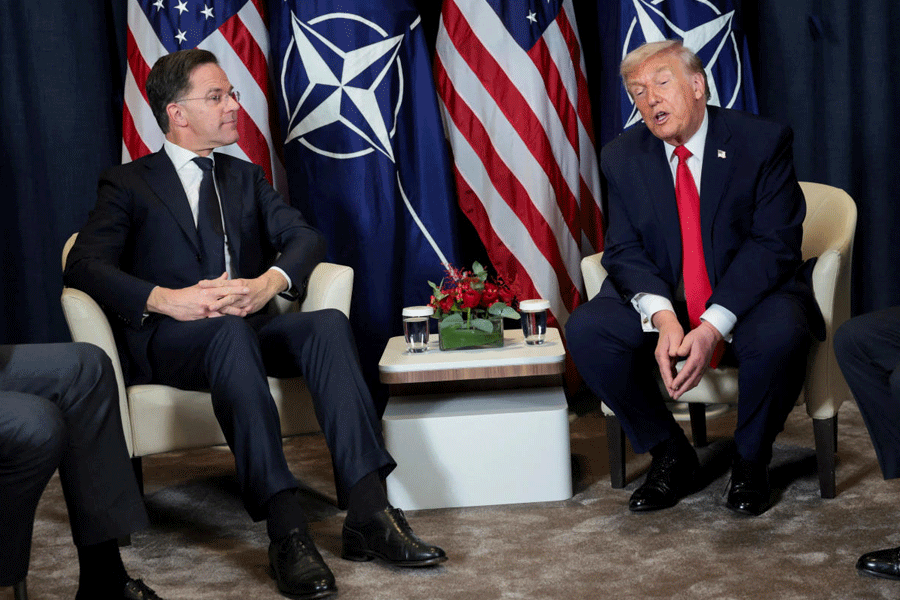
US President Donald Trump sharply escalated his criticism of NATO after a closed-door meeting with Secretary-General Mark Rutte, underscoring deepening transatlantic tensions triggered by the Iran war.
Following the White House talks, Trump signalled lingering anger over what he sees as inadequate support from European allies during the conflict, posting on social media: "NATO WASN'T THERE WHEN WE NEEDED THEM, AND THEY WON'T BE THERE IF WE NEED THEM AGAIN," Trump said in his post.
The meeting came at a critical moment for the alliance, just a day after the US and Iran agreed to a fragile two-week ceasefire that includes reopening the Strait of Hormuz, a key global oil artery disrupted during the conflict.
Despite the temporary truce, divisions within NATO over the war have pushed the alliance to what experts describe as a breaking point.
White House press secretary Karoline Leavitt said earlier, "It's quite sad that NATO turned their backs on the American people over the course of the last six weeks when it's the American people who have been funding their defense,"
She added that Trump would have a "very frank and candid conversation" with the NATO chief.
Rutte acknowledged strains within the alliance after his discussions with Trump, saying some member states had fallen short. "Some of them yes, but a large majority of European countries, and that's what we discussed today, have done what they promised before in a case like this," he said, describing the talks as "frank and open" and noting Trump’s disappointment with allies.
The US president has repeatedly suggested Washington could reconsider its membership in NATO, a move that would mark a historic shift in global security. Ahead of the meeting, Leavitt confirmed the issue was under consideration, saying, "I think it's something the president will be discussing in a couple of hours with Secretary-General Rutte."
However, any such move would face legal hurdles. A 2023 US law bars a president from withdrawing from NATO without congressional approval, reflecting bipartisan support for the alliance despite Trump’s long-standing criticism.
Tensions have been exacerbated by disagreements over the Iran war, particularly after several European countries restricted US access to airspace and military facilities during the conflict. Trump has argued that securing the Strait of Hormuz should not fall solely on Washington, telling allies last week, "Go to the strait and just take it,"
He has also lashed out more broadly at NATO’s role, at one point calling it a "paper tiger" and questioning its reliability in moments of crisis.
Adding to the friction, Trump revived his controversial rhetoric over Greenland — a semi-autonomous territory of NATO member Denmark — posting: "REMEMBER GREENLAND, THAT BIG, POORLY RUN, PIECE OF ICE!!!"
The strain within NATO has prompted concern among US lawmakers. Senator Mitch McConnell urged the administration to maintain clarity in its alliances, warning against alienating partners. "Following the September 11th attacks, NATO allies sent their young servicemembers to fight and die alongside America's own in Afghanistan and Iraq," he said, adding that it is not in America’s interest to "spend more time nursing grudges with allies who share our interests than deterring adversaries who threaten us."
Meanwhile, reports suggest the Trump administration is weighing punitive measures against allies seen as uncooperative, including potentially repositioning US troops away from those countries.
Even as tensions simmer, Rutte is expected to push for greater defence coordination and increased European military spending, while keeping dialogue open on both the Iran conflict and the ongoing Russia-Ukraine war.
Analysts warn that the fallout from the Iran war, coupled with disputes over defence spending, Ukraine and Greenland, has brought NATO to a “dangerous point” — raising fresh questions about the future cohesion of the decades-old alliance.