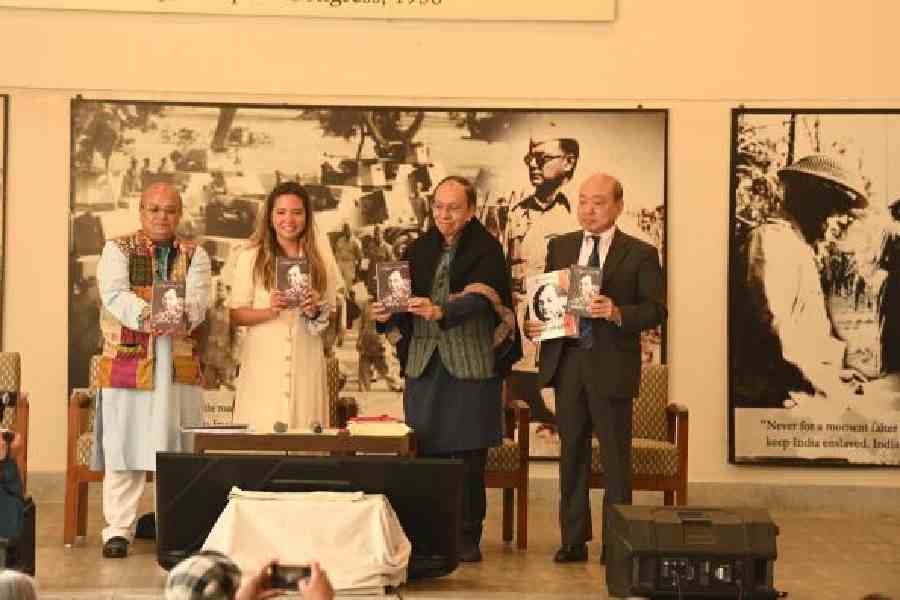
Subhas Chandra Bose’s unwavering commitment to secularism and inclusiveness came to the fore repeatedly at the celebrations marking his 129th birth anniversary at Netaji Bhavan on Friday.
Bose had deep admiration for the ideology of his political guru, Deshbandhu Chittaranjan Das, a devout Hindu and a champion of secularism — a harmony that seems almost oxymoronic in today’s India.
“I do not think that among the Hindu leaders of India, Islam had a greater friend than in Deshbandhu,” Bose wrote in an essay on Das while imprisoned in Mandalay (then Burma) in 1926. “Hinduism was extremely dear to his heart, he could even lay down his life for his religion. But, at the same time, he was absolutely free from dogmatism of any kind. That explains how it was possible for him to love Islam.”
This excerpt was among several drawn from Bose’s prison writings — letters, essays and notes — read out at the event by his grandnephews, historian Sugata Bose and political scientist Sumantra Bose.
Some of the 26-page essay on C.R. Das, written in Bengali, was read out in the original by Sugata Bose, who also translated sections into English. “It contains insights into the fundamentals of his own political beliefs... It was this spirit of broad-minded generosity in the matter of India’s religious diversity that Subhas sought to emulate in his politics,” Sugata Bose said.
Bose was transported across the Bay of Bengal to Burma in January 1925 and lodged in Mandalay prison. In a letter to his friend, musician and author Dilip Kumar Roy, he described the jail as a “place of pilgrimage”.
On January 23, 1926 — his 29th birthday, though he made no mention of it — Bose wrote two letters from prison: one in Bengali to Basanti Devi, the widow of C.R. Das, and another in English to his elder brother, Sarat Chandra Bose.
Translating from the letter to Basanti Devi, Sugata read: “I hope you will not forget, even in the midst of your misfortune and grief, that innumerable sons of Bengal have accepted you as their mother. In spite of being poor and helpless, they have made your misfortune their own.”
Friday’s celebrations also recalled that in 1928, Bose was the principal organiser of the Indian National Congress’s annual session at Calcutta’s Park Circus Maidan. “The same year, at just 31, Netaji was one of eight members of a Congress committee constituted ‘to determine the principles’ of the Constitution for Free India,” Sumantra Bose said in his welcome address.
“The committee’s report asserted, among other things, that ‘there shall be no State religion for the Commonwealth of India, nor shall the State, directly or indirectly, endow any religion or give any preference or impose any disability on account of religious belief or religious status’,” he said.
The guest speaker at the event was historian and author Nichole CuUnjieng Aboitiz, whose lecture focused on the interconnectedness of anti-colonial movements in Asia during World War II. She spoke at length about Jose P. Laurel (1891-1959), a lawyer, judge and politician who became the first president of the Philippines during the Japanese occupation.
Laurel, a contemporary of Bose, met him in 1943, and both were prominent figures in the broader pan-Asianist movement. Quoting from Laurel’s address in Manila on November 22, 1943, Aboitiz said that he had referred to Bose as the “leader of 350 million Indians in their effort, which is legitimate and divine, to free themselves from British rule”.
Also present at the programme was Ishikawa Yoshihisa, the Japanese consul general in Calcutta. The celebrations included the ceremonial launch of a new edition of Taruner Swapna, a collection of Bose’s essays and letters outlining his vision for India’s youth.