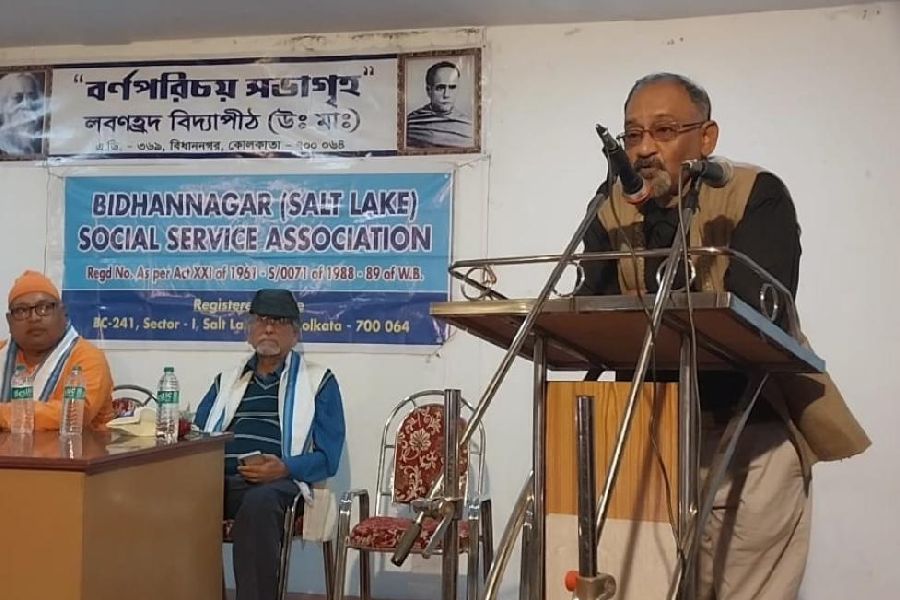
Swami Vivekananda emphasised that the poor and downtrodden were the first Gods to be worshipped. He believed that serving humanity was equivalent to serving God and did not believe in a religion that couldn’t wipe away the tears of a widow or bring bread to an orphan,” said Arijit Sarkar, a professor who specialises on Vivekananda.
He was speaking at a seminar on the occasion of Swamiji’s birth anniversary at AD Block’s Laban Hrad Vidyapith school. The event had been organised by BC Block-based philanthropic group Bidhannagar Social Service Association, in collaboration with the school.
Sarkar observed that while Vivekananda is widely discussed, social transformation based on his teachings remains limited. “We garland Swamiji on his birthday, but forget him for the rest of the year. If we truly remembered Vivekananda, the social landscape of our country would have transformed. But there is hope yet,” he said.
He cited Vinayak Lohani, an IIT and IIM graduate, who began the humanitarian institution Parivaar with three orphaned children in Bengal, that has now expanded across states.
Another example was Babar Ali of Murshidabad, recognised as the world’s youngest headmaster. At the age of nine years, Ali noticed children whiling away time in his neighbourhood playing danguli and started a school under a tree. “Today, his life and work are studied globally. An organisation that stands by people and works for their welfare is truly following Swamiji’s vision.”
Swami Muktanandaji Maharaj of Burdwan, followed by reflecting on Sarkar’s key points. “Vivekananda’s mission was guided by Ramakrishna’s dictum that service to humanity is service to God. Swamiji had identified three pillars of self-reliance: excellence in religion, education and occupation. The divine spirit within is to be awakened, education is meant to awaken dormant knowledge, and occupational excellence will ensure dignity and self-sufficiency,” said the monk, concluding his address with a prayer seeking wisdom and noble thoughts for all.
The event also had some music. The song Bharat amar Bharatbarsho was sung by members of Bidhannagar Social Service Association Sharmistha Mukherjee, Anindita Dey, Pratima Kundu and Aparna Chakraborty.
“This is the first time our association organised a seminar on Swami Vivekananda,” said president Nitin Pal, adding how they focus on welfare activities the rest of the year. “Such was Vivekananda’s influence that when French author and Nobel laureate Romain Rolland expressed curiosity about India, Rabindranath Tagore famously replied: ‘If you want to know India, study Swami Vivekananda’.”
Secretary Aloke Dutta outlined the activities of the organisation and recited self-composed poems on Vivekananda and Ramakrishna. Technologist Amitabha Ghosh and Sajal Kanti Mandal, headmaster of the host school, were also present on the occasion.
Breath of fresh air
Dakhina Batas, a township-based cultural group, hosted an evening to showcase the talents of a wide range.
It opened with a recitation collage presented by children of various age groups performing in groups. This was followed by recitations by participants of Manjari, a group from Dum Dum, who recited works by legendary poets such as Sunirmal Basu, Shankha Ghosh, Joy Goswami and Mallika Sengupta, as well as contemporary poets. “Children today have little time and few opportunities to enjoy their childhood. I have tried to weave small dreams for them that may leave a deep impression on their minds,” said Sumita Pal, teacher and mentor of Manjari.
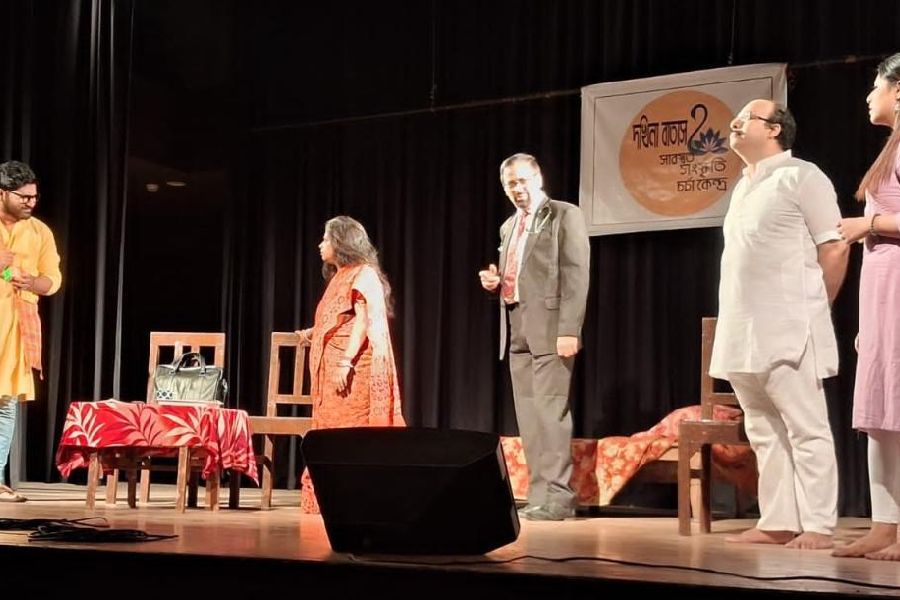
The play 'Aguner Dinlipi' being staged at Rabindra Okakura Bhavan
A highlight of the first phase was the recitation of Rabindranath Tagore’s poem Kripan from Gitanjali, presented in Bengali by Arijit Sen and its English translation by Urmy Pal Chowdhury.
The second phase began with the presentation of three popular folk songs by Soumitra Talapatra and his sister Sharmi Majumdar. This was followed by a kathak performance by budding talent Ahana Mukherjee, whose graceful movements and expressive gestures left a lasting impression.
The final segment featured the Bengali one-act play Aguner Dinlipi, directed by Trishit Bhaduri and produced by Kolkata Srishti Sukh. The play explores how the peaceful life of a family of three — Pradip, Meera and Rumki — is shattered by a television news report of a pregnant upper-caste woman who is burnt alive for marrying a lower-caste man.
The incident deeply disturbs Meera, who begins to see bloodstains everywhere and sense the smell of burning all around her. Ultimately, a stranger appears and urges Meera to step out of her isolation and face the world. The play concludes
with the message that fearful confinement indoors will not solve social evils. One must rise and act to stop such deep-rooted devastation in
society.
Arup Chatterjee, head of Dakhina Batas and a member of Kolkata Srishti Sukh, portrayed Pradip. His nuanced performance as a supportive husband drew attention. Goutami Basu’s portrayal of the panic-stricken Meera was compelling and convincing, too.
The programme concluded with the felicitation of eminent theatre personality Seema Mukhopadhyay, Soumitra Basu and Shyamal Chakraborty, along with film director Sujit Chakraborty. The show was conceptualised by Chatterjee and jointly anchored by Kakoli Ghoshal and Madhumita Kabya.
Bharati Kanjilal