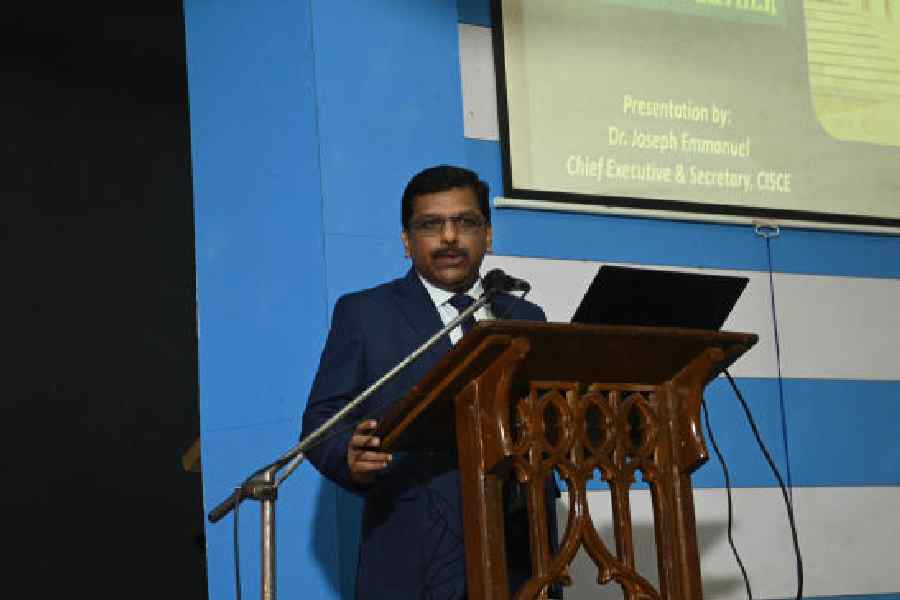
The chief of the Council for the Indian School Certificate Examinations (CISCE) on Monday sought to dispel the perception that the ISC curriculum is less suited for students aiming to crack all-India entrance tests.
While the number of such students may be relatively small, given the fewer ISC schools, their performance is among the best in the country, said Joseph Emmanuel, chief executive and secretary of CISCE, at the 103rd annual conference of the Association of Heads of Anglo-Indian Schools in India, held at La Martiniere for Girls.
“Seventy to 75% of children appearing for medical, engineering, or CUET (Common University Entrance Test) clear these exams with high ranks, which is often not noted in the outside world,” Emmanuel said.
He added: “In terms of numbers, CISCE students are fewer; state boards and other national boards have larger student numbers.”
Speaking to Metro, Emmanuel later provided further details: of the roughly 1 lakh students in Class XII, 50,000 to 60,000 pursue science. Around 40,000 to 50,000 of them appear for medical or engineering entrance exams, and 75% of that group achieve decent ranks. “This demonstrates that the ISC curriculum is equally, if not better, suited for cracking entrance exams,” he said.
In recent years, some students have switched boards at the Plus II level, reinforcing misconceptions about the ISC curriculum. Many Calcutta schools have reported losing top performers to boards such as the CBSE.
“Many parents mistakenly believe that opting for CBSE at the Plus II level gives their children better chances in engineering or medical entrance exams,” said a principal attending Monday’s conference.
Emmanuel also emphasised that CISCE students perform “extremely well” on the international stage.
Founded in 1958, the CISCE has a legacy that extends more than a century. Its roots trace back to the Senior Cambridge global education board, which began conducting exams in 1858. A century later, the Parliament decided to have its own educational system through an exam board, the CISCE.
The council started with 159 affiliated schools and now oversees more than 3,300. “As the number of schools grows, it is crucial to maintain quality across all affiliated institutions. Legacy schools bring centuries of experience, but that must be combined with enthusiasm to move forward,” Emmanuel said.
He stressed the importance of keeping institutions relevant: “While it is important to acknowledge our contributions, we must also update ourselves regularly.”
The council’s initiatives are aimed at aligning with national policies and programmes while maintaining institutional autonomy, he said.
The conference drew principals from Mumbai, Bengaluru, Shimla, Dehradun, Lucknow, and Coimbatore.
CISCE deputy secretary Sangeeta Bhatia addressed the gathering on the upcoming ICSE and ISC exams, scheduled to begin next month.