Breast cancer tops the list of cancer types prevalent in eastern India among women while head and neck cancer is the commonest type among men, according to data collected by Saroj Gupta Cancer Centre and Research Institute (SGCCRI), Thakurpukur. Also lung cancer is being seen among non-smokers too, pointing the finger at air pollution as one of the major causes.
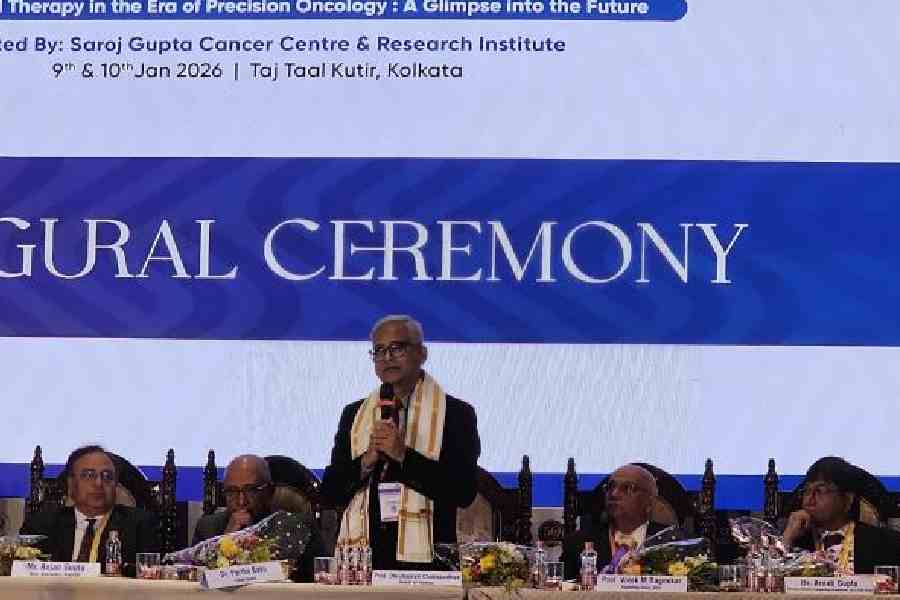
Such findings were being discussed at a global cancer consortium being held over two days in January at Taj Taal Kutir, in New Town.
“We have published last 30 years’ data from our hospital, since 1996. We have seen that the incidence of breast cancer has definitely gone up while cervical cancer incidence has come down among women. In the male population, head and neck cancer occurs the most because of the tobacco habit. The second prevalent type is lung, followed by colorectal and prostate cancers in third place,” Dr Arnab Gupta, director, SGCCRI and organising committee chairperson, told The Telegraph Salt Lake.
Lung cancer, he pointed out, was getting triggered by both smoking and pollution. “Among non-smokers, the incidence of lung cancer is much, much less. But people who get lung cancer without smoking are getting it because of pollution. It is a different kind of cancer called adenocarcinoma, which is not related to smoking. That can happen to anybody. So when women, who never smoke, are still getting lung cancer, pollution is responsible. The combination of smoking and pollution leads to a higher risk of lung cancer. That’s why the incidence of lung cancer is higher in the cities than in villages,” he said.
The global cancer consortium was holding its first conference in eastern India — sixth in India — sharing the latest findings in oncological research with members gathered from across the globe. “We started in 2020. Our aim was to have interactions between different institutions so as to promote cancer research, education, outreach activities and clinical care so we can provide necessary understanding of cancer to all the collaborating partners. We had five founding institutions — Markey Cancer Center in Lexington, Kentucky — that’s where I am from — Mayo Clinic Cancer Center in Rochester, Jacksonville and Scottsdale, SGCCRI, Tata Memorial Center and Manipal Academy of Higher Education. So these were the five founding institutions,” Vivek M. Rangnekar, the consortium chair, told The Telegraph Salt Lake.
In the next two years there was lot of interest in the consortium from various other institutions. So four more were added — University of Kansas Cancer Center, Brown University Cancer Center in the United States, China Medical University in Taiwan and the Universidade de Sao Paulo in Brazil.
“In 2023, we started decentralising and formed regional chapters. Currently we have five chapters to promote cancer research, education and training — South Asia, North America, East Asia, Europe, and West and South Africa,” he added.
The consortium chooses member-institutes which are focused on precision therapy, especially molecular testing and the therapy related to the changes they find on molecular testing. “The data that we are contributing from eastern India is mostly from two centres, Chitranajan National Cancer Institute and us. So that probably would represent about 20 to 30 per cent of the (cancer-afflicted) population in eastern India but we ensure 100 per cent coverage. Data is being captured for everybody, including about 7,000-8,000 new patients every year,” Dr Gupta said.
The theme of the conference was “Personalised therapy in the era of precision oncology: A glimpse into the future.”
Speaking on the sidelines of the inauguration, Dr Gupta added that while treatment practices had not suddenly changed because of the association, there were more collaborations. “We’re getting many answers to questions that we had, how to find any cancer which is not easily being picked up by genetic testing. We are refining our treatment according to that. And there are many researches going on in collaboration. Hopefully, such collaborations in the future will actually result in more precision in cancer diagnoses and the classification of the cancer, so that we can give the exact treatment which is required for the particular individual,” he said.
Another aim, Rangnekar said, was to promote “global oncology” so that “when patients are traveling, they can identify which institutes are part of our different chapters and are able to get the care they need from hospitals which are associated with the chapters”.
A cardio oncology workshop, which deliberated on providing care to cancer patients so that their heart health was protected while they were getting cancer treatment, was also held as a pre-conference event, which, the organisers claimed, was a first in India. A genomics workshop was the other activity on the conference schedule.