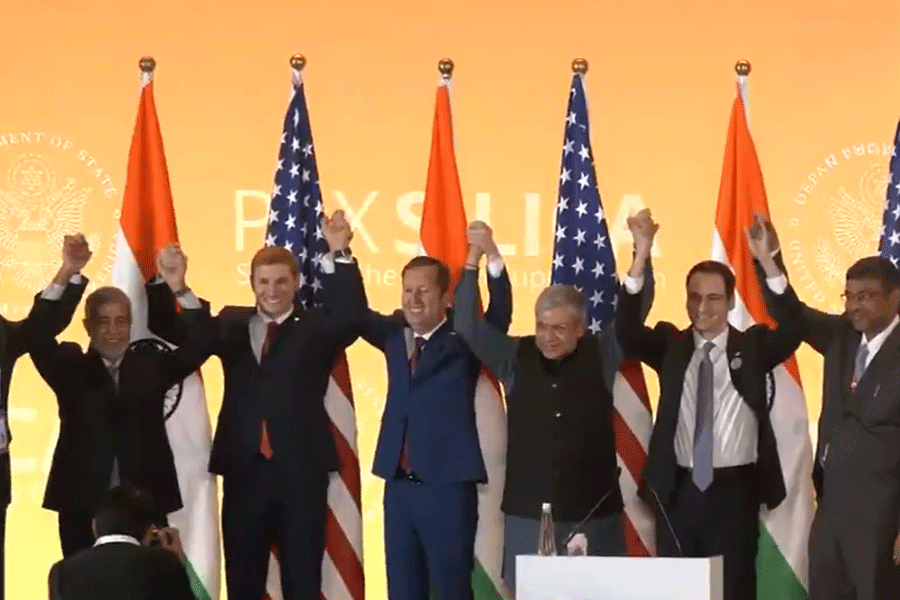
India on Friday formally joined the US-led strategic alliance ‘Pax Silica’, a coalition aimed at building a secure and resilient supply chain spanning critical minerals, semiconductors and artificial intelligence (AI), marking a significant step in deepening India-US economic and technology cooperation.
The pact was signed at the AI Impact Summit in New Delhi in the presence of Union Minister for Electronics and IT Ashwini Vaishnaw, US Under Secretary of State for Economic Affairs Jacob Helberg and US Ambassador to India Sergio Gor, among others.
The move comes amid efforts by New Delhi and Washington to finalise a proposed trade deal and advance broader initiatives to stabilise and strengthen bilateral ties following a period of strain.
What is Pax Silica?
Launched in December last year, Pax Silica seeks to create a secure, innovation-driven supply chain across the full “silicon stack” — from raw materials and mineral processing to semiconductor manufacturing and AI infrastructure.
The Pax Silica Summit was held in Washington on December 12, where partner nations signed the declaration. Current members include Australia, Greece, Israel, Japan, Qatar, Republic of Korea, Singapore, the United Arab Emirates and the United Kingdom. Gor had last month announced an invitation to India to join the coalition.
The declaration states: “We recognise that a reliable supply chain is indispensable to our mutual economic security.”
It further adds, “We also recognise that artificial intelligence (AI) represents a transformative force for our long-term prosperity and that trustworthy systems are essential to safeguarding our mutual security and prosperity.”
“We believe that economic value and growth will flow through and across all levels of the global AI supply chain, driving historic opportunity and demand for energy, critical minerals, manufacturing, technological hardware, infrastructure, and new markets not yet invented,” it said.
One of its key pillars is establishing a durable economic order to drive AI-powered prosperity across partner nations.
‘Say no to weaponised dependency’: Jacob Helberg
Speaking at the signing ceremony, Jacob Helberg said the declaration marked a “historic milestone” in India-US ties.
Helberg said, “It is a profound honour to be here in Delhi at the India AI Impact Summit to mark a historic milestone in the partnership between the United States and India. Today, we signed the Pax Silica Declaration, a document that is not merely an agreement on paper, but a roadmap for a shared future. There is a line from antiquity attributed to ‘Alexander the Great’, who famously said that the peoples of Asia were slaves because they had not yet learned to pronounce the word ‘No’. Alexander saw himself as a conqueror addressing a world of subjects. After travelling 11,000 miles over eight years, it was in India that he finally met his match and turned back. He did not know India, and India said no. The truth is that both our nations were forged by that very word. Both claimed their freedom by learning to say no…So today, as we sign the Pax Silica Declaration, we say no to weaponised dependency, and we say no to blackmail.”
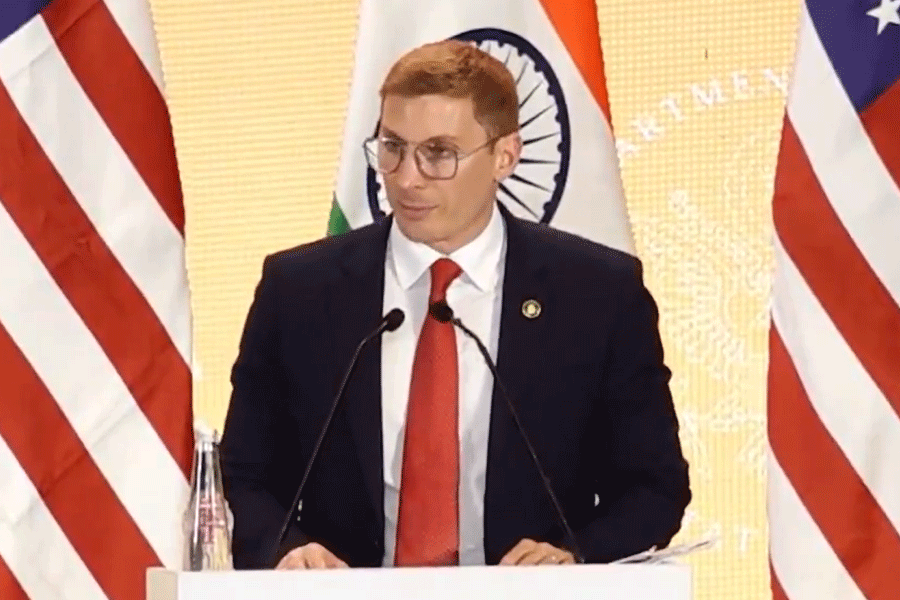
He further asserted, “Together, we say that economic security is national security. But we must be precise about what that means. Some use words like global governance and sovereignty in the same breath, just as Orwell used freedom and slavery interchangeably. America and India are not deceived. Sovereignty does not come from a global bureaucracy. It comes from builders—from the very builders present in this room today. It comes from those who build smelters and oil wells, airplanes and expressways, and from the hardworking people who lay the rails of the future. Through the joint statement we are signing today, the United States and India affirm our embrace of a pro-innovation approach to AI, standing against those who would constrain or set us back.”
India eyes semiconductor leadership
Union Minister Ashwini Vaishnaw underlined India’s semiconductor ambitions, linking them to long-term economic compounding.
"If this spirit had persisted since 1947, we can all imagine how much compounding would have occurred in India's growth. No problem, even if it's from 2014. Now, your generation will reap the benefits of this compounding...," Vaishnaw said.
Highlighting India’s growing chip design capabilities, he said, "Today, our talented engineers are designing the most complex, most advanced 2-nanometer chips here in India. We all know that the semiconductor industry will need about 1 million more talented people. Where will that talent come from? This will come from here. Today, students have access to the world's best semiconductor design tools and they're absolutely free. And it's yielding results...When we say chips, some people think of potato chips. Forget it, they will keep crying. Sometimes they cry in Parliament, sometimes somewhere else. All this will continue, we have to move forward. The country has a direction, a clear goal, and we have to take global leadership in the semiconductor industry and the electronics industry."
Strategic coalition for 21st century: Sergio Gor
US Ambassador Sergio Gor described Pax Silica as a framework to reshape the global technology order.
“A strategic coalition is being formed to shape the 21st-century economic and technological order, securing the full silicon stack—from critical minerals and chip manufacturing to AI deployment. Called ‘Pax Silica’, it aims to replace coercive dependencies with trusted industrial partnerships that empower free markets. India’s participation is described as strategic and essential, citing its engineering talent, mineral processing strides, and role in strengthening U.S.-India tech cooperation. The partnership seeks to advance trusted AI globally, emphasising that peace comes through strength,” Gor said.
Sanjay Mehrotra, CEO of Micron Technology, said, "...the Pax Silica initiative will bring the technology collaboration closer between the US and India..."
US-India role critical in AI future: Sundar Pichai
Google CEO Sundar Pichai stressed the importance of collaboration in shaping AI’s global trajectory.
"Yesterday, at the opening session, I shared some thoughts on this profound moment of AI. I said we are on the cusp of an era of hyper progress and new discoveries, but the best outcomes are not guaranteed," he said.
He further added, "We must work together to ensure the benefits of AI are available to everyone and everywhere. The US India partnership has a critical role to play."
Google is proud to serve as a connection point between the two countries "both figuratively and literally", he said.
Elaborating, he noted, "We have teams across both countries working seamlessly together on some of our most important initiatives, innovations that start in India, like Google Pay are making products better for people all over the world."
Bullish on India’s AI trajectory, Pichai said, "I believe India is going to have an extraordinary trajectory with AI, and we are supporting it with a full stack commitment, including product scaling and infrastructure."
India’s entry into Pax Silica signals its intent to position itself at the centre of the next-generation technology and semiconductor supply chain, even as Washington seeks trusted partners to counter coercive dependencies and secure AI-driven economic growth.