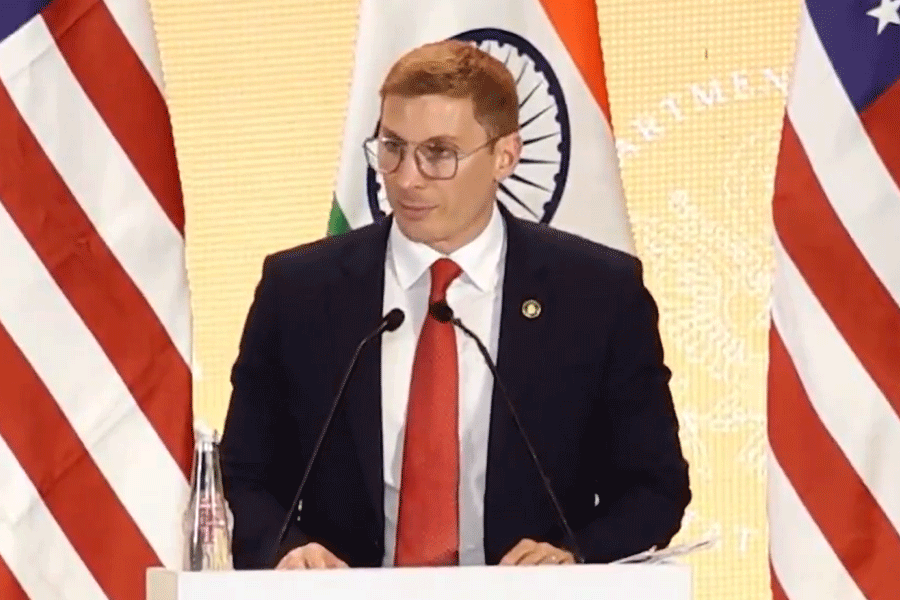
Jacob Helberg on Friday spoke about “the lights of a great Indian city extinguished by a keystroke from across the border”, prompting speculation that the US under secretary of state for economic affairs had just confirmed what had been suspected for a long time about the Mumbai power outage of October 12, 2020.
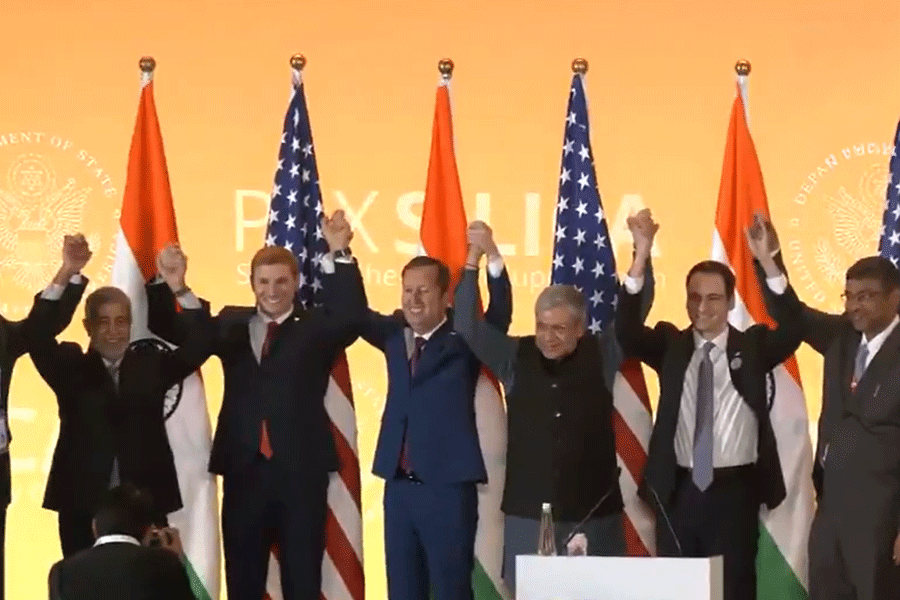
Helberg’s remarks came as the US and India signed the Pax Silica Declaration, deepening strategic cooperation in critical minerals, semiconductors and emerging technologies.
In his speech, Helberg warned of rising economic coercion and cyber threats.
‘Lights of a great Indian city extinguished’
Helberg pointed to vulnerabilities in critical infrastructure.
"We watch as our friends and allies face daily threats of economic coercion and blackmail, forced to choose between their sovereignty and their prosperity,” he said.
He added: “We have seen the lights of a great Indian city extinguished by a keystroke from across the border…."
Helberg was most likely referring to the blackout in Mumbai, which was widely suspected to be linked to Chinese cyber intrusion.
"...Today, as we sign the Pax Silica Declaration, we say no to weaponised dependency, and we say no to blackmail. And together, we say that economic security is national security…," Helberg added.
The 2020 Mumbai grid failure
Several parts of Mumbai and the Mumbai Metropolitan Region witnessed a massive power outage on October 12, 2020, disrupting daily life and suspending suburban train services.
The outage was attributed to multiple trippings of power lines supplying electricity to the city, affecting nearly 360 MW of power.
Subsequent reports suggested that Chinese state-sponsored actors may have deployed malware targeting Indian power grids and seaports amid escalating border tensions along the Line of Actual Control (LAC) in mid-2020.
A report by US-based cybersecurity firm Recorded Future, cited by The New York Times, indicated that the October 12 grid failure in Mumbai may have been linked to Chinese malware activity.
The Massachusetts-based firm said it observed a surge in malware targeting Indian government, defence organisations and public sector entities in the run-up to the India-China clashes. While India’s power ministry confirmed attempts to breach systems, it maintained that the power sector had not been impacted.
“There is evidence that some of the intrusions remain ongoing; however, a significant proportion of the activity appeared to cease in early to mid-February following notification,” a spokesperson for Recorded Future told The Hindu.
China rejects allegations
China’s foreign ministry had dismissed the report as “irresponsible,” arguing that there was no conclusive evidence linking Beijing to the alleged cyber activities.
“China firmly opposes and cracks down on all forms of cyber attacks,” spokesperson Wang Wenbin had said, adding that “it was highly irresponsible to accuse a particular party when there is no sufficient evidence around.”
Helberg’s remarks underscored the broader objective of the Pax Silica Declaration: to build resilient supply chains and safeguard critical infrastructure against economic coercion and cyber threats.
Hidden in the diplomatese was also perhaps a warning on Beijing to New Delhi?