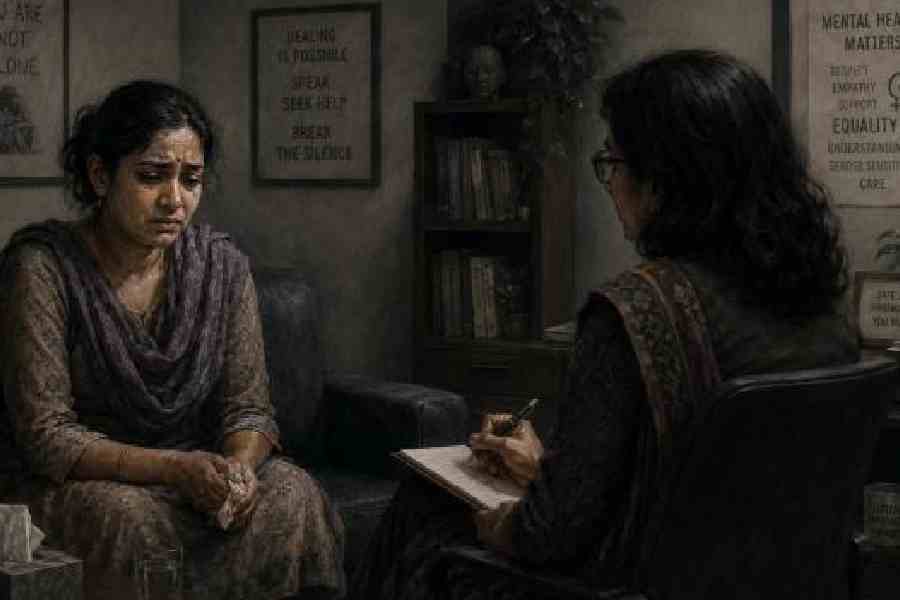
A lady spent nearly 30 years in a suffocating marriage, facing verbal, physical and sexual abuse, before she managed to seek help from a mental health expert. When asked why, she said she had nowhere to leave her little daughter and come for a session.
“This is a classic example of how a person’s gender influences care even when seeking mental health support,” said Chandana Bakshi, psychotherapist, Samikshani mental health centre, Dhakuria. She was speaking at Sector V’s Swasthya Bhavan to sensitise mental health workers on handling cases with special attention to gender. The session was organised by the department of Psychiatric Social Work, Institute of Psychiatry-centre of excellence IPGME&R – SSKM Hospital.
“The lady’s husband was erratic — sometimes treating her decently, but often subjecting her to abuse,” said Bakshi. “But when I asked her about the verbal abuses she endured, she couldn’t bring herself to repeat the words, due to another gender stereotype. She believed that women should not use the kind of language men do.”
It was only when she was approaching menopause, when her hormones were wreaking havoc on her emotional state, that the lady finally reached her breaking point. By then, her daughter — now grown up and mature enough to understand the situation — provided moral support and forced her mother to seek help.
But men don’t always have it easier. “There are men who are beaten by their wives, but the stigma is such that they don’t even go to the doctor, let alone to the police or a mental health expert. The ‘mard ko dard nahin hota’ culture makes them internalise their pain and instead of dealing with it maturely, often take to drinking to drown their sorrows,” Bakshi noted.
The LGBTQ community is another vulnerable section. Bakshi shared the case of a trans man who, from his teens, kept his hair short and dressed in boys’ clothes. “A relative raped him to ‘teach him a lesson’ that dressing like a boy does not make you one. The trans man, then still a teenager, was traumatised, but the crime went unreported as he never sought medical help. He already hated the female body he had been born into and did not want a doctor examining him.”
This survivor has since grown up to become a driver, but his unresolved trauma manifests itself in severe road rage, aggression, and drug and alcohol abuse.
Indrani Bhattacharyya, CEO of the NGO Child in Need Institute (CINI), felt that society, if not engendered, is endangered. “Even today, there are families who don’t celebrate annaprashan for girl children, but at least there should be no discrimination in healthcare. Experts should listen to patients of all genders and orientations without judging. Use respectful language and ensure confidentiality,” she said.
Some of the health workers in the audience spoke their minds. One confessed that he counsels other parents about gender sensitivity, “but in my own house, I keep an eye out to check if my son is playing football or with dolls. I secretly pray he conforms to traditional norms of masculinity,” he said.
Another lady recalled how her daughter once declared she was ‘transgender gay’. “I didn’t delve deeper,” the lady said. “After some months, I asked her about her orientation, and she said she was straight. So often youths need time to discover themselves, and as parents we should allow them that freedom.”
The CINI staff played a short film about children being asked what they want to be when they grow up. Amidst the clamour of “doctor, lawyer, engineer,” one girl answers that she wants to become a boy, as it is only boys that she sees getting showered with love. The message was that for a generation to treat each other equally, they have to be raised equally. When in need of guidance, children were asked to dial the toll-free helpline 1098. And the toll-free mental health helpline for everyone is Tele Manas - 14416.
Also present was Dr Amit Dan, special secretary (medical education), department of health and family welfare. “Adolescents today are far more aware of mental health issues than middle-aged people and are more open to seeking online counselling,” said Dr Amit Kumar Bhattacharyya, director, Institute of Psychiatry.
“Doctors, too, must show empathy. A patient may take five years to muster the courage to visit a doctor, so it’s not right if he’s barely spared two minutes by the mental health care expert. Doctors should also not discriminate between someone wearing a tie and a torn shirt.”
Dr Kaustav Nayak, director of the Institute of Health and Family Welfare, Swastha Bhavan, added that many issues are easier to address in childhood before they become deep-rooted in adulthood. Almost half of all mental health disorders begin at a young age, but for patients to seek help, the stigma around has to end.”