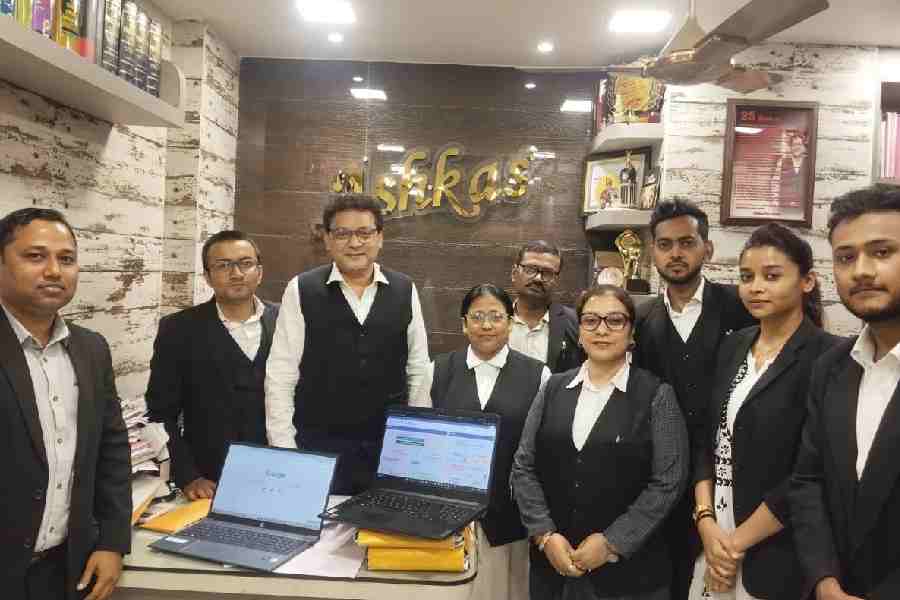
A law firm in central Calcutta is offering pro bono assistance and filing appeals with SIR tribunals on behalf of disenfranchised citizens.
The applicants include daily wage earners, a leading leather exporter and a well-heeled food connoisseur. In the past 12 days, more than 270 appeals have been filed.
The controversial and polarising special intensive revision of electoral rolls in Bengal has stripped more than 2.7 million people of their voting rights after adjudication.
Nineteen tribunals, each headed by a retired high court judge, are now the last hope for these citizens. But many of the deleted voters lack the literacy, digital access or means to file appeals on their own.
“We have processed more than 270 applications. A majority of them are from people at the margins, mainly from low-income groups and the unorganised sector. But we have also filed appeals for middle- and high-income individuals,” said Tarique Quasimuddin, a lawyer at Calcutta High Court who runs Ashka’s Law Chamber on Kiran Shankar Roy Road, a short walk from the high court.
He said more than half the appellants are women. “To date, none of our clients has received any call or message from the authorities regarding their hearings. But their exclusion will not ultimately stand legal scrutiny,” Quasimuddin said.
So far, only four cases are known to have been decided by the tribunals, and in each case, voting rights were restored.
The anomalies that apparently led to many exclusions defy logic, the lawyer said. “I had no idea that a missing dot or a mismatch of a single letter could be so powerful. Minor discrepancies in Muslim prefixes have led to exclusions in approximately 20% of the cases I am handling,” Quasimuddin, who has been practising law for over 20 years, said.
Online challenges
The process of filing appeals online presents numerous hurdles. Applicants’ EPIC and Aadhaar numbers must be linked to their phone numbers to receive OTPs to file appeals. “Many do not have these linked. They cannot file online appeals,” said a junior lawyer from Quasimuddin’s team.
The online form includes a column titled “Brief Facts of the Appeal”, where applicants must summarise their case within a 1,000-character limit, including spaces.
“One thousand characters is 150 words at most. Explaining a case in that space is difficult. An ordinary person who has lost their vote cannot be expected to do that. That is where legal acumen comes in — being concise while still capturing all relevant information,” Quasimuddin said.
A second section requires applicants to write down the “relief sought”.
In addition to seeking permanent restoration of voting rights, applications filed by Quasimuddin’s team include a common demand: an “interim order for casting vote in2026”.
On Monday, the Supreme Court rejected a plea for 27 lakh excluded voters in Bengal to vote in the Assembly elections pending tribunal adjudication. However, legal experts said that tribunals are free to grant interim relief while deciding individual cases.
Another category of applicants is also approaching the chamber — those who have already attempted to re-register as new voters using Form 6 after being deleted.
“They have been misled by BLOs. We cannot help such people. BLOs are wrong if they have advised deleted voters to apply through Form 6 during the adjudication process,” Quasimuddin said.
He added that he expects all his clients to be called for hearings by the tribunals. “It is their right to be heard in person. If not, we will file writ petitions in the high court,” he said.