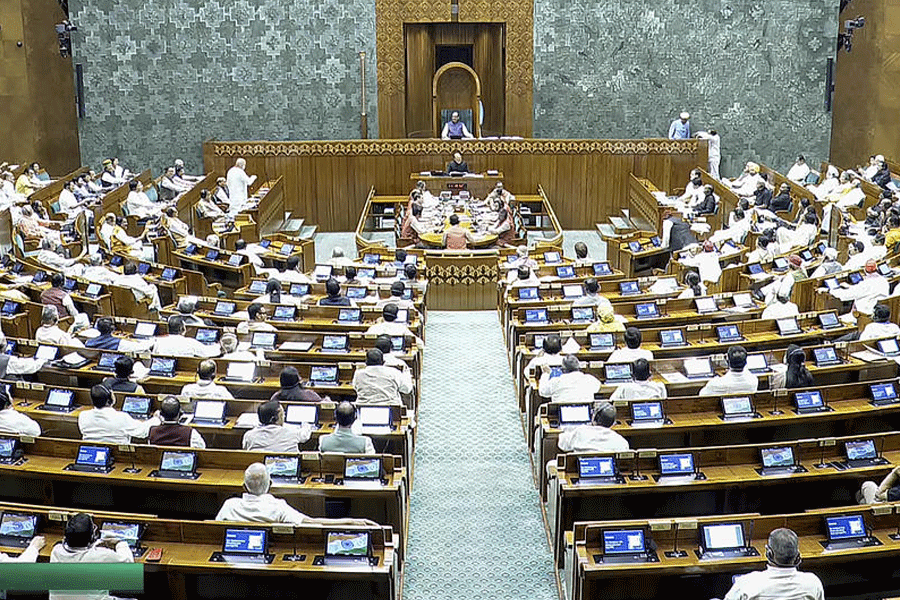
The Opposition on Thursday slammed as anti-constitutional and vowed to fight tooth and nail the Centre’s move to introduce three bills in the Lok Sabha to implement the women's quota law by 2029 and increase the strength of the House to up to 850.
The special three-day sitting of Parliament started on Thursday, in which The Constitution (One Hundred and Thirty-First Amendment) Bill, 2026, The Delimitation Bill, 2026 and The Union Territories Laws (Amendment Bill), 2026 are being introduced and debated for passage in the Lower House.
The Congress said the true intent of the bills being brought by the government in the garb of implementing women's quota law is "mischievous" and they have to be rejected completely in their present shape and form.
After a meeting of INDIA bloc leaders ahead of Parliament proceedings, Congress president Mallikarjun Kharge said the Opposition will not allow Parliament to be hijacked by flawed delimitation bills disguised as women's reservation.
"We stand united and will fight this devious assault on our Democracy with all our strength," Kharge said on X.
Besides Kharge, Leader of Opposition in the Lok Sabha Rahul Gandhi, Congress general secretaries K.C. Venugopal and Jairam Ramesh, the NCP(SP)'s Supriya Sule, DMK's TR Baalu, TMC's Sagarika Ghose, CPM's John Brittas, RSP's N.K. Premchandaran, among others, attended the meeting at Kharge's chamber in the Parliament House complex.
Congress general secretary in-charge communications Jairam Ramesh said the three bills are being taken up in Lok Sabha and the packaging and marketing is women's reservation but the fundamentals have to do with delimitation.
"Many concerns have been raised from across the country regarding the delimitation proposals that privilege a few populous states where the BJP is strong now. The relative strength of a number of states in the Lok Sabha will actually decline," Ramesh said on X.
The way delimitation has actually been done in Assam and Jammu and Kashmir shows how "diabolically the Modi-Shah duo work," he said.
"The true intent of these Bills is mischievous, their content devious, and their damage enormous. They have to be rejected completely in their present shape and form," Ramesh asserted.
"The Opposition demand is simple: Reserve one-third of the current strength of the Lok Sabha of 543 for women along with reservation for women belonging to SC, ST, and OBC communities," he said.
This was the Opposition's position in 2023 and this continues to be the position even now, he added.
"This is true power-sharing and vastly more democratic and in keeping with Constitutional values and principles," Ramesh said.
Union ministers Arjun Ram Meghwal and Amit Shah on Thursday moved to introduce the bills.
Venugopal questioned why proposed changes in the women's quota law were not incorporated when it was earlier passed by Parliament. "Bills to tweak the women's quota law and set up a delimitation panel are anti-constitutional," he said.
Akhilesh Yadav questioned the rush to introduce the bills, saying: "We are in favour... but why do you not want a census to be done?"
Shah hit back, saying the Census 2027 is on and the Centre has also decided to go for caste enumeration, but reservation based on religion is "unconstitutional".
According to the draft Constitution amendment bill, Lok Sabha seats will be increased to a maximum of 850 from the current 543 to "operationalise" the women's reservation law before the 2029 parliamentary polls, following a delimitation exercise based on the 2011 Census.
Seats will also be increased in state and Union Territory Assemblies to accommodate 33 per cent reservation for women.
The seats reserved for women in the Lok Sabha and legislative assemblies "shall be allotted by rotation to different constituencies in a state or Union territory", the draft bill circulated among Lok Sabha members said.
Several opposition parties on Wednesday decided to unitedly vote against the delimitation provisions in the Constitution amendment bill in Parliament, while asserting that they are not against reservation for women in legislative bodies.
The total strength of the ruling NDA in the Lok Sabha is 292, while the major opposition parties have 233 MPs.
For the Constitution amendment bill to be through, it requires a two-thirds majority of those present in the House at the time of voting.