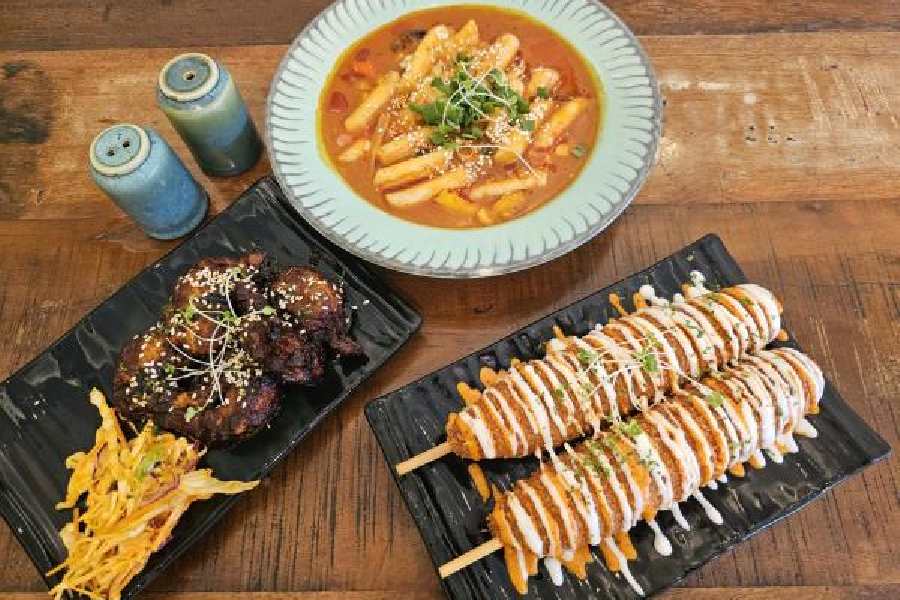
Korean food and a breakfast spread. These are the latest offerings to be added to the menu card at Main Street Cafe. The cosy AA Block sip-and-bite outlet, run by the father-daughter duo of Pinaki and Prithika Deb, is reporting an upward tick in sales ever since they introduced Korean fare, while a trial run is on for its breakfast menu since last week.
“We are experiencing at least 50 per cent rise in orders in the months since we replaced Chinese with Korean dishes,” says Pinaki, an MBA batch topper who gave up his technology consultancy job to avoid a transfer abroad. “It started with the K-pop group BTS becoming popular in India. Now young people want to participate in Korean culture, which includes food,” he reflects.
In fact, The Telegraph Salt Lake had featured a cover story titled “Hungry for K-food” on January 30 on this trend.
Korean spices are mostly in a fermented state, he points out, as Korean cuisine relies heavily on fermented condiments. “Even their chilli is less hot, is less prone to causing acidity but is bursting with flavours,” says Prithika, a third year economics student in Delhi, who comes home every six weeks.
Korean cuisine mostly uses Gochugaru, which is milder than many Indian chillies and is slightly smoky and sweet. Other than Gochugaru in a powder form, a key ingredient that is imported from South Korea is Gochujang, a fermented red chilli paste, that also uses soybean powder, glutinous rice and salt.
Their hottest Korean offering is Chicken Cheese Corndog (priced Rs 440), a streetfood in Korea, served on skewers, that is crunchy on the outside and cheesy within. It has two non-veg avatars, in Chicken Sausage Corn Dog (Rs 419) and Sausage and Double Cheese Corn Dog (Rs 461).
Chicken Rameon, another youth favourite, requires a bit of convincing for the middle-aged to order, at Rs 629 a bowl. “The slurpy noodles are often mistaken for Maggi as Korean noodles are now sold off the shelf. But we stick to authentic ingredients, otherwise the flavour profile will not be the same. Gochugaru powder costs thrice as much as dry Indian chilli. The chicken too is marinated in Gochugang, grilled and tossed. The vegetables have a special cut, which is different from both Indian and Continental dishes,” Pinaki argues.
The spicy broth, that came topped with slices of boiled egg, kimchi, vegetables, mushroom and chicken shreds, is no comparison for what comes out of instant noodle packets. The menu has options in vegetables, paneer, prawn and chicken katsu. In the last variety, that costs Rs 100 more, chicken breast is breaded with panko crumbs, deep-fried until crispy and then sliced and placed over the noodle soup, adding a heavy and crunchy element to the slurpy noodles.
Veg Tteokbokki is another street-food dish, made with rice cakes cooked in a spicy sauce with vegetables (priced Rs 713). Also available in a chicken variety (Rs 734), the chewy rice cakes acquire its deep red colour and spicy flavour from the use of Gochujang. “We make the gravy lighter. It is an acquired taste,” admits
Prithika.
Another dish, rabokki, is traditionally vegetarian, being a combination of Rameon and Tteokbokki (Rs 745). But a chicken variety (priced Rs 787) is featured as well. Being a combination of noodles and rice cakes, it is quite filling.
Dakgangjeong Crispy Fried Prawn (Rs 577) is served tangy, sweet and slightly spicy, and is a winner. Dakgangjeong is traditionally a chicken dish, dak meaning chicken, being tossed in a glaze made with soy sauce, garlic, sugar and gochujang.
Father and daughter take as much pride in the way they have resurrected the ground floor from a termite-infested shed to the 46-seater cafe as they do in the food. The Korean meal ended with a Nolen Gur Cream Americano. “We serve 35-40 types of coffee,” Prithika smiles.