Friday, 08 May 2026
Friday, 08 May 2026
Friday, 08 May 2026
It has been a gruelling March for 35-year-old Mahima Molla, who has been making the long journey from the Sundarbans to Kolkata’s Salt Lake administrative district, navigating a legal process that has left her drained and uncertain.
Since February, she has appeared before officials once at the office of the principal chief conservator of forests and once at the Sundarbans Tiger Reserve office in Canning as instructed by Calcutta High Court. She doesn’t have a choice. At stake is a decision that could determine whether the state will compensate her for the death of her husband, Abur Ali Molla, who was killed by a tiger in July 2024 while inside the mangrove forests of the Sundarbans.
“The court accepted that the tiger took him,” Mahima tells The Telegraph Online. “It instructed the forest department to examine the case. There have been two hearings so far. They say they are trying to compensate me.”
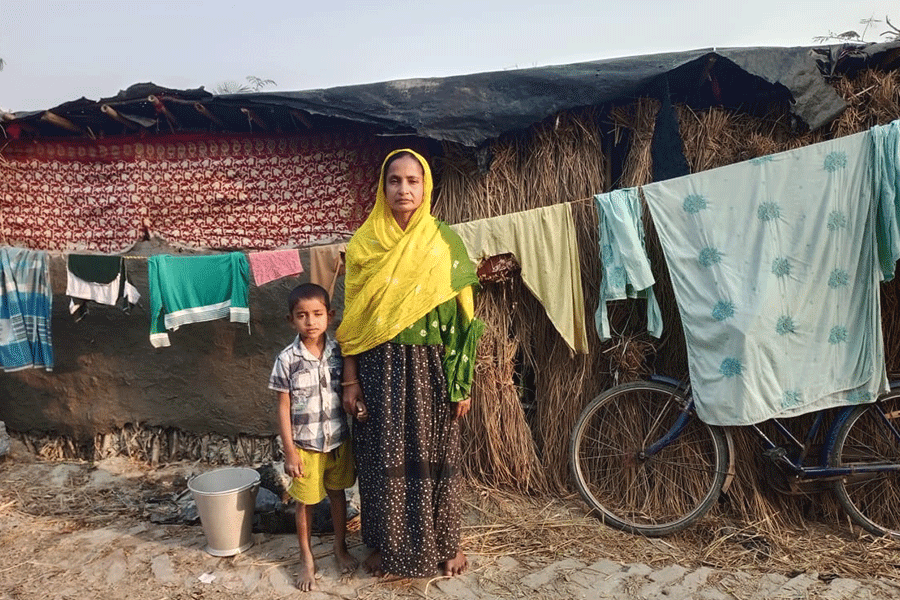
“We are living in extreme poverty. My husband was the main earner. Now he is gone, and those of us who are alive are the ones who must spend, but we earn almost nothing. Villagers help us survive. But how long will this continue,” Mahima, a widow raising three children, says standing in front of her small hut.
Her younger sons are with her in the village; her eldest has dropped out of the madarsa and taken a job in Kolkata to help support the family.
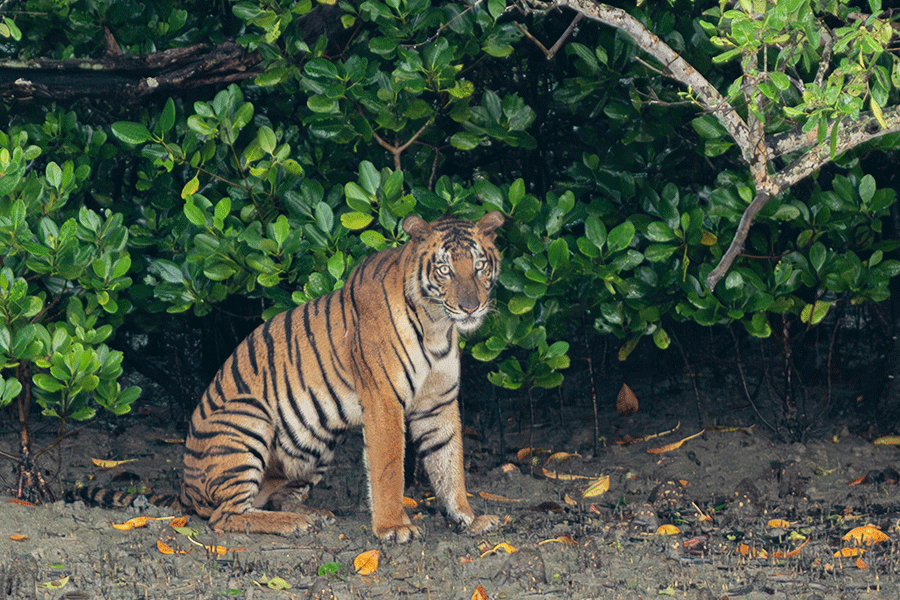
In the Sundarbans, the world’s largest mangrove forest, deaths of humans from tiger attacks are an enduring and brutal reality. As is the case with Abur Ali.
Yet, securing compensation due to her has proved elusive. The primary reason is that Ali’s body was never recovered and therefore no official death certificate was issued. The forest department has refused to proceed without that gap being filled.
The Calcutta High Court, however, intervened earlier this year, ruling that sufficient evidence existed to establish that Abur Ali was killed by a tiger. The court set deadlines of March 30 for the authorities to resolve the matter and April 15 for compensation disbursal depending on the decision.
Despite that, bureaucracy has refused to give relief to Mahima. Forest officials have posed at least 13 detailed questions to her. Many of the questions, activists helping her say, are framed to suggest that Ali was at fault for entering the forest.
While that is true, it’s also true that the people living in the region depend almost entirely on the tiger’s forest for their livelihoods. Entering the forest is not a matter of choice for them.
Division of a tiger reserve into buffer zones and core areas
The Sundarbans was designated a tiger reserve in 1973. Spanning roughly 2585 square kilometres which is the Sundarbans Tiger Reserve (STR), it is divided into buffer zones and protected core areas — about 885 sq km and 1,699 sq km, respectively. The buffer constitutes a wildlife sanctuary and multiple-use zone where the forest-dependent population is allowed entrance with a valid permit and a boat licence certificate. Entry into the core area is not permitted.
“The forest division of South 24 Parganas maintains only buffer forest compartments with two sanctuary zones prohibited from entry where fringe people regularly intrude to collect biotic resources,” says Soma Sarkhel, research scholar at Visva-Bharati University, Santiniketan, conducting research on man-animal conflict in Sundarbans.
“Due to the maze of innumerable tidal creeks, the boundaries of prohibited zones are often not clearly understood by forest goers, especially at night or in fog.”
As reported by The Telegraph in 2025, a merger of the STR and tiger habitats of South 24 Parganas has been approved by the National Board for Wildlife. This will increase the area of the STR to 3,600 sq km. It will also make life difficult for those dependent on the forests for a living.
Mahima’s experience follows the pattern faced by scores of women known locally as “tiger widows”, wives of men killed by tigers, deaths often left unacknowledged by the state. In 2016, Direct Initiative for Social and Health Action (DISHA) and ActionAid brought tiger widows into an organisation. Some of them received compensation. Ten years later, their fight for justice continues along with other organisations for other tiger widows.
“Mahima and her children have a legal right to live with dignity,” Sreemoyee Mukherjee, her counsel, tells The Telegraph Online. “This is the battle she is fighting. These families are poor. Their livelihoods are tied to the forest. Survival itself puts them at risk.”
Families cannot be denied compensation
Under a Bengal government scheme from 2021, families of those killed in tiger attacks are entitled to Rs 5 lakh in compensation. In January 2024, in a landmark ruling, Calcutta High Court Justice Sabyasachi Bhattacharyya had ordered the state government to pay that amount to two Sundarbans tiger widows, Sarojini Mondal and Saraswati Auliya, after their husbands were killed.
Saraswati’s husband was dragged inside the forest by the tiger. Unlike Abur Ali, a death certificate was issued in that instance.
The high court decision established a crucial legal principle: Families cannot be denied compensation solely because the deceased entered restricted forest areas for their livelihoods. For communities in the Sundarbans, where fishing, collecting honey and gathering firewood are essential to survival, the court acknowledged that economic necessity frequently collides with conservation law and that cannot be helped.
According to data compiled by Sarkhel, there have been 133 tiger attacks since 2020. This averages about 19 attacks per year. Official data often don’t reflect this, say activists. State authorities have routinely characterised victims as trespassers or encroachers and disqualified their families from compensation if they do not bear valid permits and licences.
Residents and activists reject that framing as detached from reality.
“No one enters the core forest out of choice,” Mahima says. “The village, the river and the forest are all intertwined. Often you cannot tell where one ends and the other begins.”
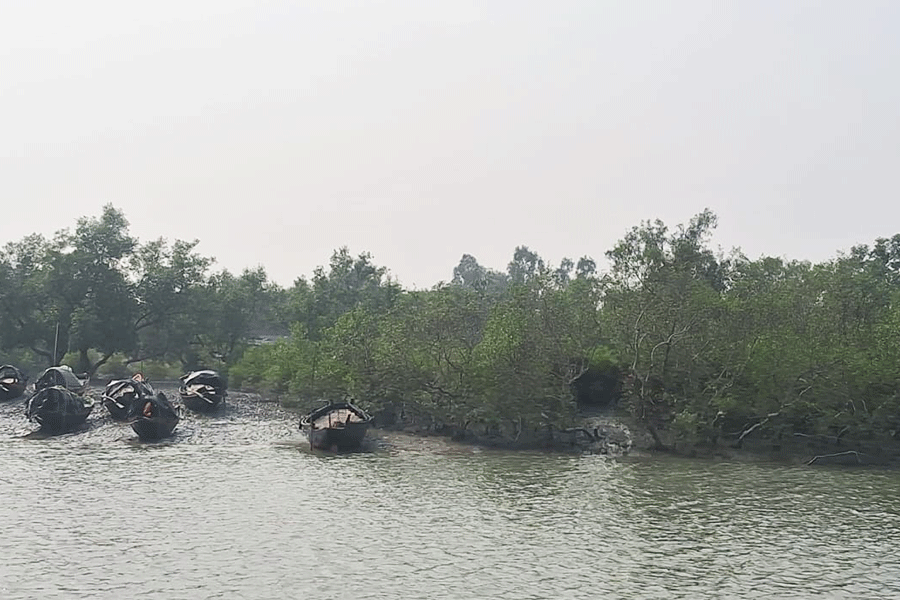
At night, she adds, the dangers increase manifold. Strong tidal currents can pull small boats off course, drawing them deeper into protected zones without warning. “In the dark, with the tide against you, it’s impossible to know. You don’t realise you’ve crossed a line until it’s too late.”
‘We froze as the tiger took him away’
Let's return to that July morning in 2024.
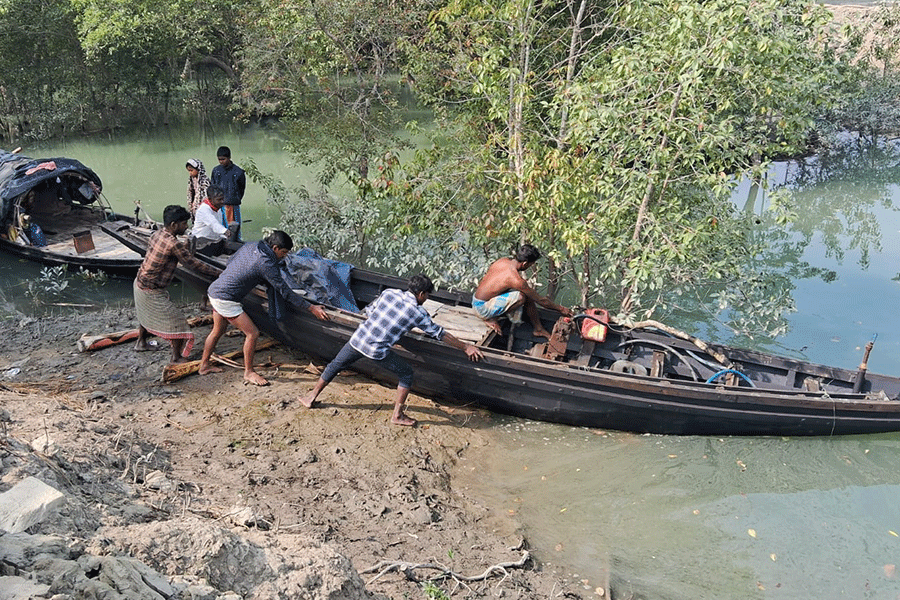
Abur Ali, a fisherman, and six other men had set out by boat, entering the forest. Just ten days earlier, the fishermen had received a boat licence certificate permitting them to fish in the area.
“We couldn’t fish that day,” Roish Goldar, one of the men on the boat, tells The Telegraph Online. “The tide was high and we were forced into a creek to anchor for the night.”
According to Goldar, the group was preparing dinner at around 6.30pm. One man was cooking, two others were sitting nearby and talking, while three were in the small cabin of the boat.
“Abur stepped out towards the edge of the boat,” Goldar says. “That’s when the tiger, which must have been watching, jumped onto the boat and dragged him away.”
The men screamed in fear. The attack had taken place in a matter of seconds in the dim glow of a kerosene lamp.
“I saw Abur being pulled away,” Goldar says. “Then the tiger disappeared into the forest. I used a torch, but there was nothing we could see. Only darkness and dense mangroves.”
The group did not attempt a rescue. “We sat there in silence, frozen with fear as the tiger took him away,” Goldar recalls. “These things happen here, but we had never witnessed something like this.”
The remaining men eventually returned home.
A report was entered into the police diary the following day. A police beat officer requested that a forest range officer help recover the body. A week after the incident forest officials visited the site with Mahima but did not disembark from the boat during the visit. Abur’s body was not recovered.
The law and the jungle
Movement through the forest is governed by a dense web of laws: the Wildlife Protection Act of 1972, the Indian Forest Act of 1927, the Forest Conservation Act of 1980 and the Environment Protection Act of 1986. Overlaying those restrictions is the Forest Rights Act of 2006, intended to safeguard the rights of tribal communities and forest dwellers whose lives and livelihoods predate the modern conservation regime.
According to the 2011 census, about 4.4 million people live along the fringes of the Sundarbans. More than 35 per cent belong to the Scheduled Castes; nearly 5 per cent are from the Scheduled Tribes.
There are at least 100 tigers in the region.
In August 2025, The Telegraph had reported that the distribution of boat licences, required for fishing inside the forest, had been stalled as the state government wanted to revise its list of licence-holders. One licence allows one boat, typically carrying five or six men, to enter the forest.
Residents say the number of licenses issued falls far short of requirements.
That gap has fueled a shadow economy. Fishermen without licences often rent permits on the black market, paying as much as Rs 1 lakh for nine months of access, gambling that longer stays inside the forest would yield higher returns.
Many are also trapped in the dadon system, in which middlemen provide advance loans against future catch. Once indebted, the pressure to repay is relentless, pushing fishermen to take greater risks: Staying in the forest for longer, travelling farther in, and edging closer to prohibited zones.
“Yes, entering the core area is illegal. But the deeper crime is forcing people into a situation where this feels like their only option,” Anil Mistry, a poacher turned conservationist, tells The Telegraph Online. Many who enter the forest, he says, are unlicensed fishermen renting permits at ruinous rates, betting everything on survival. It’s also an unequal battle, pitted against climate change and mechanised fishing.
Licensing failures, however, are only part of the problem.
Cycle of death and legal battles
“If there are at least 3,00,000 people dependent on fishing and crab collection, only a fraction can legally enter the forest,” Mithun Mondal, a Sundarbans-based activist working with the Association for Protection of Democratic Rights (APDR) and assisting Mahima, tells The Telegraph Online. “There may be barely 1,700 boat licences. On top of that is the state’s reluctance to recognise tiger deaths. Every case is subjected to interrogation. The process is exhausting, humiliating and pushes the family towards deprivation.”
The forest department’s position on tiger widows has often been adversarial regarding compensation. In 2021, Shantibala Naskar was denied compensation after her husband, Lakhai Naskar, was killed by a tiger, despite the availability of a post-mortem report. The government argued that he had entered a protected core area. The Calcutta High Court rejected that position, ruling that illegal forest entry could not be grounds to deny compensation.
This year, in another case, the court recognised that Tulsi Mondal’s husband, Prafulla Mondal, was killed by a tiger in 2019 while he was collecting crabs. Prafulla’s body was never recovered, and no post-mortem was conducted. Exactly like Mahima, Tulsi was asked to appear before the forest department for them to decide on compensation.
“It’s an unwritten cycle,” Mithun says. “Every tiger widow has to go through it whether there is a body, a post-mortem report, or neither. Legal precedent exists, but the families are still harassed over core and buffer zones.”
Advocacy groups, including the Association for Protection of Democratic Rights, have pressed the state to speed up the process of compensation and increase payouts. The Supreme Court in November increased the compensation to Rs 10 lakh in the context of an inquiry into Corbett Tiger Reserve.
Beyond the legal and financial calculus is the quiet erosion of individuals and families, caught in a web not of their own making.