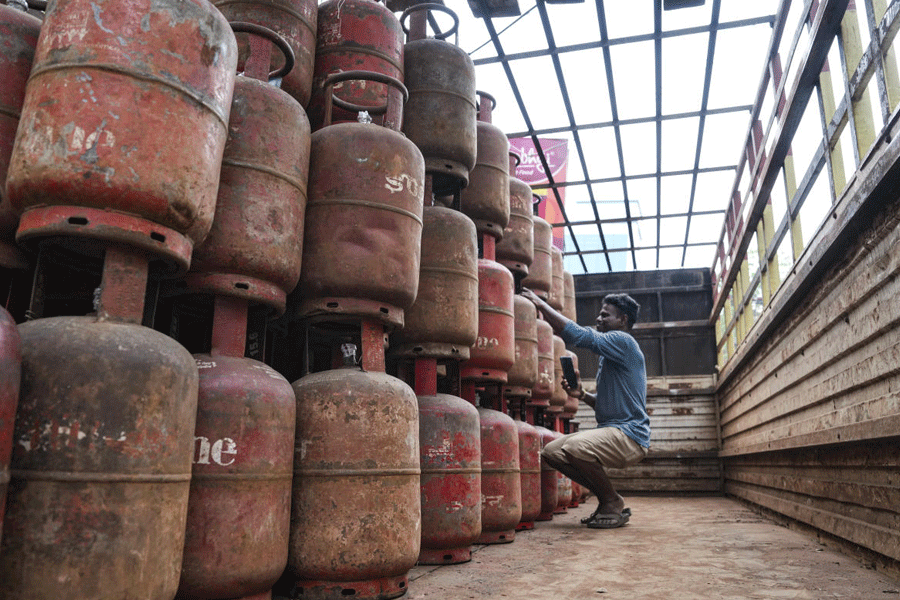
The turmoil in global energy markets is already spilling into India, where fears of cooking gas shortages have triggered panic buying in Calcutta and other parts of the country. Hoarding and black marketing of cylinders are also reported to be widespread.
Analysts say shortages of liquefied petroleum gas, or LPG, could continue in the coming weeks, even as the government presses refinery companies to maximise production.
Prime Minister Narendra Modi has pushed back against those warnings, saying they are fuelling unnecessary alarm. “Some people are trying to create panic on LPG,” Modi told a summit in New Delhi on Thursday. “I will only say they are not only exposing themselves before people but hurting the country.”
He’s also urged state governments to clamp down on profiteering: “I request the state governments to enhance monitoring to stop black-marketers and hoarders in such times.”
Separately, Modi says he spoke with Iranian President Masoud Pezeshkian about what he describes as the “serious situation” in the region. He says he expressed “deep concern over the escalation of tensions and the loss of civilian lives as well as the damage to civilian infrastructure.”
“The safety and security of Indian nationals, along with the need for unhindered transit of goods and energy, remain India’s top priorities,” Modi posted on X.
The conversation reflects India’s effort to keep channels open with Tehran while also maintaining its ties with Washington and Gulf allies. India was once one of Iran’s closest partners and imported large volumes of its oil, but that relationship cooled after the United States reimposed sanctions.
Modi’s comments came after crude oil surged above $100 a barrel for the first time since 2022 following attacks on ships in the Gulf that have left millions of barrels stranded in the region. The global Brent benchmark jumped 9.2 per cent in a single day on Thursday.
Vessel attacks across the Arabian Gulf have signalled what traders see as a widening Iranian campaign to disrupt shipping beyond the Strait of Hormuz. Before the war, the narrow passage was one of the world’s busiest energy routes with about 80 tankers sailing through it daily, carrying 20 million barrels of crude and fuel, according to a New York Times analysis of shipping data. Now, only one or two ships a day are managing to make the crossing.
The International Energy Agency says the world is facing the “largest supply disruption in the history of the global oil market.”
Ayatollah Mojtaba Khamenei, Iran’s new leader, declared in his first message since becoming Supreme Leader that the waterway will remain shut as a “tool of pressure” in the war. The statement was read on Iranian state TV on behalf of Khamenei, who has not appeared in public since he was appointed to replace his father, killed in a US attack on the war’s first day.
“LPG availability is the real variable to monitor in the coming weeks,” says Sumit Ritolia, lead analyst at Kpler, which tracks ships and provides global energy data.
India consumes about 1 million barrels of LPG a day but produces only 40 to 45 per cent of that domestically. The rest has to be imported, and 80 to 90 per cent of those imports normally travel through the Strait of Hormuz.
To ease the pressure, the government has asked fuel companies to scale back petrochemical production and redirect raw materials to increase LPG output. “Refineries can optimise LPG output by shifting feedstocks away from petrochemical production towards LPG recovery,” says Ritolia.
A spokesperson for Reliance Industries said the company is “optimising LPG production but we don’t expect that to affect petrochemical production.” The spokesperson added that the shift would lead to a substantial increase in LPG output but declined to give figures.
Even so, analysts say the increase won’t come close to filling the gap. Refineries may be able to raise LPG output by 10 to 20 per cent, which would lift domestic supply to 47 to 50 per cent of demand. “That would leave a significant gap that must still be filled through imports,” says Ritolia. Replacement supplies from outside the Middle East are possible, but shipping times are much longer.
India has one of the largest LPG consumer bases in the world with about 330 million users. The government has raised cooking gas prices by 7 per cent for households and 6-to7 per cent for commercial users, stoking inflation worries.
Inflation had already started climbing even before the Middle East conflict. Official statistics data shows that India’s consumer price index rose to 3.21 per cent in February from 2.74 per cent in January. Soaring oil prices threaten to push inflation even higher, widen the already large trade deficit and slow growth.
The outlook is more positive for crude oil. A large number of ships carrying Russian crude are already on the high seas, and India is expected to try to secure as much of that supply as possible.
Analysts say India could secure 1.6 million barrels per day, or even as much as 2 million barrels, in line with the volumes it imported from Russia for many months last year and helping narrow the shortfall from supplies that normall pass through the strait.