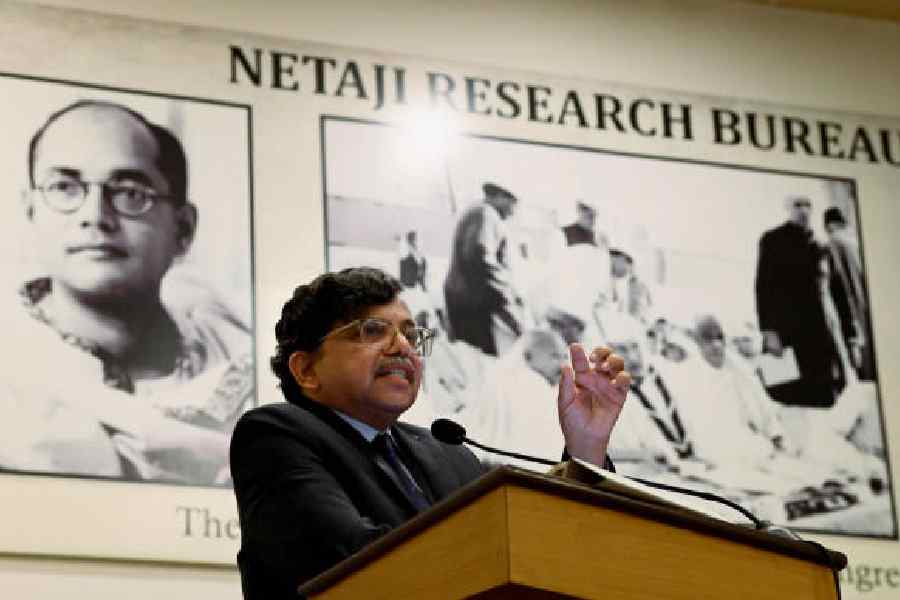
The Indian judiciary has so far rebuffed attempts by the legislature to curb its independence, but has lately not shown the same degree of confidence in standing up to a powerful executive, a former judge unafraid of speaking truth to power said on Saturday.
“The judiciary has, until now, rebuffed attempts by the legislature to whittle down its powers or its independence. One cannot say that the judiciary has shown the same degree of confidence in standing up to a powerful executive. It appears that the last time it happened was more than five decades ago in 1973 (the landmark Kesavananda Bharati v. State of Kerala case, where the Supreme Court ruled that Parliament could not alter the Constitution’s basic structure)” said Justice (Dr) S. Muralidhar (retired), former chief justice of Orissa High Court and former judge of Delhi High Court.
He delivered the annual Sarat Bose Lecture at Netaji Bhawan. The 90-minute address offered an exhaustive analysis of the relationship between the legislature, executive, and judiciary.
Justice Muralidhar has worked with victims of the Bhopal gas tragedy, prisoners on death row, and the National Human Rights Commission. He is also chair of the
United Nations Independent International Commission of Inquiry on the Occupied Palestinian Territory (including East Jerusalem) and Israel.
He had made headlines following his midnight transfer from Delhi High Court to Punjab and Haryana High Court after he ordered Delhi Police to file FIRs against some BJP leaders for hate speeches ahead of the Delhi riots in February 2020.
At Netaji Bhawan, he criticised the judiciary’s role in the recent regime changes in states such as Karnataka (2019), Madhya Pradesh (2020), and Maharashtra (2022).
“The court becomes a very important political actor. The court is deciding when a floor test is to be held.… It refuses to take notice of the brazen subversion and actually plays along in bringing about regime changes that were all pre-determined,” he said.
He also described as a threat to federalism the reluctance of governors in Opposition-ruled states to give assent to bills passed by state legislatures. “This, too, needed judicial intervention. We need the judiciary to be strong, consistent, independent and free from pressures of all kinds,” he said.
Justice Muralidhar explained why a common argument, often made by legislators, on judicial overreach is flawed.
“Every now and then, we hear politicians being vocal about an unelected judiciary being able to overturn laws passed by a sizeable majority in the legislature. This happens at the instance of an individual or a group. But that is the beauty of our Constitution. It does not envisage a democracy that is merely majoritarian but one which accommodates differences, diversity, plurality and is inclusive,” he said.
Historian Sugata Bose and political scientist Sumantra Bose — grandsons of Sarat Bose, barrister, freedom fighter and elder brother of Netaji Subhas Chandra Bose — hosted the lecture.
Sugata Bose called it “befitting” the legacy of his grandfather.