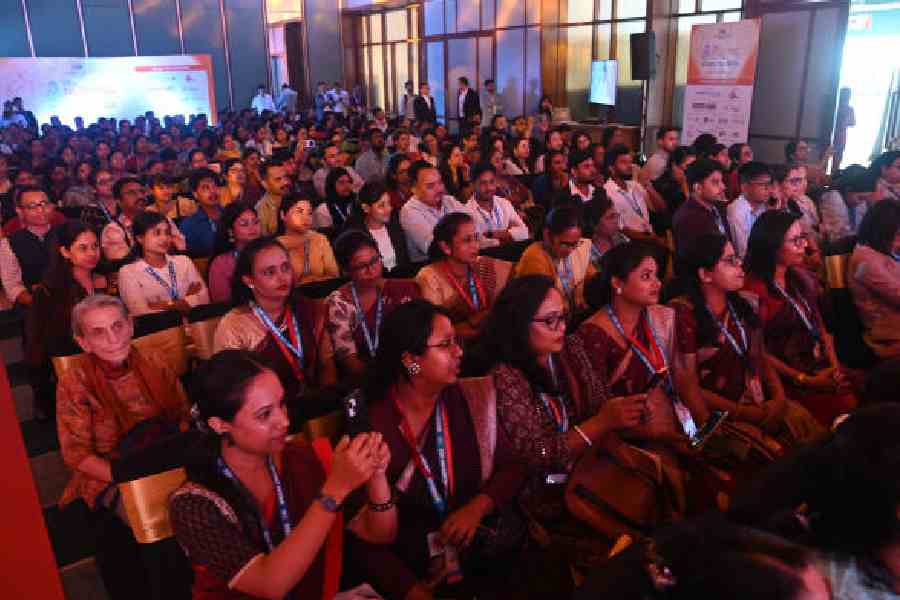
The human touch, empathy and compassion cannot be replaced by artificial intelligence (AI) in nursing, said the head of a nursing department at a hospital at a conclave held recently in the city.
“Nursing is defined by care, compassion, empathy and a soft human touch.
AI cannot replace a nurse’s healing touch on a patient,” said Lt Lalita Thambi, head of nursing services, CK Birla, CMRI Hospital.
Thambi was a speaker at a session on the Essence of Nursing Care-Compassion, Care & Changing Care Delivery at the 10th edition of the CII (Confederation of Indian Industry) Nursing Conclave.
Thambi, who has more than a decade of experience in nursing, said a patient does not always speak up about what is bothering them.
“Patients want somebody to listen to them and understand them. Sometimes
they speak, but many patients are quiet, and they do not want to speak. It is the nurse’s healing touch that comforts them,” said Thambi.
“Many patients do not otherwise respond, but a human touch is like a therapy for them. Human beings can put themselves to understand and heal them,” Thambi added.
The session discussed how the nurse’s role extends beyond the patient to the family as well.
Often, family members are in pain too, worried about their kin’s health, the treatment protocol and also the expenses of treatment.
The nurse has to be caring not just to the patient but also to the family, said Thambi.
“There are occasions when a spouse is in the hospital, and the other person is taking care of the child, running the family, doing the household chores and is understandably worried. A nurse has to be sensitive enough to observe the family member and lend support through counselling,” said Thambi.
Nurses or administrators of hospitals did not overrule the importance of AI in healthcare management, but said it would be more of an enabler.
Ayanabh Debgupta, regional director (east), Manipal Hospitals, said AI will reduce human error and replace repetitive tasks such as typing or data collection, thus giving a nurse more time to communicate or interact with a patient.
Metro has reported on healthcare professionals’ concerns about the shortage of nurses, where the number of caregivers is not expected to match the quantity of beds that Calcutta is expected to add in the next two years.
“When you have a shortage of nurses, the overall coverage of beds to nurses becomes stretched. But technology is enabling and plays a supporting role, monitoring the patient all the time. Whether it is a fluctuation in blood pressure or a cardiac abnormality on the monitor, it is picked up by technology and a specific alarm is raised, and somebody can attend to it quickly,” said Debgupta.
Technology can help raise the alarm and make healthcare delivery more efficient, Debgupta said.
Rupak Barua, chairman, CII, West Bengal State Council and managing director and CEO, Woodlands Multispeciality Hospital, said: “Excellence in healthcare is not measured solely by clinical outcomes but by kindness shown to a patient.”