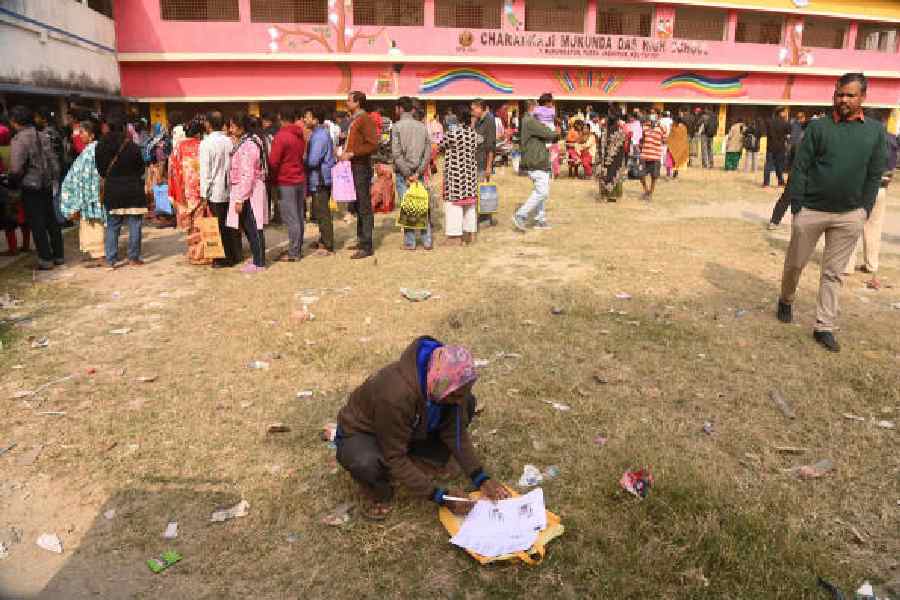
Many migrant workers from Bengal have returned home after being summoned for hearings as part of the ongoing special intensive revision (SIR) of Bengal’s electoral rolls.
The unscheduled leave from work has meant travel expenses, loss of daily wages and uncertainty about employment. But the fear of disenfranchisement is greater, as many think it could raise questions about their citizenship.
Confusion around the contentious roll revision continues. Several workers said they were unsure when their hearings would be held, while others who have already attended hearings said they were uncertain whether the process was complete or if further scrutiny awaited them.
Rehana Khatun, 28, from Dinhata in Cooch Behar, has been working in Delhi for the past two years as a caregiver to an elderly woman in Dwarka. Rehana’s husband, who worked in Hyderabad, died in an accident a few years ago, forcing her to seek employment. Her daughter, in Class III, lives with Rehana’s parents and brother in Dinhata.
Rehana’s brother filled out her SIR enumeration form. Rehana herself was not a voter in 2002, though her father was. An apparent mismatch in the spelling of her father’s name led to the discrepancy, she said, quoting the booth-level officer (BLO).
“I was told that hearings would begin on December 17. I boarded a train from Delhi on December 16 and reached home the next day. But my hearing has not taken place yet. Now I am being told it will happen on January 5,” she said on Saturday.
She has already received more than one call from her employer. “They cannot wait for me for long. The woman I look after is old and ailing and needs constant support. But I cannot leave until this hearing is done,” Rehana said.
Similar disruptions have affected workers across sectors. Prafulla Gayen and Pradip Gayen returned to their village in West Midnapore from Chennai, where they work as goldsmiths.
“Several men from Bengal have come back for hearings. They had to pay for train tickets and will not be paid during this unspecified leave,” said a spokesperson of an association that represents goldsmiths.
This newspaper had earlier reported how migrant workers in other states returned home in large numbers during the first phase of the SIR to fill their enumeration forms. Activists working with migrants said some workers have now been forced to make a second trip in less than two months. In other cases, relatives had filled in the forms on behalf of migrant workers.
Antu Sk, 40, a mason working in Chennai, received a call from the BLO in the third week of December informing him of a spelling mismatch in his name. He was asked to appear for a hearing.
Antu travelled by train and reached his home in Bhagabangola in Murshidabad on December 27. His hearing took place on December 30 at a primary school in the village.
“I carried my Aadhaar and PAN cards. The officers checked the documents and made some entries. When I asked whether my problem was resolved, they could not give a firm assurance,” Antu said. “What if another issue crops up? I cannot keep coming back from Chennai. So I have decided to stay back a little longer,” he added.
Antu works with different contractors in Chennai and is paid weekly. After expenses, he manages to save around ₹5,000 a week. He is single but supports two younger sisters back home.
Bengal has around 22 lakh registered migrant workers employed outside the state. Activist groups believe the actual number is higher. Districts such as Murshidabad, Malda, Cooch Behar, Birbhum and East Burdwan contribute the largest share of migrant labour to other states.
Bengali-speaking migrant workers are under attack in BJP-ruled states. On Christmas Eve, suspected Hindutva men killed a 21-year-old migrant worker from Murshidabad and injured two of his companions after branding them “Bangladeshi infiltrators”.
The atmosphere of polarisation has heightened anxiety, particularly among migrant workers from the minority community.
“It feels as if I am under constant scrutiny for my name, faith, dress and language. I cannot take chances with my voting right,” said a 36-year-old man from Murshidabad who works with a road construction contractor in Chhattisgarh and has also returned home for an SIR hearing.
“If, by some design, my name does not feature in the valid voters’ list, I will be an easy target for people who take the law into their own hands,” said the man, who did not wish to be named.
The Migrant Labourer Unity Forum has written to the Election Commission of India and the chief electoral officer of Bengal, urging them to introduce virtual hearings for migrant workers.
“Migrant workers are spending a lot of money on travel. Some who had come home to fill the forms are now being called again for hearings. There are some who do not have the money to return. For the sake of fairness, the Election Commission should conduct virtual hearings,” said Asif Faruk, state general secretary of the forum.