The classic Bengali bhadralok must embrace “the other” to survive, a Bengali bhadralok said at the Calcutta book fair on Thursday.
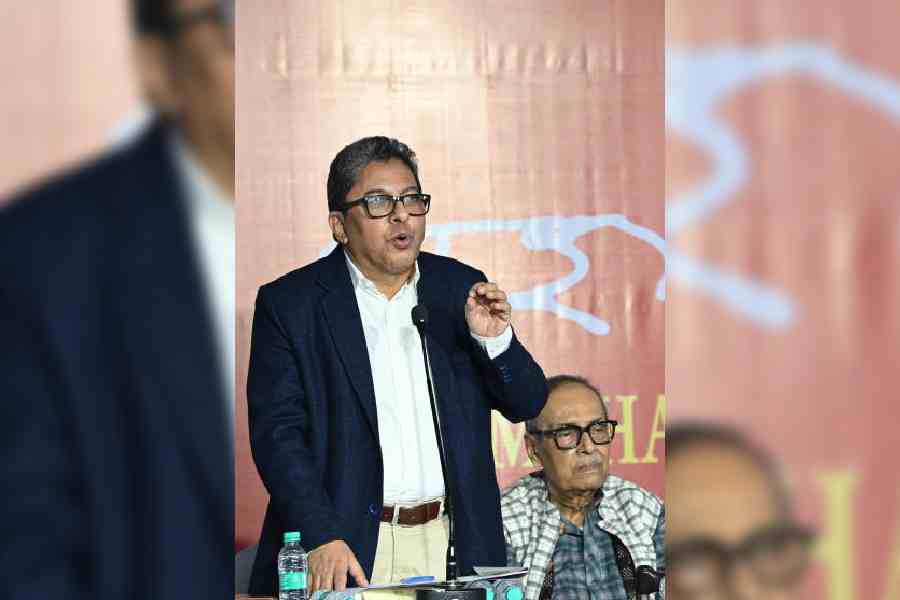
Women, Muslims, backward classes, Dalits and tribals must be welcomed by the bhadralok, insisted Alapan Bandyopadhyay, chairman of the West Bengal Heritage Commission, chief adviser to chief minister Mamata Banerjee and former Bengal chief secretary.
On Thursday, he discussed his new book, Bangali’r Mon (the Bengali mind), which was launched at the book fair on the same day.
Sections of the book address the existential crisis that hangs over the notion of the Bengali bhadralok and the remedies to alleviate it.
“Women cannot be alienated; Muslims cannot be kept waiting at the doors; backward classes should be seated at the same table; Dalits must help to broaden the sphere; the rich culture of the tribals must be acknowledged. The bhadralok must even respect the entrepreneurial and intrepid spirit of people who don’t speak Bengali but live in Bengal,” Bandyopadhyay said at the launch.
A Bengali bhadralok (literally gentleman) is typically a member of the educated, cultured, and predominantly upper-caste Hindu elite that emerged in 19th-century Bengal during the colonial rule. He is usually defined by his intellectual pursuits, proficiency in English, respectable, often sedentary occupations, and a passion for literature, arts, and political discourse.
In the book, Bandyopadhyay argues that the declining power of Communism on a global scale, the dominance of neo-liberalism, the advancement of the marginalised class, and the politics of populism have all contributed to the crisis that the bhadralok now confronts, as noted by historians, economists, and social chroniclers.
The objective of the book was to draw from different essays and writings to “reconstruct a unit called the Bengali mind”, the author said.
Members of Bangla Pokkho — an organisation that advocates the rights of Bengalis, works to protect the Bengali language and culture, particularly against a perceived linguistic imperialism of Hindi in Bengal — were in the audience.
Bandyopadhyay addressed Garga Chattopadhyay, the leader of the organisation, before making his point about the need to engage with the classes that the bhadralok have so far largely alienated.
After the launch, Metro sought Chattopadhyay’s response to the author’s comments on embracing the non-Bengali merchant class. Chattopadhyay said: “Bengalis must take a lesson from the Biharis and Marwaris on how to stay united.”
The Bengali identity is in the spotlight now. Many project it as a counter-narrative to the largely north-Indian Hindutva project launched by the saffron ecosystem.
On Thursday, Bandyopadhyay put things in perspective, outlining a course-correction that
the bhadralok, the perceived champion of that Bengali identity, must undertake
before accusing the other side of bias and discrimination.
Shirshendu Mukhopadhyay, one of the most loved Bengali writers, and poet Srijato Bandyopadhyay were among those present at the book launch.