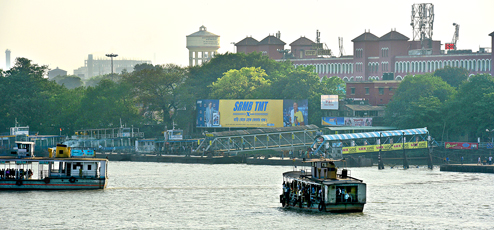
Below the bustle of a weekday afternoon at the Howrah station jetty, the East-West Metro quietly burrowed its way into the Hooghly in a historic push for India’s first mass transit network with a river tunnel.
By Wednesday night, 500-odd engineers and workers were readying the special reinforced concrete segments needed for the tunnel-boring machine to go through the riverbed to reach Calcutta.
The 1,100-metre journey till the riverbank had started at Howrah Maidan almost a year ago, passing the country’s busiest railway station along the way.
The flurry of activity throughout the day was happening 34 metres below the post office on the Hooghly riverbank, unbeknown to the thousands of busy feet making their way to and from the jetty. The post office is the point where the tunnel meets the slush under the river, according to an Afcons engineer.
In contrast to the cacophony overground, the only noise in the construction hub almost nine storeys below was the hum of the tunnel-boring machine and the chatter of the workmen. Technicians were seen running last-minute checks on the boring machine. Workers in yellow helmets, boots and fluorescent jackets flitted in and out of the tunnel.
For them, it may have been just another day in the office. For Calcutta, it was a massive moment. Metro was there.


What lies beneath ⇒


The segments are marked “R” and arrived on Wednesday.
From afternoon, these segments were carried down with help of cranes and carried on a train to
the tunnel-boring machine and fitted on the walls. The diameters are same as normal diaphragm walls of the tunnel, 5.5m. But officials said these segments contained more steel to take
the pressure of water.