|
|

Prasanta Kumar Ghosh,
Barasat
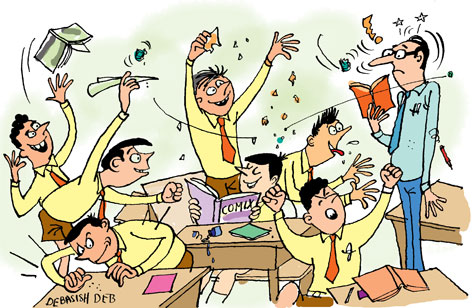
Teaching isn’t everyone’s cup of tea. A sense of humour coupled with a grasp of child psychology, clear knowledge of the subject and attractive presentation are the requisites of a good teacher. Now a days classes have too many students and it is not possible to catch their attention with a public address system. Students are not basically unruly. They are sensitive human beings who should not be laughed at, but laughed with. Once Charles Lamb was speaking in a public hall. Some people were making a hissing sound. He did not fly into a rage. Instead, he calmly said: “Snakes and idiots make hissing sounds. I don’t think that snakes are around; would the idiots kindly stand up and expose themselves?” The noise stopped and he carried on with his speech.
Arnab Mondal,
Garia
A ‘yes’ or ‘no’ sounds hypothetical. It depends on the teacher-student relationship and the standard of the school. Also, we should not forget that a class consists of both good and naughty students. Indisciplined behaviour and homework problems have been regular habits of students for generations. Making them realise their fault through counselling should be preferred to rebuking them. Lastly, teachers are not flawless either.
Atif Ayaz,
Serampore
Teaching is a noble profession and a teacher must be aware of his responsibilities and ways of handling students. He/she has every right to reprimand students but must not publicly humiliate them. This can even provoke the student into taking his or her life.
Monoj Kumar Biswas,
Bagnan
Arguably a teacher can manage a class without reprimanding students. The question obviously doubts the abilities of the teachers. Today’s education system demands more humane treatment of students; and the teacher, being the most important part of the process, should take the initiative in this regard. He or she must think beyond the traditional ways of teaching and create class lessons in keeping with the times to interest adolescent learners. Several scientific approaches have been validated through research. But how much does an aspiring teacher get to know of such methods in a Bachelor of Education course that lasts barely 10 months? If the need of the hour is managing a class without rebuking students, teachers must first educate themselves.
Kanta Chandra,
Address not mentioned
It is not difficult to manage a class without reprimanding students. In my 35 years of teaching at home and abroad I did not need to scold students. If there was a problem I would have a one-to-one talk with the student after class and try to sort things out with a patient hearing and right advice. It always worked. Teachers must be genuinely interested and sincere so that students trust them.
P.B. Saha,
Salt Lake
Teaching goes beyond the job of just helping students cram up lessons and score good marks. Those who continue with archaic methods of handling disobedient students do more harm than good. Unfortunately, corporal punishment appears to have become an obsession with a section of teachers dedicated to disciplining students. Love and affection can inculcate discipline too. Scolding and punishing for a petty offence is likely to prove counterproductive.
A.S. Mehta
New Alipore
The question of whether a student should be reprimanded or not has become extremely complex as there are instances of students committing suicide after being reprimanded either by a teacher or by parents. Teachers have to keep in mind the stiff competition faced by children everywhere and the pressure from parents to perform.
Madhabi Banerjee,
Madhyamgram
Teachers should manage a class without reprimanding the students. My daughter is in Class III and she loves the teachers who are more friendly with her. They can share their problems with teachers. They find studies more interesting with friendly teachers. But children are afraid to approach a teacher who always scolds.
Saptarshi Mandal,
Howrah
Teachers can teach students without reprimanding them. Some teachers however feel that if a student is being mischievous he should get the proper treatment (caning or the like). This is the scenario in many schools, but not in colleges and universities. Teachers are much more friendly with the students there. If a pupil gets a teacher’s affection he tries to work hard on his subject.
Ranajit Mukherjee,
Park Circus
A teacher’s psychological set-up and personality are crucial factors in class management. A stern gaze or a comment by teachers scares students and often make them analyse their own behaviour. It is a teacher’s duty to imbibe in students the will to work till they reach their goal.
Nabanita Das,
Kankurgachhi
A teacher’s influence is immense in a student’s life.When a student is rebuked by his teacher continuously, a communication gap develops between them. The student feels scared to approach him. So I feel a teacher should manage his class without reprimanding students. If a teacher is incapable of managing a class without rebuking, it only reveals his inefficiency.
Ranajit Chatterjee,
Parnasree
The question should be why and to what extent a teacher should reprimand a student to manage a class, rather than yes or no. Mostly it is the teacher’s attitude, her training, skill, knowledge and experience in managing a class that ensures discipline, as is evident from the fact that the same student behaves differently with different teachers. My granddaughter was admitted to a school in LKG. I used to drop her off and her class teacher would receive her affectionately. She said the child was sweet and obedient. Later, she started going by school bus. After three months she refused to go to school claiming that her new classteacher would beat her up. When I met the teacher, she told me: “I don’t know how to make her do what I say because we are not allowed to touch students”. What I did not tell her was that she might not have thrashed the child to her heart’s content but had done enough to scare her of school.