 |
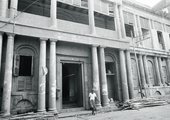
| Metropolitan Institution on Prasanna Coomar Tagore Street. A Telegraph picture |
The Burrabazar branch of Metropolitan Institution on Prasanna Coomar Tagore Street in Pathuriaghat has a colonnaded façade like hundreds of other old buildings in north Calcutta. The studded doors gates are immense and lead to a moderate sized courtyard with a bust of Iswarchandra Vidyasagar, who had opened this school, on its right side. A small door leads to another empty plot, that was once a garden. Women in saris and nighties cook lunch on kerosene stoves in the passage connecting the courtyard and the barren plot.
The house is a picture of neglect, and classes are held in large rooms on the first and ground floors. Fanlights adorn the doors of some of the first floor rooms. Facing the Vidyasagar bust is a thakurdalan whose ornamentation is quite unique — arches like the trunks of elephants and pillars, all carved out of deep red stone. It is quite obvious that this was not originally constructed for educational purposes, and that it was a dwelling house. Rising behind the building housing the school are the walls of another mansion, which is Prasad, the palace constructed by Raja Jatindramohan Tagore.
Till 1954, the building that houses the school belonged to the Tagores. Kalyanaksha Bandyopadhyay, who is in his early 70s now, is one of the two living members of the family who was born in this building. Now he lives in the neighbouring Prasad, but with his prodigious memory, he has vivid memories of the days when the Metropolitan Institution building was known as Rama Niketan.
Darpanarayan Tagore died in 1793, and after a few years in 1804, his son Gopimohan constructed four houses on a square plot of land, close to the family seat at 2 Raghunandan Lane (named after the eponymous Tagore), and what is now known as 36 Darpanarayan Tagore Street. The current addresses are 65 and 66 Pathuriaghat Street and 9 and 10 Prasanna Coomar Tagore Street. The first of these was the residence and the last served as his office in daytime, and as a venue for musical soirees in the evening. He was a patron of many great musicians of those days. Gopimohan was the first public figure among Tagores — he was one of the founders of Hindu College, and is said to be the first person to pose for a self-portrait. Superstitious Indians used to fear that they would die if their likenesses were created.
Gopimohan’s youngest son, Prosanna Coomar, was a lawyer by profession, and was one of the first Indian members of the Viceroy’s Supreme Council, the other being Radhakanta Deb. Prosanna Coomar had founded the first Hindu theatre at Sunro in Beleghata. After five or six years of Gopimohan’s demise, Prosanna Coomar moved to 10 Prosanna Coomar Tagore Street, now known as Metropolitan Institution. During Prosanna Coomar’s lifetime, litterateur Iswarchandra Gupta, who was editor of Sambad Prabhakar. A few days before his death, Prosanna Coomar had shifted to 26 Prosanna Coomar Tagore Street, which subsequently became Tagore Castle.
Prosanna Coomar had taken along with him his three grandsons, all three of whose names were synonyms of serpents. They were Nagendra Bhushan Mukhopadhyay, who had established Minerva theatre on Beadon Street, Bhujagendra Bhushan Chattopadhyay, whose eldest daughter married Abanindranath, and Seshendra Bhushan Chattopadhyay, whose daughter Pratima Debi was Rabindranath’s daughter-in-law.
Bhujagendra had no male issue and after his death the remaining two sold 10 Prosanna Coomar Tagore Street to their maternal uncle, Jatindra Mohan Tagore. His son, Pradyot Kumar, was one of the founders of the Academy of Fine Arts, and was in his own rights a pioneering photographer.
Jatindramohan bequeathed Rama Niketan or 10 Prosanna Coomar Tagore Street to his daughter Chaturbarga Pradayani Mukherjee, whose pet name was Manoroma Debi. Her husband Pundarikaksha Mukherjee, treasurer, Calcutta Corporation, had renovated and redesigned the building and named it Rama Niketan. He brought stone from Rajasthan and created the current thakurdalan. He also introduced skylights along the staircase. Manoroma moved to this house along with her family. Manoroma Debi was great grandmother of Kalyanaksha Bandyopadhyay. His father, Karanjaksha, had sold the house to Metropolitan Institution in 1954. In 1956, they shifted to Prasad. Next week, the current owner of Prasad will talk about his impressions of this sprawling building which has 278 rooms.