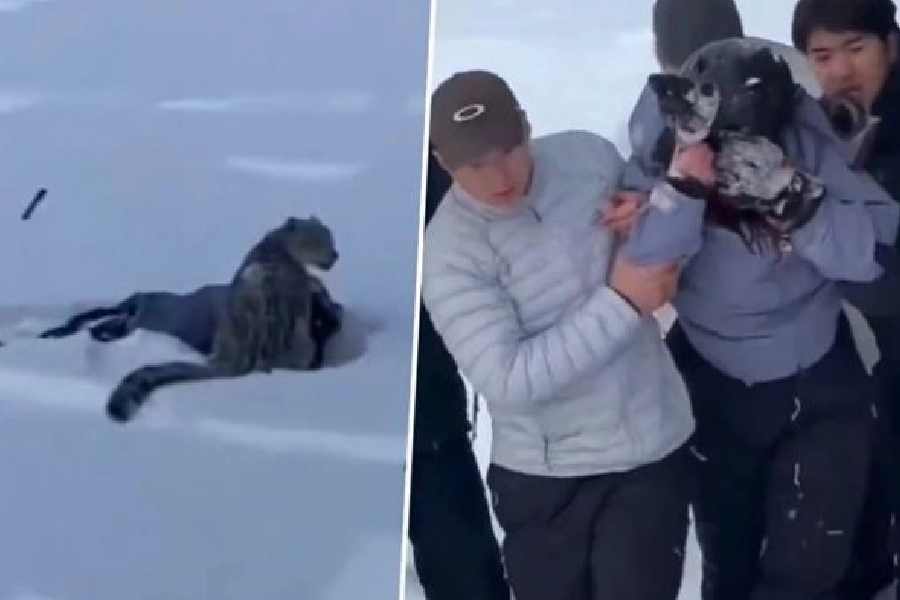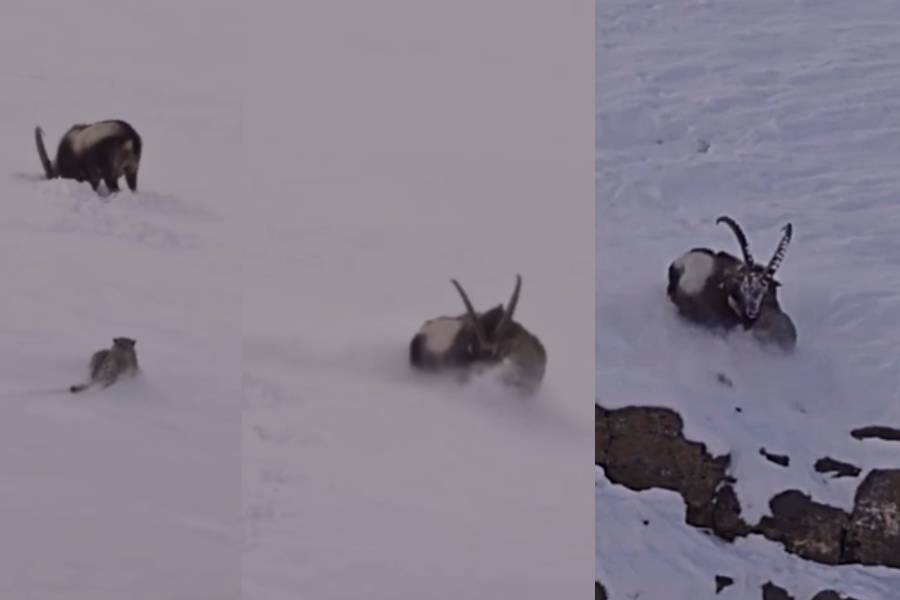
A wildlife photographer’s Instagram post has left social media awestruck after capturing something people rarely get to see so clearly. A snow leopard attempting to bring down a full-grown male ibex in the icy wilderness of Himachal Pradesh’s Kibber region.
The video was shared by Guatemalan photographer and wildlife enthusiast Andres Novales, who called it “the best wildlife moment of my life.”
The sighting came on the final afternoon of his trip to Kibber, after the group had been confined indoors for two days as a fierce snowstorm battered the region.
“Not long after, we saw her again. The same female snow leopard we had watched a few days earlier,” Novales wrote.
He explained that the leopard had left her two cubs at the bottom of a gorge before climbing alone to the top of a slope where a group of ibex were grazing.
Such scenes are exceptionally rare.
Snow leopards are notoriously difficult to observe in the wild, and actual hunts, especially those involving large prey, are not documented in real time as much. They are practically elusive and so much so that they are called ‘ghosts of the mountain’.
What followed was a textbook example of the species’ hunting style.
“Watching her move through the snow was unreal. Slow. Silent. Completely focused,” Novales recalled.
After carefully closing the distance, the leopard launched herself at the largest male ibex in the group.
“She went straight for the biggest male. At first, it looked like she might bring him down quickly. But the ibex fought back,” Novales wrote.
The video captures the struggle in striking detail. The snow leopard clings to the ibex’s back as it bolts across the icy incline. As Novales described it, the ibex “broke into a full sprint, running straight toward the cliff, with the leopard still attached to his back.” The pair slipped repeatedly, crashing into rocks and snow, tumbling down the slope.
Finally, the snow leopard lost her grip.
“That split second allowed the ibex to change direction and escape.” The leopard gave chase briefly, then stopped. The hunt was over.
“We stood there shaking, trying to process what we had just witnessed.” Novales wrote.
Snow leopards hunt like no other big cats, and decades of research explain why a predator weighing roughly 35 to 55 kilograms would repeatedly target prey that can exceed 100 kilograms.
According to studies by the Snow Leopard Trust, the ideal meal for a snow leopard is the ibex, specifically, fully grown males in the prime of their lives.
This preference is unusual among large cats, which generally hunt prey smaller than or similar in size to themselves. Snow leopards, however, show minimal sexual dimorphism, meaning males and females are nearly the same size, and both regularly take on much larger animals.
Research shows that snow leopards select large male ibex more often than females, despite female ibex being closer to them in size. Younger males and yearlings are also hunted at lower rates than their numbers would suggest.
Snow leopards adjust their hunting strategies to seasonal vulnerability in ibex populations.
“Young ibex kids haven’t yet developed the agility and speed needed to escape, while adult females lose much of their agility in late pregnancy, making them both easier targets,” says Dr. Örjan Johansson, senior scientist at Snow Leopard Trust and associate professor at the Swedish University of Agricultural Sciences and lead author of the paper.
Ironically, the very traits that help male ibex dominate breeding, large bodies and massive horns that continue growing with age, can become liabilities in steep, broken terrain.
While those horns offer advantages in competition, they do little when an ambush unfolds on a snowy mountainside.
Heavier bodies and reduced agility can make prime-aged males more vulnerable in the crags and cliffs where snow leopards hunt.
A BBC Wildlife report last year echoed these findings, citing GPS tracking data and 12 years of research from Mongolia’s Tost Mountains.
The study found that male and female snow leopards deliberately select prime-aged ibex males, despite them being at least twice their body mass, because they are, paradoxically, easier to kill in extreme terrain.
The Kibber video, then, is more than a spectacle. It is a rare window into a predator-prey dynamic shaped by anatomy and is not accidental at all.