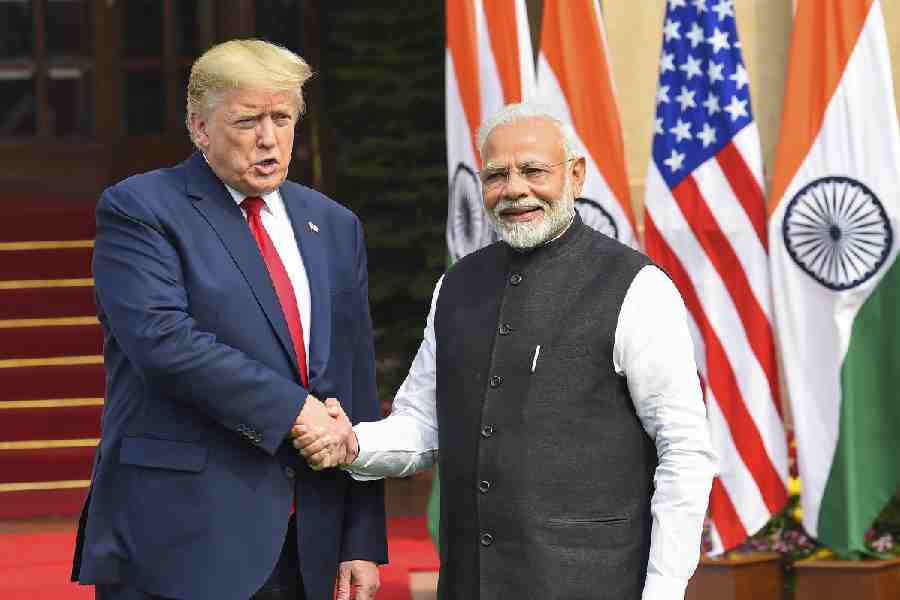
Delhi and Washington both claimed their interests were served in the framework announced on Saturday on the trade deal under which the US will lower tariffs on Indian goods to 18 per cent from the earlier 50 per cent and India will eliminate or reduce duties on selected American food and agricultural products.
US President Donald Trump’s “dealmaking is unlocking one of the largest economies in the world for American workers and producers, lowering tariffs for all US industrial goods and a wide array of agricultural products,” US trade representative Jamieson Greer said in a statement.
“Today’s announcement demonstrates the deepening ties between the United States and India as we create new opportunities for farmers and entrepreneurs in both countries. I thank Indian minister of commerce and industry [Piyush] Goyal for his leadership and commitment to achieve fair and balanced trade with the United States,” he added.
In a social media post, Greer’s office said: “From tree nuts and dried distillers' grains to red sorghum and fresh and processed fruit, the US-India agreement will provide new market access for American products.”
On the Indian side, the government said no duty concessions would be offered to the US on a range of “sensitive” agricultural and dairy products, citing the livelihoods of small and marginal farmers.
Staples and core farm sectors remain outside the scope of concessions, Goyal said in a social media post.
“The agreement reflects India's commitment to safeguarding farmers' interests and sustaining rural livelihoods by completely protecting sensitive agricultural and dairy products, including maize, wheat, rice, soya, poultry, milk, cheese, ethanol (fuel), tobacco, certain vegetables and meat,” Goyal said.
These products are considered sensitive because they directly affect the income of small and marginal farmers, who form the bulk of India’s agricultural workforce.
“The interests of farmers remain paramount in all trade negotiations,” Goyal said, adding that the Modi government remains fully committed to protecting farmers and securing rural livelihoods.
“No concessions have been extended to sensitive agricultural sector produce in grains, fruits, vegetables, spices, oilseeds, dairy, poultry, and meat amongst many others while securing preferential access for Indian goods through the India-US Interim Agreement framework,” he said.
Delhi has not offered duty concessions on sensitive agricultural and dairy products in recent free trade agreements with the European Union, the UK and Australia.
Trade agreements typically involve a mix of immediate tariff eliminations, phased reductions over time, partial duty cuts or quota-based concessions. India has kept sectors such as dairy, rice, wheat, meat, poultry, cereals, genetically modified foods, soymeal and maize outside the ambit of these pacts, according to a PTI report.
Agriculture and allied activities, including animal husbandry, employ over 700 million people in India.
The US exported agricultural goods worth $1.6 billion to India in 2024. Major items included almonds in shell worth $868 million, pistachios worth $121 million, apples worth $21 million and ethanol (ethyl alcohol) worth $266 million.
India’s agricultural exports rose to over $51 billion in FY 2025 from $45.7 billion in 2023–24. Exports to the US accounted for around $5 billion. India’s total exports in FY25 stood at $437 billion.
The government has set a target of reaching $100 billion in combined exports of agriculture, marine products, and food and beverages over the next four years. Key export items include tea, coffee, rice, cereals, spices, cashew, oil meals, oil seeds, fruits and vegetables.
As per the joint statement issued by India and the US, New Delhi will eliminate or reduce tariffs on several American food and agricultural products.
These include dried distillers' grains, red sorghum for animal feed, tree nuts, fresh and processed fruit, soybean oil, wine and spirits, along with additional products.
The Opposition accused Prime Minister Narendra Modi’s government of selling out India’s interests.
“The US will now monitor whether India is importing oil from Russia or not. If the US decides India has imported Russian oil directly or indirectly the extra 25% tariff penalty is back. This is truly extraordinary. And the Modi govt has accepted it!! Naam Narender, Kaam Surrender,” wrote Congress leader Jairam Ramesh on social media, attaching a link to the White House statement.
The full text of the White House order is here
"This is only a joint statement, still a statement of intent,” Ramesh told PTI VIdeos.
“The details have not been announced, they will be announced, I suppose, in the next few months. From the joint statement that has been issued, five things are very clear. We will eliminate or reduce import duties on farm products from the US, it's a clear benefit for US farmers, not Indian farmers.
“Second, what is absolutely clear is that we are going to stop importing Russian oil and separately, the US government has announced that even if we import oil from Russia directly or indirectly, we will still be subject to the 25 per cent penalty tariff.”
He added: “For all the 'huglomacy' that Modi has indulged in, all the photo-ops he got with President Trump, the trade deal is frankly not something that we can say our interests have been furthered. We will import more from America, that's 100 per cent certain."