
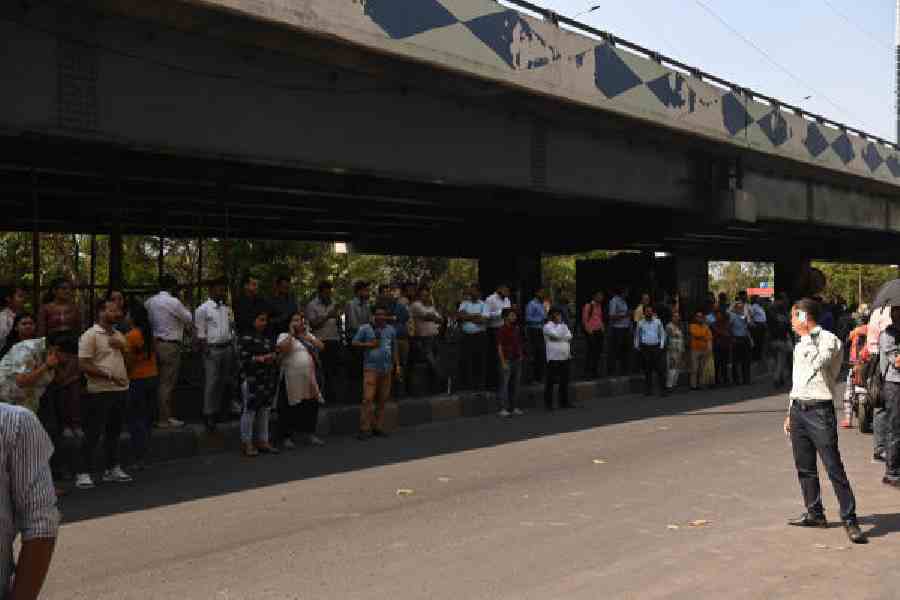
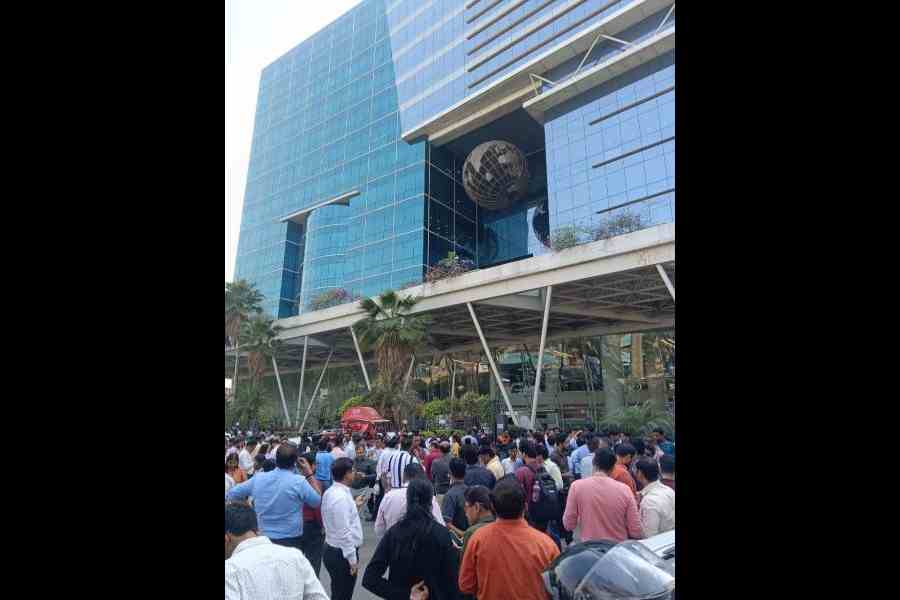
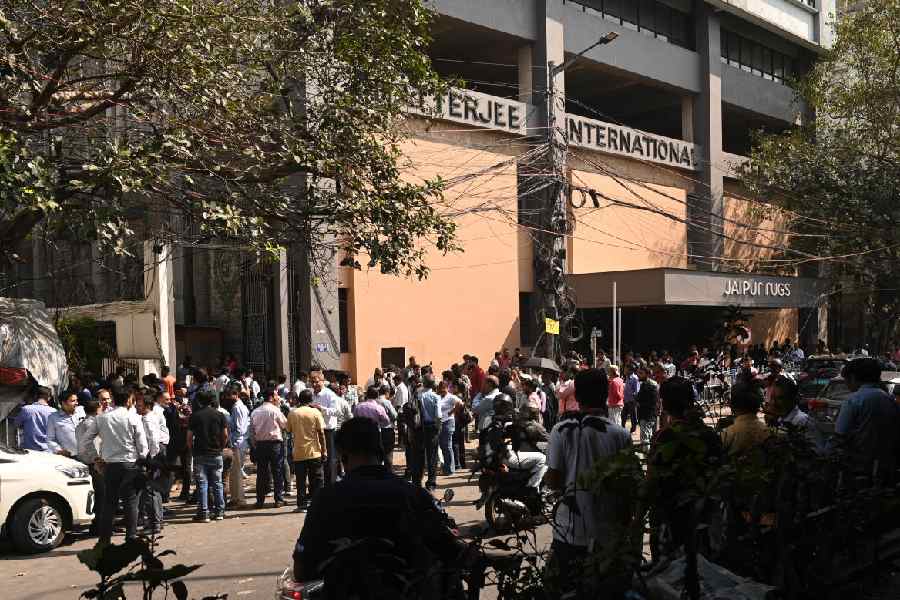
A moderate earthquake measuring 5.5 on the Richter scale sent shockwaves across several districts of south Bengal, including Calcutta, on Friday afternoon, triggering widespread panic as residents rushed out of homes and offices fearing aftershocks.
According to the National Centre for Seismology, the tremor struck around 1.22pm at a shallow depth of nearly 9.8km, making the impact more perceptible across the Gangetic plains.
The tremor was strongly felt in North 24-Parganas, South 24-Parganas, Nadia, Howrah, Hooghly, East Midnapore, West Midnapore, Jhargram and Murshidabad. Residents described swaying ceiling fans, trembling furniture and mild structural vibrations that lasted nearly 10 seconds — an unusually long duration for a moderate seismic event.
Although no major damage was reported, incidents of structural cracks were reported from parts of the Basirhat subdivision in North 24-Parganas, which is close to the suspected epicentre at Satkhira in Khulna division of Bangladesh, roughly 125km from the city and around 60km from Taki near Basirhat in North 24-Parganas.
At places like Taki town and in Minakha and Hingalganj blocks, several buildings reportedly developed cracks, while some under-construction structures partially collapsed.
Eyewitness accounts poured in from affected pockets.
Bapi Sardar, a resident of Hingalganj, recounted the panic.
“I was on the road when vehicles parked beside it began shaking horribly. Two-wheelers fell to the ground. People started crying in panic as they rushed out. Some were offering afternoon prayers at a nearby mosque and came out immediately, alerting others,” said Sardar
Local sources claimed that several buildings in Sakchura suffered damage, prompting authorities to declare recess in some primary schools after cracks appeared in the structures.
Students of Bankra-Dobor Primary School in Hingalganj ran outdoors in panic as the tremor was felt.
In Minakha, the wall of a residential house developed visible fissures.
The tremor was also felt in Midnapore town, where staff of the district magistrate’s office stepped outside as a precaution. Similar scenes unfolded in Jhargram, Howrah and Hooghly, where residents left buildings fearing further jolts. In the Canning subdivision of South 24-Parganas and parts of Sunderbans, schoolchildren and government staff evacuated buildings and gathered in open areas.
Seismologists note that eastern India periodically experiences tremors originating from seismic activity in neighbouring regions such as Myanmar, Bangladesh and the Bay of Bengal, which can transmit noticeable shaking across the plains.
The latest event follows a series of minor quakes reported across the eastern Himalayan region in recent days. Earlier on Friday morning, a mild tremor of magnitude 2.5 was recorded in Darjeeling.
On Thursday, quakes measuring 3.9 and 3.7 struck the Mangan region of Sikkim around 4am, with mild vibrations felt across parts of north Bengal. Reports indicate that as many as 16 tremors occurred in Sikkim in a single day, raising concerns among residents.
According to the Sikkim State Disaster Management Authority (SSDMA), 57 earthquakes have been recorded across the Sikkim–Nepal–Bhutan–Tibet region since February 9, with 41 originating in Sikkim.
An SSDMA source said: “Seismic activity is common in the Himalayan belt. The strongest tremor recorded in the state during this period measured 4.6 magnitude in Gyalshing on Thursday. While minor tremors have been felt across Sikkim, such occurrences are generally not a cause for major concern.”
Many of these Himalayan tremors were also felt in sub-Himalayan Bengal, including Siliguri and Darjeeling.
Emphasising preparedness, an SSDMA official said that schools have been sensitised on earthquake safety in coordination with the state education department. “Mock drills are being conducted regularly, disaster management clubs are being formed in schools under teacher nodal officers, and school safety handbooks have been distributed,” the official added.
Additional reporting by Siliguri bureau