 |
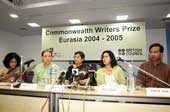
| The shortlist being announced at British Council on Wednesday. Picture by Aranya Sen |
The Commonwealth Writers Prize (Eurasia region) is being held in Calcutta for the first time. The shortlisted titles were announced on Wednesday.
The award, given to the best book as well as the best first book, covers in its Eurasian leg India, the United Kingdom, Bangladesh, Cyprus, Maldives, Malta, Pakistan and Sri Lanka.
In the best book category, Gita Hariharan’s In Times of Siege and Uzma Aslam Khan’s Trespassing were selected from the Indian entries, by the panel chaired by Sanjukta Dasgupta, Calcutta University professor, and including Maya Jaggi, UK-based journalist and critic, and Fakrul Alam, Dhaka University professor.
The others that made it to the list are The Voices, by Susan Elderkin, Judge Savage by Tim Parks, Caryl Philips’ A Distant Shore and Adam Thorpe’s No Telling.
In the ‘best first book’ category, the judges selected Monica Ali’s Brick Lane, The Calligrapher by Edward Docx, The Curious Incident of the Dog in the Night Time by Mark Haddon, How the Light Gets In by M.J. Hyland, Talitha Stevenson’s An Empty Room and D.B.C. Pierre’s Booker Prize-winning debut novel, Vernon God Little.
A record number of entries — a total of 103 — were received from the region, 15 per cent of which were from India. The final verdict will be announced on Friday, at the Bengal Club, where the judges and Amit Chaudhuri, who won the prize for his debut work A Strange and Sublime Address, will participate in a discussion on ‘Translating Culture: Relevance and Responsibilities on Contemporary Commonwealth Literature’. Boyd Tonkin, a member of the Commonwealth Prize advisory committee, who has been a judge for the Booker Prize, will also attend.
The winners in the two categories will then be pitted against those from the other three regions — Africa, Caribbean and Canada, South East Asia and South Pacific — in the finals to be held in Melbourne this May.
The elimination thus far was “very challenging” according to Dasgupta, who will serve as chairperson for next year’s award as well. Reading over 100 titles in a few weeks was “taxing and difficult”, felt Jaggi, as “writers fit uneasily into national boundaries”. Though there are no real parameters for selection, Jaggi says that one “instinctively looks for originality” and a work that appeals to both “heart and mind”.