 |
Urban balconies for greater access, low-level bridges for better connectivity, open-air theatre, food courts and waterside cafes? Talk to the river, don?t turn your back on it.
The first integrated riverfront development initiative, involving all the stakeholders and kicked off late last year by the Buddhadeb Bhattacharjee regime, has picked up wind on its sail, with the salient features for Action Area I ? the stretch between the two towering bridges ? drawn up.
?We have studied the development of six major cities ? Marseilles, Shanghai, London, Paris, Osaka and Birmingham ? where a river runs through, and is well-stitched with the urban fabric,? city-based architect-planner Partha Ranjan Das told Metro.
Das, appointed by Writers? Buildings to coordinate among the various stakeholders, will do a ?dress-rehearsal? presentation before the urban development department, the CMDA and the civic bodies of Calcutta and Howrah on Wednesday. The presentation, highlighting core issues, will precede a trimmer exposition before the chief minister.
Using relevant observations from the riverbank growth of the metro sextet as reference points, the planners have identified the major roadblocks, which impede dialogue with the river, suggesting possible remedial measures.
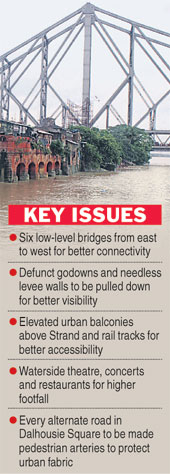
Connection is the key, feels Das, who has prescribed six low-level bridges from the east bank to the west as extensions of major roads on both sides. To improve visibility, it has been proposed that defunct godowns and needless levee walls be pulled down and Foreshore Road brought closer to the river wherever possible.
?Accessibility is another major problem, more so on the Calcutta side because of the heavy traffic on Strand Road and the Circular Railway fencing. Pedestrians find it extremely difficult to cross the chaos corridor and reach the river,? observes Das, anchoring the riverside reconnoitre with technical inputs from Charles Correa.
Das has recommended a number of elevated urban balconies above the Strand and the rail tracks connecting the eastern pavements with the riverfront to augment ingress.
A wide array of activities, like waterside concerts and open-air theatre, restaurants and museums in the refurbished warehouses, has been suggested to draw footfall.
A proposal to curb the various ?incompatible usage? of the river has also been mooted. For instance, there is a move to provide an alternative temporary base for the Sagar pilgrims further south.
To protect the crumbling urban fabric of the central business district, the planners are keen to address the dense vehicular traffic in the zone.
Accordingly, the possibility of converting every alternate road in Dalhousie Square leading to the river into pedestrian-only arteries is being explored. There was also near-unanimity on the need for an iconic structure by the river.