 |
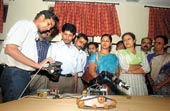
| The robot demonstration at Nehru Children’s Museum. Picture by Aranya Sen |
Think robot and the closest your experience goes is a Sunday siesta with Isaac Asimov. And after this Friday, possibly a three-hour date with Will Smith and Sonny at a cinema. Now, students have a chance to create their own Sonny, or at least a part of it.
On Thursday, a Delhi-based IT education company came to town with a roadshow on robotic education. The firm has devised a three-year graded curriculum for schools which will teach students the fundamentals of programming, designing and building of robots.
On the screen at the Nehru Children’s Museum auditorium flashed the following lines:
IF (INIS=1) AND (IN14=1) THEN
PULSOUT 12, 850 ’MOVE RIGHT PIN 15
PULSOUT 13, 650 ’MOVE LEFT PIN 14
On the table, a wheeled Boe-Bot robot rolled and stopped and turned at right angles in response to the commands as teachers from city schools watched in admiration. And soon, a robotic arm was bending to grip a box, pour out its contents and set it back in place. “Students will be taught to do all this and more,” declared Vijay B. Aggarwal, CEO and director, Pitambar Infovision.
The robotics programme is meant for students of Class VI and above. A school will be required to set up a laboratory with Pentium computers and Internet access. A special table will be supplied on which a maze can be formed with building blocks. Students will be taught to programme a robot to negotiate the maze. At the end of each year, they will have to take an examination.
“It is a great thrill for students to see the impact for their programming in execution. This is new to them, as the Indian educational system follows a theoretical approach,” said the former head of the University of Delhi’s computer science department.
Robotics has been gaining in popularity in the West “over the past 10 years”. “A competition in Atlanta this April drew 7,000 students,” he recalled.
Aggarwal believes that Indian students have a high IQ but it is lack of exposure to technical knowhow that has kept such advances out of the classroom here.
That is changing in other parts of the country, though. A school in Lucknow has started an international contest, while a recent pilot tournament in Bangalore by the world-famous Honeywell Labs had the 80 young participants drawing praise from Fred Rose, a robotics expert. Many public schools in Delhi have already signed up with Pitambar Infovision.
The teachers were enthusiastic in their response. “If the focus is on application, then the students should not have difficulty in comprehension,” felt Debashish Roy, who teaches physics at La Martiniere School for Boys.