
Picture by Anup Bhattacharya
Tapan Kumar Sen’s house in Birshibpur is a collector’s haven. A sandstone sculpture from Odisha has found place at the entrance to his home. A divan in the living room is decorated with wooden owls from Burdwan’s Natungram. The walls have masks from the Andaman and Nicobar Islands and small dolls of tribals made from wood and shells. Clay dolls from Howrah, Midnapore and Birbhum have also been used to decorate the room. “The tepaputul or rani putul, is typically made in Howrah,” said Sen. A Petromax, that was earlier used for lights in jatra programmes, hangs from the ceiling of his living room. “I got this one from a jatra group that was selling these. With electricity everywhere these days, they don’t need these lights anymore,” said Sen.
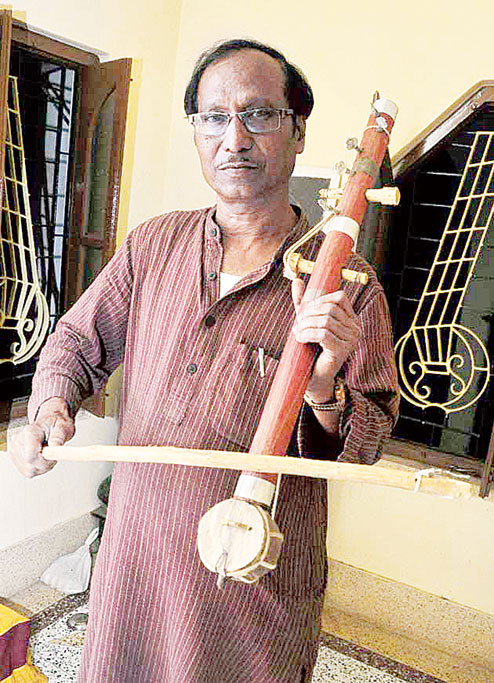
Folk culture, including art and music, are the things that interest Tapan Kumar Sen the most. His music room has a collection of dhols, flutes and string instruments that he has collected from various parts of the state and country. A snake charmer’s flute (been) is also among his collection as are ektaras, dotaras and a sarangi used by folk singers in Rajasthan. “My house is a common meeting place for most folk artistes. Baul groups or other folk artistes who pass this way must come to my place and sometimes we have musical evenings in this room,” said Sen, posing with a flute, ready to play a tune from a Rabindrasangeet.
Among the many folk dance forms that are prevalent in the districts, Howrah’s own is the kalikapatari. “In recent years, this dance form has got recognition from the government and the two main groups practising the art are getting programmes. However, there are other folk music and dance forms like Bhaiya which is also called Chaiti Baul and tarja which are still neglected. One or two groups in the rural belt practise these forms, the rest have taken up other professions,” said Sen. While travelling through the districts, Sen has also collected folk songs from different groups.
Sen has been involved in his folk culture research for many years now, ever since he was a boy. His initial inspiration was his maternal uncle, Shaktipada Basu, who was the curator of the archaeology department of the Indian Museum. “I would watch him work with old things, ancient artefacts and that made me curious,” said Sen.
Sen started his research on folk culture in his own district, Howrah. He has travelled the length and breadth of the district where he has studied the temples, festivals and the rituals. He had also worked for some days with Tarapada Santra, often taking his guidance. “There isn’t a place in Howrah district where I haven’t gone. I have covered all the temples in the rural belt, including the lesser known ones situated in remote villages,” said Sen. I have travelled to see various kinds of rituals and religious practices during festivals. Charak is one such festival that I have seen very closely. People pierce their tongues and bodies with rods in villages where this festival is observed in a big way,” said Sen.
Sen has written a few books with whatever he has learnt and seen. They are Howrah Jelar Mandir, Puja, Utsav, Mela and Banglar Nandanik Lokshilpa. Other than that, Sen is editor of a little magazine, Gramin Puthi, which also focuses on folk culture. “The magazine was earlier a monthly edition, now it is published annually, during Durga Puja. It is difficult to get articles for the magazine as people take less interest in these things and have lesser time to write,” said Sen.
He is also a lyricist and has written and composed some folk songs, which are still sung by artistes. “I am a registered lyricist for All India Radio and have written many songs for the channel,” said Sen. Some of his popular songs are Sakh kore gerosto keno beral pushli, Mone boro dilo betha bou eshe.
MORE ABOUT TAPAN
- DoB: January 9, 1953
- Born in: Howrah
- Education: MA
- Family: Mother, wife, son
- Loves: Travelling, music
- Hates: Deceit
Dalia Mukherjee