 |
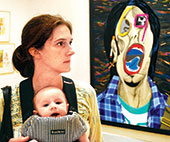
| A visitor before a work at Extend Beyond at Studio21 |
A group show of five artists inaugurated at Studio21 on Friday offers a collage of moods and expressions that are essentially urbane.
The term collage comes to mind since the works on display at Extend Beyond, on till October 12, utilise extensive fragmentation — offering disjointed narratives, reflective of these times, as it were.
Ashis Chakraborty worked as a news and lifestyle photographer for city publications till he moved to Baroda and took the plunge as a full-time artist. His acrylic-on-paper works tweak everyday images with a hint of satire.
In his Bachelor Bed series, Ashis creates a neo-realist ambience that brings in everyday objects like a cycle pump, a sneaker afloat in a pink cloud of incense smoke, a telephone receiver or a nail-cutter and turns them into living, breathing and even biting creatures; objects that are a far cry from the Page 3 glitter that he was perhaps clicking every day and night.
The treatment of acrylic akin to watercolour in Ashis’s paper works leaves a lot to be desired. Interestingly, the tonal palette turns richer with its viridian when he shifts to the canvas in Stolen Kiss; its twin goats and their extended horns act as the rest for the framework of a female figure.
Santanu Mitra’s untitled watercolours dwell on violence, the idea of religion and the male gaze. His acrylic-on-canvas works offer broken images of the urban mundane; his tones shifting from muted greys and ochres to washed-down mauves.
In contrast, Sumantra Mukherjee speaks in loud colours, simultaneously embracing and laughing at present-day youth culture in his typically large works like Sinking Ship. The goatee-sporting, guitar-slinging, crucifix earring-adorned wannabe rocker with shades that spell “69” over his eyes screams out a roar of escapism from his immediate reality, only to sink deeper into that which he cannot really escape.
The brand of matchsticks underscores the sarcasm. As in this work, numerics recur in The Prayer, while the dainty punk teen girl in Delirium is perhaps a direct offshoot of Neil Gaiman’s character from his Sandman graphic novels; the reflection of a troubled and confused mind trying too hard to impress.
But Sumantra’s vision is not bitter: his 14/2 offers a Shakespearean couple in a background of a rajanigandha-decked photo studio, its kitsch enacted with the man’s tunic emblazoned with a modern-day sportswear brand’s logo and a ballpen top peeking from the pocket. The humour is not exactly subtle, but it works.
Chinmay Mukherjee lets his snails recur and roll in his acrylic-on-canvases, be it in Hay Truth or the quadtych Four Windows, the latter a Warholesque photomontage with luscious lips of glamour as a counterpoint to the innocence of a child’s sling.
It’s a multi-layered world, where the snail perhaps signifies ennui. Chinmoy’s mixed-media works offer interesting wallpaper-like backdrops, with many-layered images offering as many possibilities of meaning in the intriguing Which Are My Lips, a study in anatomical anomaly. There’s more original thought in these smaller works than the ambitious use of Rodin’s iconic The Thinker in Above Reality.
Figures impress in Puspen Roy’s works — all acrylic-on-canvases — as do tones and thought. Stamped swans from a well-known publishing house offer that much of a twist to Black and White.
The contrast of a free-falling diver and a paratrooper is detailed in line and form and interesting in its analogy and execution, including the divided palette of orange and pool aquamarine. The photomontage element recurs in Dependence II, Surrogate or the smaller Terror In Error.