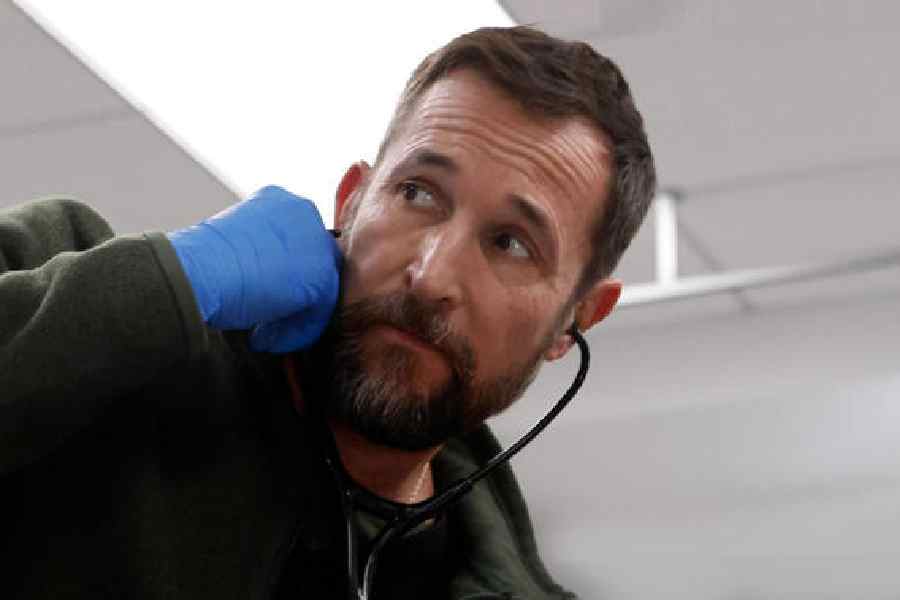
Last year’s runaway hit The Pitt turned one day in a high-strung, hyper-pressure emergency room into an epic season of TV. The show — that followed a group of emergency doctors/frontline heroes meeting challenges on a heart-pounding nano-second basis in a hospital in Pittsburgh, Pennsylvania, even as it examined the right and wrong of the American healthcare system — was powered by its sharp writing and on-spot performances from its eclectic ensemble cast, led by Noah Wyle.
Wyle, a veteran of the medical drama genre, having been a central figure in the popular series ER, returned to The Pitt as Dr. Michael “Robby” Robinavitch, also functioning as a writer and executive producer on the show. At the Emmy Awards 2025, The Pitt notched a whopping 13 nominations, earning five trophies, including the Outstanding Lead Actor honour for Wyle.
Season 2 is returning today in the same format — 15 adrenaline-pumping episodes, each for one hour of a grinding hospital shift — and will be released on an episodic basis on JioHotstar right up to April.
At a recent virtual interaction with select journalists from around the world, including t2, Noah Wyle spoke about how and why The Pitt has become an obsession and the journey from Season 1 to 2.
PRESSURE OF PART ONE
Opening to remarkable reviews and top ratings, with riveted viewers tuning in week after week to follow Doc Robby and his team of dedicated, diligent, but also vulnerable healthcare workers operate on a war footing — drug overdose to severe burn to even mass shooting — The Pitt is considered the gold standard of the medical drama genre. The second season will inevitably bring on comparisons to Season 2, which Wyle is more than aware of. “Of course, we felt it. The proverbial sophomore slump is real. And when you have something that is as impactful and as successful as our first season was, it is inevitable that you are going to be combating expectations. John (Wells, co-executive producer) alleviated us from a lot of that pressure early on by saying: “You don’t have to do it bigger, better, faster, stronger... You just have to do it again... remember what you did the first time and stay true to the characters and be honest and go from there.”
Looking back at the humongous reception to Season 1, Wyle, 54, said that the medical community giving a two-thumbs-up to The Pitt is what helped the show break through the clutter and find big favour with viewers week on week. That despite the fact that the action almost wholly takes place within the confines of the hospital — specifically the emergency room — rarely cutting out to any other plot thread or location.
“The medical community embraced it first, and embraced it loudly. Since that was the audience we were aiming at and hoping to get the stamp of approval from, that was extremely gratifying. I feel their stamp of approval gave other people the confidence to watch it and believe like this wasn’t going to be a waste of their time. And then, word began to spread from there,” said Wyle at the interaction.
Wyle’s years of experience doing ER — the NBC show, in which playing Dr John Carter earned him as many as four Screen Actors Guild Awards — was also a big help, providing a handbook to the actor when he put on his scrubs for The Pitt.
“What gratified us back in the ER days was that if we said it on television, you could believe that it was true, that if we said this was a medical fact, you could take that to your doctor and have that verified. Medical shows have played fast and loose with that over the years, and the culture has changed a lot. The relationship between patient and doctor that used to be pretty sacred has a lot in between it now — misinformation, cynicism and distrust, which makes it difficult to have an engaged conversation with your practitioner.”
It was that sense of scepticism and wariness that Team Pitt — Wyle has joined hands with his ER colleagues John Wells and R. Scott Gemmill (creator and showrunner) here — aims to combat. “On The Pitt, we try to be faithful to the medicine and the accuracy, so much so that you could take it back to your physician, open up a dialogue, and have it be a way of triangulating your own health journey through something you saw or heard on the show,” explained Wyle.
Wyle, whose turn on The Pitt has once again reinforced his image of the silent rock star of the small screen, is also aware of the fact that this is a different world from the one in which ER played out. “Back in the ER days, my mother, who was a nurse, would call me and say: ‘You never touch your face with bloody gloves! I have to go to work tomorrow, and I am going to have to answer that!’ Now, thanks to the Internet, I have about eight million mothers out there to tell me: ‘I think your stethoscope was backwards, jackass!’ laughed the man.
REWIND & FLASH FORWARD
When asked what the biggest takeaways from the first season of the show, which the crew may, or may not, have taken into Season 2, Wyle said: “The physical production bit. Once we realised that certain things were working and that was validated by the viewers, it gave us confidence to come back and put a bit more emphasis on certain things and less on others. We learned that there is a delicate balance between the cases and the characters, and that a lot of people respond to the medicine, for sure, but many viewers also responded to the internal journey of our characters.”
He added: “In Season 2, it was less about coming up with ‘sexy’ cases and more about being faithful to the interior architecture of the characters and where they were and how these cases that they are working on reflect on them. Also, I think we achieved such a high level of competence in Season 1 that before this season, we were told: ‘Things are starting to look too polished, too choreographed... You guys look too efficient, and the composition is too perfect... don’t be so good at your jobs!’
ER TO THE PITT
So how does storytelling in the medical genre now differ from that of his ER days, especially given the state (evolution or not) of healthcare all over the world? He replied: “We had a huge dry-erase board on which we wrote all the things that we never did on ER that could be talked about today. And we were amazed at how fast we filled up that board — whether it was fentanyl, trans rights, gun violence, nursing shortages or boarding crisis... it went on and on. Covid-19 was a huge impact on healthcare, and we wanted to address that and its long-term repercussions on healthcare professionals as well as the general public. I think also the amount of misinformation that is out there was something we never had to deal with before, and we have tried to address that as well.”
RETURN TO ROOTS
Season 1 of The Pitt was primarily filmed on a detailed set at Warner Bros. Studios in Burbank, California. For the second season, the cast shot on location in Pittsburgh for a large part. Did that lend more authenticity to the tone and texture of the season? The answer is a ‘yes’ and ‘no’ from Wyle. “Shooting in Pittsburgh gives us an opportunity to break the monotony of production in Los Angeles, to have everybody go away and bond as a cast on location, which is significant for us. It is a great ambassadorship to the city of Pittsburgh, which has opened its arms to us, and Allegheny General Hospital, which allowed us to shoot there. So we try to be responsible stewards of that. But essentially, this is a claustrophobic, immersive experience that keeps you in the emergency department as much as it can. Occasionally, we go up to the helicopter pad when a patient arrives. We also follow Robbie into work and follow him home, but that is pretty specific.”
Like the first season, Season 2 mandated spending time in an emergency room, something which Wyle says stood the team in good stead. But that also involved a boot camp of sorts, which, true to its definition, was a tough task. “At boot camp, we all tried to stay on our feet for 15 hours and note where we were holding tension, note which foot got tired first, when did we feel hungry, when did we feel like we had to go to the bathroom.... Those things were written in the script, and as those hours in the shift came up, we had our appropriate body language for it. So, it was a good exercise to let everybody know that this is what weighs itself physically on you as well as emotionally,” Wyle said.
He added: “The body doesn’t differentiate between the real or symbolic — so there is a lot of unwinding and un-programming, releasing and flushing that needs to happen at the end of the season for all of us involved in it. But that is sort of the masochistic aspect of what we do for a living. We invite these things, we play with these things....”
Which is your favourite medical drama series?
Tell t2@abp