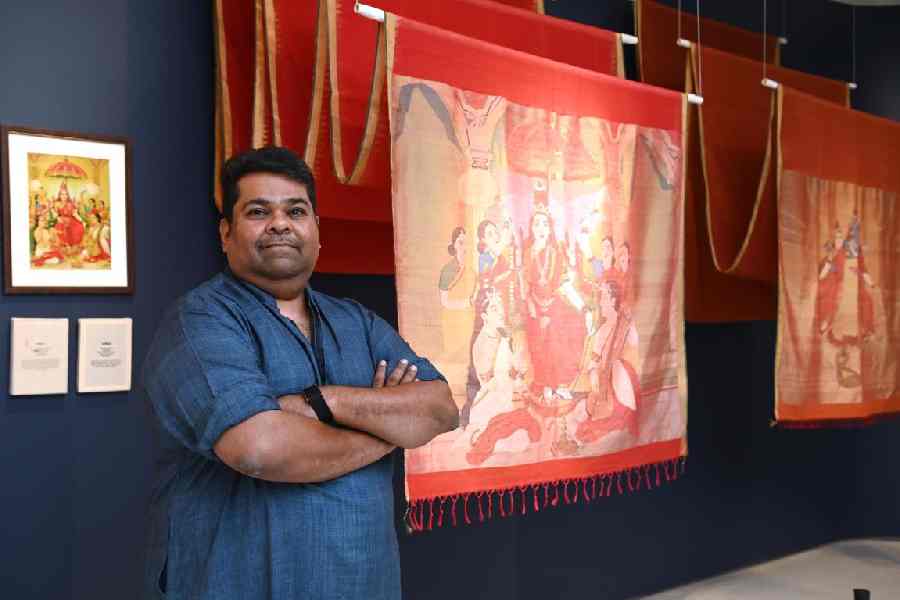
Gaurang Shah is a man with a purpose, with a strong passion driving it. No frills, no fuss, none of the paraphernalia usually associated with the fashion world. I last met the fashion designer and textile artist in 2024, when he took a select group of fashion journalists to a tour of his looms in Hyderabad and Visakhapatnam, where his passion for the weaves was palpable as he showed us around his weaving clusters. The same passion shines in his eyes when I meet him last week in Calcutta, at the TRI Art & Culture in Ballygunge, which is showcasing an art collection he has done with Raja Ravi Varma’s paintings. Titled ‘Khadi, a Canvas’, the exhibition is curated by Lavina Baldota and presented by TRI Art & Culture in association with the Abheraj Baldota Foundation and Gaurang Shah. The exhibition, featuring 19 handwoven khadi saris using the intricate jamdani hand-weave technique, is on at the gallery till April 26.
“We have worked on a project where we recreated Raja Ravi Varma’s painting in jamdani weaves. You had come to Hyderabad, Srikakulam… so those women in Srikakulam have woven these saris. So we acquired the rights to Ravi Varma’s paintings… we have the original lithographs. So you can compare it, every centimetre is an exact replica,” says Gaurang as he guides me through the exhibits — a mindblowing range of saris whose pallus feature the woven replicas of the paintings. The print of the respective painting is framed on the wall behind each of the saris, so that you can compare.
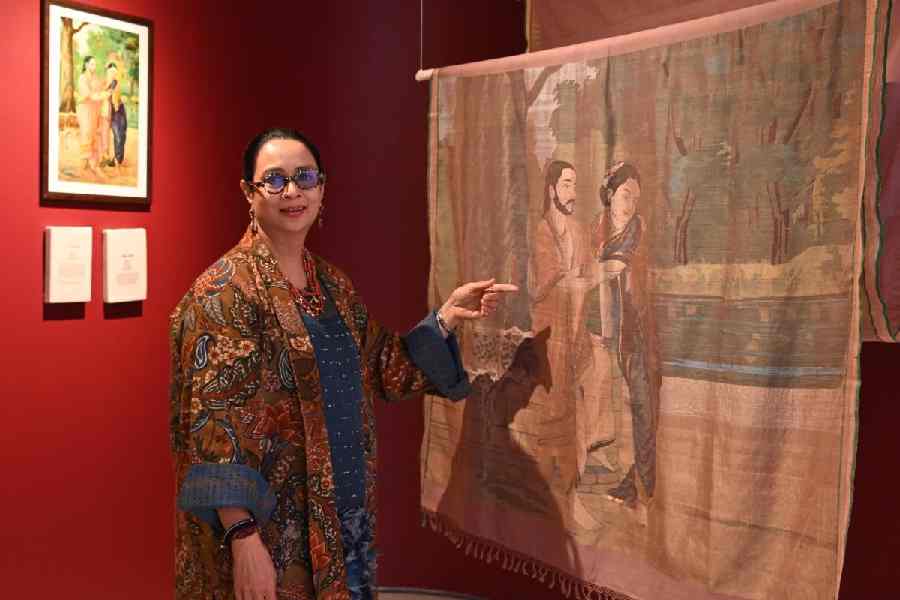
Lavina Baldota at the exhibition
“See, painting is easier because you paint it, if you don’t like it, you can change it. But whereas here, once you put the thread, it’s done. You cannot undo it,” explains Gaurang. “You see the textiles, you will get to see the facial expressions, the detailing, you see the detailing on the leaves. So these black lines you see, see how straight it is going. Look at the perfection…,” he points at a sari and shows us the minute details, with pride in his eyes.
“You saw the weaving process in Srikakulam, there’s a drawing paper underneath the bar (which has the print of the painting on it). They look at the drawing paper and they weave. That’s the same technique which we have used here. But the designs are so detailed, it’s very difficult. We have got the painting rights from the foundation and digitally we have printed them,” he explains the weaving process.
He introduces us to Lavina Baldota, who has worked with him to curate the collection. The work on the collection started in 2014, and took five years to finish and was first showcased on October 2, 2019. This is the first time the collection has travelled to a gallery in Calcutta.
On our stroll of the gallery, we stop at a wall, where Gaurang points at the palette that has been created specifically for the collection. “So for each painting, we created a shade card. And all dyes used were natural dyes. So about 600 colours we have created, 200kg of yarn. The yarn dyeing happened in Ajrakhpur (in Gujarat) by a national award-winning artist,” he adds.
A passion project for both Gaurang and Lavina, the deeper purpose behind it was democratisation of art and craft and to show to the world what India is still capable of. “So the reason we wove Raja Ravi Varma paintings in khadi was because my idea was to talk about democratisation. Like how Gandhiji with his spinning made every household a part of the freedom movement. Similarly, Raja Ravi Varma with his printing press, made art a part of every household… every household in India could have art. It was not meant for only a few privileged people. And I think he got people closer to the Gods,” says Gaurang.
He then draws my attention to the sari drapes. “Also, the iconography, the way the saris were draped. So all the drapes we see are from different regions (of India), in the paintings. And this is how the whole sari draping thing has become famous. So anyone who does sari drapes is referencing Ravi Varma. And then it also became like an identifying factor for the rest of the world.”
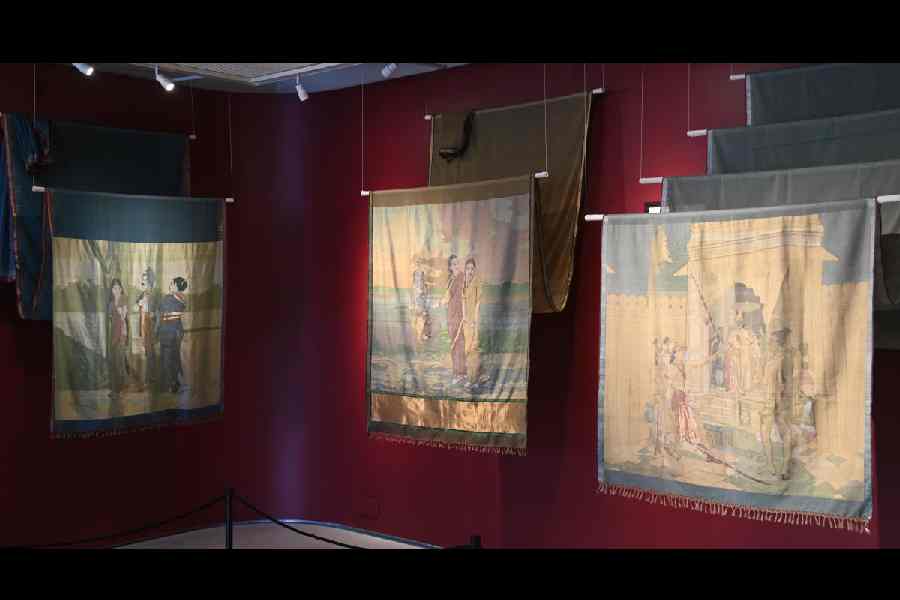
The exhibition, on till April 26, showcases 19 khadi saris woven with Raja Ravi Varma paintings
Lavina shares my wonder in the fact that the exquisite works of art were woven by the humble women of Srikakulam. “It is fascinating how those women sitting there (in Srikakulam) are, you know, weaving such wonders. Especially in this project, because the colours… there were so many different shadings. They are so intricate, my God. Look at the detailing!” says Lavina.
The collection, which is meant only to be showcased as art and not to be worn as saris, has travelled to select galleries in India, as well as to Melbourne and New York.
An obvious question that I ask Gaurang is, if the saris are meant to be displayed only and not worn, why not just make canvases, why bother making full saris. “But everyone does that,” pat comes his reply. “See, our work is with saris only. She (Lavina) is so passionate about saris and I am so passionate about saris,” he adds. He shares how a woman at the preview of the exhibition the day before almost fought with him for not selling the saris.
“We both have a common motive of making art public. We want all Indians to take pride in our heritage. To show to the world what India is still capable of. Otherwise, Indian textiles everywhere in the world is always seen from the past… in old textiles and all. Nobody understands what we are doing. Nobody understands what is the capability. So people like Gaurang, through this show and in everything that he is doing, he’s pushing boundaries. Like he’s creating new vocabulary which anybody can relate to,” says Lavina.
While I end my tour of the gallery, I ask Gaurang what his next passion project was. “So, after Ravi Varma, I had created a range of Srinathjis in different textile forms. So Srinathji in handpaints, weaves, embroideries. After that, I did Ganeshji in different textile forms. Now we are working on (a collection with) Venkateswara Swami. So every two years one new project,” he says with a twinkle in his eyes.