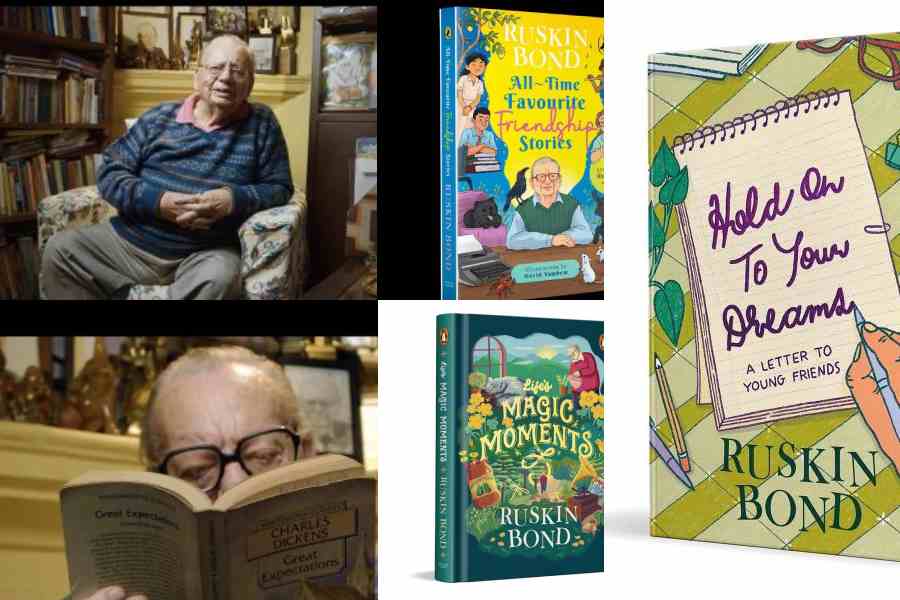
Just before we were to meet the star of the Ruskin Bond Festival, organised by StoneX Global in Dehradun, a casual conversation with a fellow journalist, on who could be considered the GOAT of the contemporary Indian literary universe, ensued. Before we could finish adding names to our list, Ruskin Bond appeared like an undisputed king, in a yellow T-shirt, seated in a wheelchair, accompanied by his close ones. We gathered to celebrate his birthday once more, his fifth cake, as he said delightfully before blowing out the candle. We forgot about our list.
At 92, the nonagenarian, who has penned around 200 titles, is a living legend. Age might have caught up with him, and his eyes might be failing him, but his memory is still sharp. When his fans arrived with copies of his books to be signed, despite the need for rest, he was eager to know the titles of the books. His pen never moved unless his ears were comforted with the name of the book. And the way he remembered each book is remarkable. The author, whose books are always on the bestseller list, doesn’t have any airs about his achievements. He is humble; an advocate of kindness; and much like our grandparents, whom we love going back to again and again and not just hear the magical stories that are like a lullaby to us but also take a few lessons on life. He wants to hear stories; he wants to tell stories till his last breath. Excerpts from our chat with ‘The Bond’ of the Indian literary scene, who feels like an “old deodar tree”.
You are 92 and still the greatest storyteller that we could have. Generations have grown up reading your stories and discovering their magic. How does it feel to be one of the oldest and most consistent storytellers?
At 92, I sometimes feel like one of those old deodar trees in the hills, weathered by storms, but still quietly alive with birdsong and memory. It is a wonderful thing to know that generations of readers have grown up with my stories and carried them into their own lives. A storyteller survives because readers continue to find comfort, companionship or perhaps a little nostalgia in his words.
Even today, when I meet young readers at gatherings like the Ruskin Bond Literature Festival organised by StoneX Global and the Ruskin Bond Foundation, I am reminded that stories still create human connections across ages. That, to me, is the real reward of writing.
When you wrote your first story at the age of 18, did you ever think you would come this far and produce so many books?
When I wrote my first novel at 18, I was simply trying to understand my loneliness and the strange excitement of growing up. I certainly did not imagine that one day there would be shelves full of my books. At that age, one writes because one must — not because one expects recognition. If anything, I hoped only to make enough from writing to continue living quietly among books, trees and mountains. Life, fortunately, was kinder to me than I expected.
Nature has always been a great backdrop for your stories, and it came in naturally as you have lived in some of the most scenic places. How did you view nature?
Nature was never merely scenery in my stories; it was almost a living character. The hills have moods, the forests have silences, and even rain carries memory. Growing up in places like Dehradun and Mussoorie taught me to observe patiently — the changing colours of the sky, the smell of pine after rain, the loneliness of a small railway station. Nature gives one perspective. It reminds us that life does not need to be rushed in order to be meaningful.
Love for nature makes one romantic as well. Did you ever try writing poetry or a love letter?
Oh yes, I attempted both poetry and love letters, though I suspect my poetry was far more romantic than accomplished! Youth naturally leans toward poetry because emotions arrive before wisdom does. And love letters — those belong to another age now — taught us sincerity and vulnerability. Even if the romance faded, the act of writing those letters sharpened one’s understanding of human feeling. Perhaps some of that tenderness quietly entered my stories too.
The latest book, All Time Favourite Friendship Stories, gave us 25 stories, and we felt the stories of Sami and Omar came from a very distinct emotional core. Can you tell us about these two dear friends of yours?
Sami and Omar came from different corners of my youth, but both represented the kind of friendships that shape one’s understanding of people. Sami had a restless charm and unpredictability, while Omar possessed a gentleness and loyalty that remained with me for years. Friendships in youth are often intense because they arrive before life becomes complicated. Writing about them was my way of preserving not only the people themselves, but the innocence of those years.
Your characters often find magic in ordinary encounters. Do you think modern life has made people less observant of everyday beauty and human connection?
Some friends remain close, others drift away into memory, but true friendship leaves an imprint that time cannot entirely erase. As we grow older, life intervenes — careers, marriages, distances, misunderstandings. Sometimes people who once knew us best become strangers. Yet I have often found that when old friends meet again, even after decades, there is still an invisible thread connecting them. The affection survives, even if circumstances change.
I do think modern life has made people less observant. We hurry too much now. People often look at the world through screens instead of their own eyes. Yet beauty usually reveals itself in quiet moments — a child feeding sparrows, an old bookseller waiting patiently in his shop, the sound of rain on a tin roof. Human connection also depends upon noticing small things. Literature encourages us to slow down and pay attention again.
If you were writing The Room on the Roof today, what aspects of contemporary youth culture would shape Rusty differently?
If I were writing The Room on the Roof today, Rusty would probably face a different kind of confusion. In my youth, loneliness came from physical isolation; today, it often exists despite constant online connection. He might struggle with identity, social pressures and the noise of modern life. But beneath all that, he would still long for the same things — friendship, freedom, affection and a sense of belonging. Young hearts have not changed nearly as much as the world around them.
Your work has remained relevant across generations without chasing literary trends. How have you managed to preserve that timeless quality in your storytelling?
I never consciously tried to remain relevant. In fact, writers who chase trends often become dated very quickly. I simply wrote about human emotions that never disappear — loneliness, friendship, wonder, loss, childhood. A good story survives because people recognise themselves in it, whether they read it in 1956 or 2026. Simplicity also matters. Clear, honest storytelling has a longer life than fashionable cleverness.
Lastly, as a kid we were encouraged to make a wish while blowing a candle. Since you have blown so many candles during the run up to your birthday, what wish did you make? Or what wish would you want to make?
At this age, wishes become smaller but perhaps more meaningful. I no longer wish for achievements or recognition. I would wish for a little more time; time to enjoy the hills after rain, to meet old friends, to read quietly in the afternoon sunlight, and to continue writing while curiosity still remains alive within me. And perhaps I would wish that younger generations never lose their sense of wonder, because without wonder there can be neither good literature nor a truly fulfilling life.