When I began my dental practice more than 25 years ago, getting dental implants meant months of waiting, multiple surgeries, and uncertain outcomes. Fast forward to 2026, and modern dentistry has transformed dramatically. Today, patients across all age groups — from teenagers to those in their nineties — can often receive functional fixed teeth on the same day of treatment, thanks to technologies that seemed like science fiction just a decade ago.
As a maxillofacial surgeon who has managed thousands of complex cases including full-mouth reconstructions and intricate jaw surgeries, I’ve seen how 3D printing, CAD/CAM systems, AI-driven planning, and guided implant surgery have brought precision dentistry evolve. This evolution goes beyond simply replacing teeth — it’s about restoring natural function, confidence, and quality of life through remarkably predictable outcomes.
Think of it like moving from traditional marksmanship to precision-guided technology — the results are dramatically more accurate and reliable.
The Digital Dentistry Revolution: Precision Planning
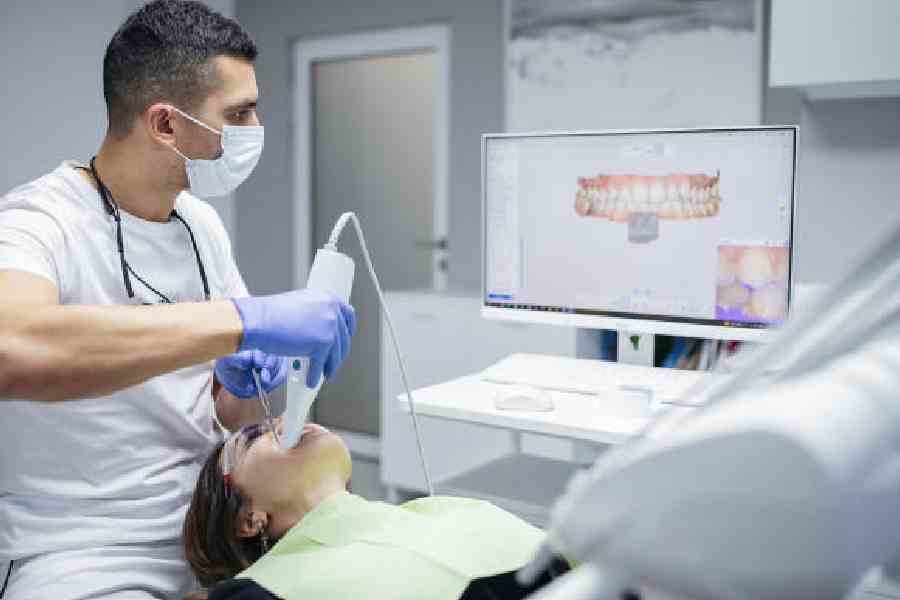
Picture this. A patient sits comfortably while a dentist’s assistant moves a wand inside their open mouth. Withing 60 seconds, this 3D intraoral scanner captures a digital replica of their entire mouth — no messy clay impressions, no discomfort. An AI-powered software then analyses bone structure, gum health, bite alignment, and facial proportions to create a digital avatar of their smile.
CAD/CAM (computer-assisted designing and computer-assisted milling) and 3D-printing technology then designs patient-specific surgical guides and implants that match each individual’s unique anatomy precisely. Most remarkably, patients can preview their “before and after” smiles on screen before any treatment begins. This Digital Smile Design (DSD) process transforms consultations from guesswork to collaborative precision planning. Advances in ceramic material technology have made cosmetic dental procedures like veneers and smile makeovers the most sought after in dentistry.
For Calcutta’s busy professionals and families, this means fewer visits and greater involvement in their treatment journey. In many cases, patients leave with immediate functional teeth on the very same day.
Same-Day Teeth: Transforming Patient Experience
The most significant advancement? Same-day functional restoration through computer-guided surgery. No more waiting for six to nine months for healing before receiving fixed teeth. Advanced dental implant procedures like all-on-4, zygomatic and pterygoid implants have been a gamechanger.
Using 3D-printed surgical guides created from the patient’s digital scan, implants can be placed with sub-millimetre accuracy. This minimally invasive precision preserves healthy bone, reduces surgical trauma, and enables immediate restoration.
A patient travelling from Bhubaneswar recently experienced this first-hand — he walked out after receiving a full-arch implant bridge and enjoyed rosogolla that very evening.
This technology proves especially valuable for complex full-mouth reconstructions. Patients previously deemed “non-candidates” due to severe bone loss, failed bridges, or congenital defects now routinely achieve functional, natural-looking smiles with success rates exceeding 98 per cent and long-term warranties on teeth.
3D Printing: Bespoke Solutions for Complex Cases
3D printing has fundamentally changed how we approach dental prosthetics and treatment planning. Beyond streamlining routine procedures, it enables Patient Specific Implants (PSI) — custom-designed solutions for complex facial reconstructions that were previously considered impossible.
These patient-specific implants offer:
- Perfect anatomical fit that eliminates micro-movements;
- Bone preservation by matching existing structures precisely;
- Superior aesthetics that harmonise with facial contours; and
- Avoids complicated bone grafting surgeries.
A 72-year-old gentleman from Darjeeling who had struggled with ill-fitting dentures for 15 years, finally received his first fixed implant bridge. His custom 3D-printed framework supports a full-arch prosthesis that functions like natural teeth. “I can enjoy ilish maach again!” he shared with genuine delight.
Guided Surgery: Millimetre-Level Precision
Navigation surgery — similar to GPS guidance used in neurosurgery — has now reached dentistry. Dynamic navigation systems provide real-time 3D positioning during implant placement with 0.5mm accuracy. When combined with emerging haptic robotic assistance, the precision rivals any other medical field.
For jaw reconstruction patients — whether trauma survivors, cancer patients, or those with congenital deformities — this technology proves transformative. Custom 3D-printed titanium reconstruction plates restore both function and facial harmony with extraordinary accuracy.
AI: The Silent Treatment Partner
Artificial intelligence processes thousands of variables — bone density, sinus and nerve positions, bite dynamics, and long-term loading patterns — to recommend optimal implant positioning before surgery even begins. The software conducts stress analysis and suggests design improvements for maximum durability.
This predictive capability underpins dentistry’s remarkable long-term success rates today. Patients receive treatment plans backed by data-driven confidence rather than empirical experience alone.
Calcutta’s Rise in Dental Tourism
Calcutta’s emergence as a dental tourism destination reflects the city’s unique advantages. They are:
- World-class technology delivered with international standards;
- Universal English proficiency eliminating communication barriers;
- Cultural familiarity for the South Asian diaspora;
- Comprehensive care packages combining treatment with recovery; and
- Strategic location serving Eastern India, Bangladesh, and beyond.
- NRIs from the US, the UK, Canada, and the Middle East increasingly choose Calcutta for:
- Full-mouth rehabilitation completed in two-week protocols;
- Complex jaw reconstructions; and
- Comprehensive smile makeovers blending orthodontics, implants, and cosmetic dentistry.
- Implants for Every Age and Condition
- Modern implantology successfully serves patients across the age spectrum:
- Teenagers with congenitally missing teeth;
- Active adults seeking aesthetic and functional restoration;
- Elderly patients preferring fixed alternatives to dentures; and
- Medically complex cases once considered too high-risk.
A 28-year-old software engineer from Guwahati born without lateral incisors now displays a digital smile design featuring custom implants indistinguishable from natural teeth. At the other end of the spectrum, a 93-year-old from Howrah celebrates her first fixed teeth in decades.
Looking Ahead
Dentistry continues evolving with nanotechnology implant coatings, smart sensors monitoring bone integration, and fully robotic placement systems. Yet today’s reality already surpasses the dreams of just a few years past.
For Calcutta residents and Eastern India — from the tea gardens of Darjeeling to the industrial hubs of Jamshedpur — world-class implantology exists right in your backyard. There is no need to travel to Mumbai, Delhi, or abroad for cutting-edge care anymore.
Modern dentistry represents far more than tooth replacement. Through precision engineering, artificial intelligence, and surgical artistry, it delivers functional restoration and aesthetic harmony — transforming lives one smile at a time.
Dr Kamlesh Kothari, MDS, DNB, DICOI, is a dental implant specialist, cosmetic dentist and maxillofacial surgeon. He is the founder and clinical director of Aesthetica,
2/7 Sarat Bose Road,
Vasundhara Building, Calcutta. He can be reached at +91-9830183000, +91-33-40035900,
www.aesthetica.co.in, and on Instagram @drkamleshkothari