Decades have gone by since the start of the LGBTQIA+ movement in India, but identity, gender labels and the queerness spectrum keep being modified by new nuances with every passing day. That is what makes conversations around gender, sexuality and inclusivity more relevant than ever, and the advocacy for equal rights across the spectrum crucial for social progress. To mark International Pride month, t2 presents Queer Conversations partnered by Kolkata Pride, with celebration partner Absolut Mixers, and venue partner The Park Kolkata, on June 9, staged a much-relevant debate with a difference, which went by the motion ‘Masc, Femme or Beyond the Binary? — The Great Indian Identity Crisis’.
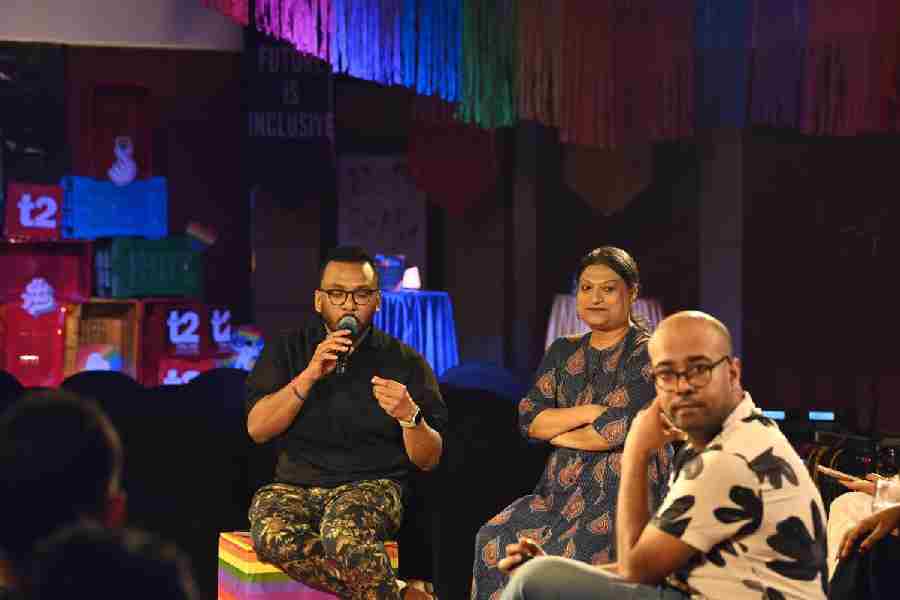
Right from the stage and podiums to the overall format of speeches, the debate spoke volumes for the binary-bending spirit of the Pride Month. With an ambulance buzzer that occasionally cut through the room as a reminder of the urgency of the times we inhabit, this was no Oxford-style ordinary proposition versus opposition affair. The rainbow-coloured circular stage had already broken away from the rigid architecture of traditional debates. There was no elevated podium, no neatly divided sides. Instead, the format itself reflected the theme it sought to explore. The panel gathered not to decide what was right or wrong, but to dwell within the contradictions of the motion.
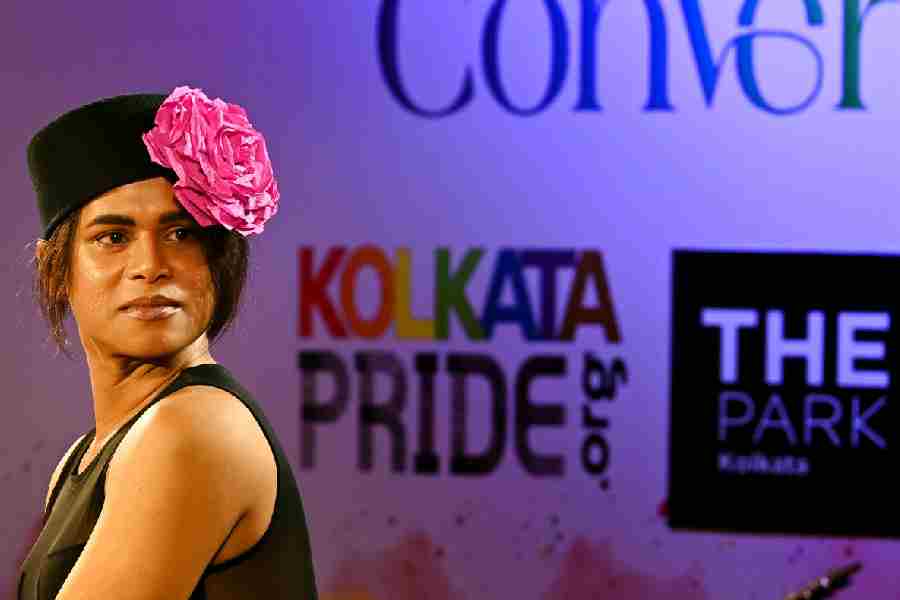
Sandeepta Das
Four speakers from diverse professional fields and personal backgrounds came together to put forth their arguments, positioned on the circular stage, doing away with the for-against contentions observed in traditional debating formats. Each was allowed 12 minutes to speak, not either for or against the motion, but to deliver statements both as part of the proposition and opposition. A show of hands from the audience was welcomed at the end of the debate to choose the side gaining more weightage, although no winner was declared in the conventional sense of the term.
The four speakers participating in the debate were Maharghya Chakraborty, assistant professor at St. Xavier’s College; Anurag Maitrayee, elocutionist and civil rights activist; Navonil Das, co-initiator of Kolkata Pride.org and co-founder, Dev R Nil; and Sandeepta Das, multidisciplinary artiste and performer. Each of the speakers shared a different perspective on whether labels should or should not define identity in these times, citing personal anecdotes and the social battles which have shaped their opinions for and against labels assigned to gender and sexuality.
A professor, literary translator as well as pop culture enthusiast, Maharghya has gained several achievements alongside his academic career, including work as a film archivist and writing subtitles for independent Bengali films. He has also translated works by Sibaji Bandyopadhyay, Taslima Nasrin, Srijato and Gulzar.
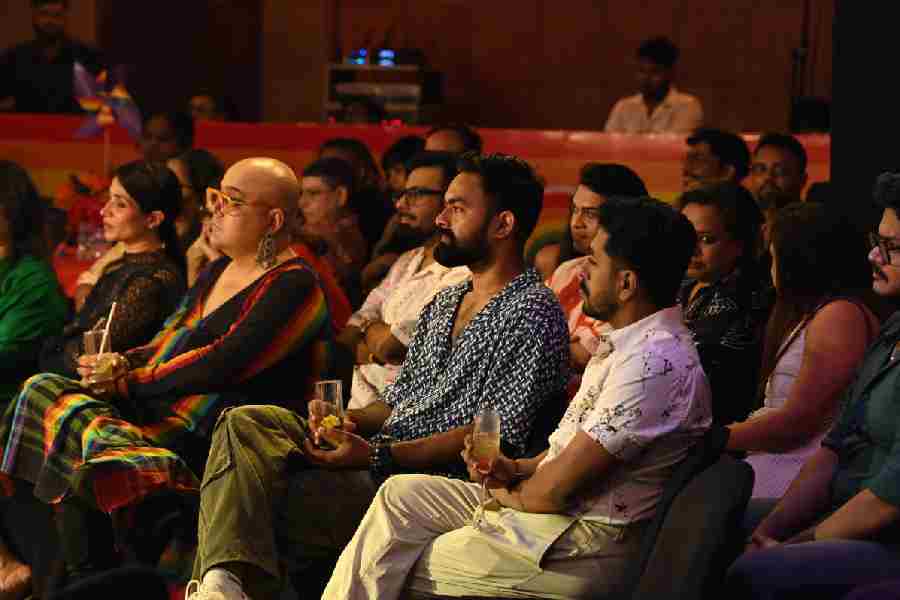
The audience listened with rapt attention as the speakers shared their perspectives on labels and their social relevance
Maharghya began by puncturing the comfort of assumed inclusivity. “All spaces are not inclusive at all,” he noted, urging the audience to acknowledge that we continue to live in a deeply segmented society. Drawing from his experiences as a teacher, he contrasted two worlds: his classrooms where difficult conversations around gender can happen safely, and everyday spaces where people do not have the privilege to express themselves openly. His argument for moving beyond labels rested on recognising gender as a spectrum. There is no singular masculinity or femininity. There are only “constant scales and spectrums that we are traversing”.
Yet, in the same breath, he defended labels. Justice cannot be imagined without first acknowledging inequality. “Labels are important because many people who are in the position of thinking positive change are thinking about labels through an enormous intersectional network.” Without addressing privilege, caste, class, access and safety, the dream of inclusion risks becoming another bubble of privilege speaking to itself.
Sandeepta is a multidisciplinary artiste whose work explores identity, transformation, and the poetics of human experience. Through an interplay of personal narrative, performance, and visual culture, she examines themes of belonging, authenticity, and self-reinvention. Rooted in both vulnerability and resilience, her practice invites audiences to engage with the complexities of contemporary life, creating space for reflection, dialogue, and meaningful connection.
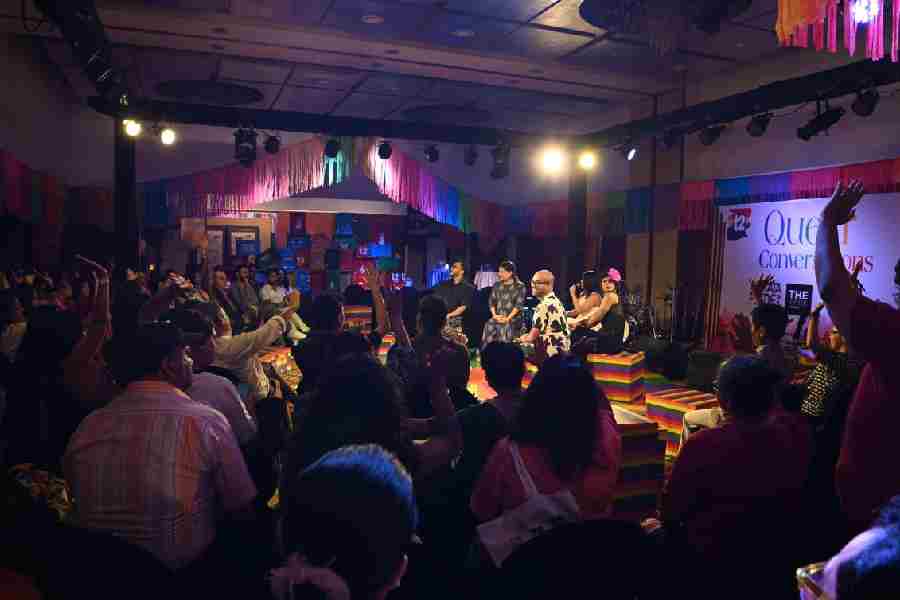
A show of hands for or against labels was welcomed from the audience after the closing remarks
If Maharghya brought structural analysis to the table, Sandeepta brought lived experience wrapped in her unapologetic presence. Dressed in a black ensemble with a bold pink head accessory, she seemed to embody the conversation before she even spoke. Switching between masculine and feminine vocal registers with ease, she transformed the abstract language of binaries into something immediate and tangible. As she rightly demonstrated, multiple selves can reside within the same person, without cancelling each other out. For her, resisting labels and embracing them were equally real experiences. “Let’s talk about humanity for a second,” she said. “We all are human, right? And we do have the right to choose the way we want to live.” Society constantly pressures individuals to fit into boxes, shaping behaviour, appearance and even transitions.
At the same time, she insisted that labels had protected her. Educational institutions, legal documents and everyday interactions repeatedly demanded identification. Perhaps the most powerful articulation of this contradiction came through her own words: “I think label does matter to me personally. I don’t speak for other individuals. I only speak for myself... though I’m a trans woman, I think we all have these personal struggles which are very personal and depending on the situations we have been through. So those labels are not a burden, but I’m totally aware of my labels because I always wanted a label to secure myself within a society where I feel safe.”
A self-procliamed transgender woman, Anurag Maitrayee is a trailblazer of rights-based movement, fighting multiple levels of oppression and discrimination in society. Currently working under different international academic researchers and professors on gender studies as a research assistant, Maitrayee has worked to raise gender awareness with the youth for over a decade. She is the editor of Anontara magazine, which focuses on the intersections of various visible and invisible discriminations prevailing in society.
Speaking for the motion, Maitrayee drew attention to the fact that for transgender persons, the very bodily difference that is used by society as a tool to oppress them can be turned into a tool of resistance, resilience and celebration. Instead of giving in to the society’s attempts to sideline transgender people based on their bodily difference from cis men and women, and accepting a position on the social back burner, transgender people should use this difference as a mouthpiece for advocacy against oppression.
According to Maitrayee, even if thousands may claim to be “allies” to queer rights on the surface, hidden, implicit discrimination is still widespread. Hence, it is more important than ever for transgender women like her as well as people in every part of the queer spectrum to assert themselves strongly through their difference, and turn the negative labels assigned by heteronormative culture into positive, self-affirming ones. “We are no longer looking for allies, no longer seeking acceptance from the heteropatriarchy and the society of cis men and women. As a transgender woman, I see my difference as my strength, and celebrate it loudly, for then only can we thrive in a society that has forever oppressed us by ridiculing our bodies. The obsession with what our reproductive organs look like, the regular laughter directed at us in public spaces, and many other forms of verbal and physical oppression can only be undermined when we come under an umbrella, celebrate our different bodies and use them as tools for resistance,” she said.
While embracing one’s unique identity is crucial for the queer rights movement to gain momentum, it is also important for society to do away with the stringent “boxes” in which it puts individuals, for selfish economic pursuits of the upper echelons. “The relentless compulsion to conform, through which society restricts the fluidity of selfhood by confining it to neatly compartmentalised boxes of maleness and femaleness, does not ultimately lead to any personal benefit for those who conform. Instead, it restricts freedom of self-expression for the individual and the choice to find one’s true identity through lifelong exploration. I, for one, have never felt that I was a transgender person who had, through any clinical or psychological rite of passage, become a woman from a man. I have always been a woman, but as that kind of identity is not superficially perceptible by society, it must define me in a certain category which can fit within the wider schemes of capitalism and the medico-surgical, cosmetic and pharmaceutical industries. In this sense, imposing social labels on one’s identity can be heavily oppressive and detrimental to self-expression,” she said.
Navonil Das is a prominent queer activist and the co-initiator of Kolkata Pride.org, as well as an accliamed fashion designer, having started the label Dev R Nil with Debarghya Bairagi in 2004. Over the years, he has contributed to create and support safe and comfortable spaces for queer people to gather and celebrate themselves, hosting Pride Walks, health camps, workshops, performances and conversations.
Defending the significance of labels asserting individual identities in the current times, Navonil highlighted how one queer person embracing their queerness can be an inspiration for hundreds to come out of the closet and assert themselves. To explain, he shared an anecdote from a gathering some years ago, where someone all the way from Guwahati had come to be a part, because there was nobody he could freely hang out with in the place he lived.
Episodes like these brought forth the realisation that holding on to some sort of label, no matter how nuanced it is, and no matter how many shifts take place in that label, is very important to secure one’s rights in a society which puts different queer lives into one blurred, generalised box of otherness. “Yes, for me, my identity is the core of my existence. Till a certain point, I was sceptical about how to portray myself, because I have a brand, and my identity is also attached to it. However, I later realised that people are watching me, and by claiming my identity as my truth, I can inspire others to be more comfortable with themselves and finally arrive at answers to the ‘am I, am I not, are there others like me?’ questions,” he said.
Navonil, however, also believes in the essentially contradictory and fragile assumptions upon which socially imposed labels depend. Recalling his childhood days, he shared that because his attitudes and gestures leant more towards the feminine part of the spectrum, he would be teased and riduiculed as “ladies” whenever he appeared in front of other boys in his neigbourhood. However, in his teenage years, being heavily involved in sports and growing muscular as a result of regular exercise, the same group of boys, who had teased his feminine attributes some years ago, would change the label given to him from “ladies” to “lad”. He also shared how some of his “visibly transgender” friends had been denied entrance to a venue in the city, while those who were not visibly so, were allowed in.
All these episodes show, according to Navonil, that labels defined by heteronormative societies are nothing but arbitrary constructs, which can define the same person differently at different points according to superficial perception. “Even after playing sports and becoming muscular, I would be a very feminine person at heart. These experiences shaped my motivation to fight against restrictive labels. No matter whether one believes social labels are good or bad, we are always at war with them. Confronting these shifting labels and discriminations all around allowed me to realise how oppressive they can be to queer people,” he said.
By the end of the evening, no definitive answer had emerged to the question posed by the motion — and perhaps that was precisely the point. The debate underscored how identity is rarely fixed, and how labels can simultaneously offer visibility, community and protection while also imposing limitations. What remained unquestionable, however, was the importance of creating spaces where these complexities can be discussed openly. In a time when conversations around gender and sexuality continue to evolve, t2 presents Queer Conversations served as a reminder that the goal is not to arrive at a single definition of selfhood, but to make room for the many ways in which people choose to live, express and understand themselves.