It feels almost identical to today. That same heavy, low-hanging sky pressing down on the city. That same stubborn summer rain — too persistent to ignore, too soft to be dramatic — blurring Park Street into a watercolour of headlights, umbrellas, and slow-moving traffic. A year ago, on a morning like this, we arrived at The Flamboyant at 9am, our clothes carrying the faint dampness of rain, the air thick with petrichor and something expectant.
Outside, Calcutta was subdued, almost reluctant to wake up. Inside, it was anything but. Flamboyant had been reassembled into something more intentional. The bar gleamed under low, moody lighting — rows of bottles catching fractured reflections, glass surfaces turning into mirrors for movement. Smoke drifted lazily across the floor, pooling and dispersing with every step, while beams of red and amber light sliced through it in deliberate strokes. The air felt denser here, as though time had slowed just enough for everything to feel heightened.
There was a rhythm to the set — assistants weaving in and out, fabric being adjusted, a light flickering before settling into place. Somewhere in the background, a track played in fragments, looping, building, pausing — never quite completing itself, but always hinting at what it would become.
And then, at the centre of this carefully constructed chaos, sat Paoli Dam in red. Not just red, but a red that seemed to hold weight — deep, saturated, almost molten under the lights. The sari moved like liquid when she shifted, catching glints of gold and shadow in its folds. The fabric clung in places, flowed in others, each pleat falling with intention. Under the warm lighting, it glowed rather than shimmered, as though it carried heat within it.
Her make-up was sculpted to match — eyes lined with precision, dark and deliberate, her gaze cutting through the haze without needing to move much at all. The red of her lips echoed the sari, but sharper, more defined. Her hair, styled with a vintage sensibility, framed her face in soft, controlled waves, adding to the sense of restraint.
She barely moved between takes. Even as the room shifted around her — lights recalibrated, crew members adjusting the fall of her pallu, someone stepping in to check shadows — Paoli held herself in a kind of composed stillness. It wasn’t passive. It was controlled. You got the sense that every gesture, every glance, would be measured, released only when necessary.
“Red, for me, has always been more than just a colour — it carries memory, defiance, and a kind of quiet sensuality,” she says, almost thoughtfully, as she smooths a pleat back into place. “With Bibi Payra, and with Jhuma, I felt like I was stepping into yet another woman who lives so much of her life internally. I have always been drawn to women-led stories, to characters who are layered and not always easy to read. This sari, this look — it isn’t just about glamour. It’s about holding back and revealing at the same time. That duality is what excites me. And to do that in a song like this, which is so rooted in the narrative, made it even more special.”
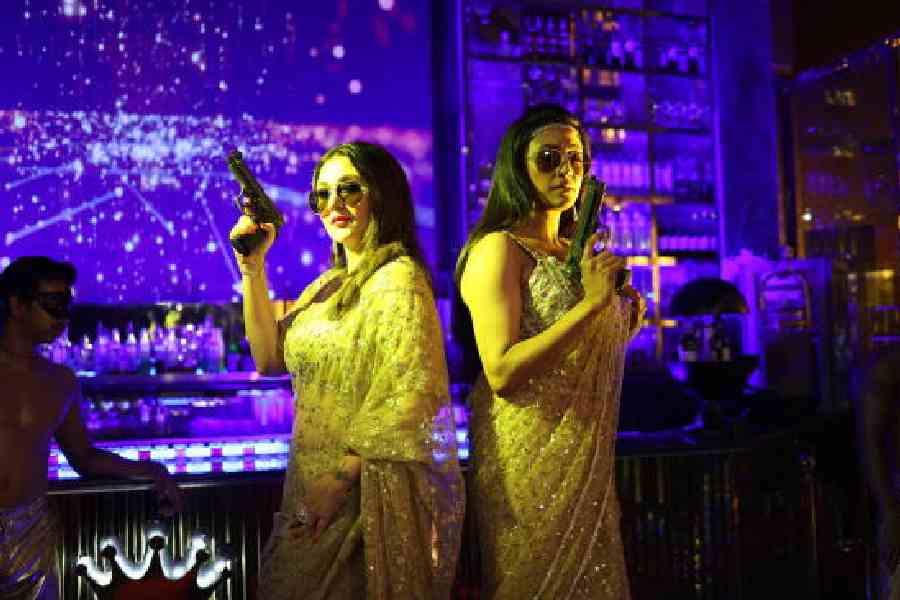
If her red was fire, it was the kind that burned inward. A few feet away, the light shifted — cooler, sharper — and Swastika Mukherjee stepped into frame. Her gold was entirely different. Brighter, more reflective, almost restless under the lights. The sari caught everything — beams of yellow, flickers of blue, the passing shadow of a crew member — and returned it with a shimmer that refused to settle. It moved with her, but it also seemed to move on its own, alive to the environment around it.
And then there were the streaks in her hair. Subtle at first glance, but impossible to ignore once the light hit them — thin, shimmering lines that caught and held brightness for a split second before letting it go. They added texture to her presence, a kind of unpredictability that mirrored the way she moved.
Because Swastika didn’t hold still. She shifted her weight, turned slightly between cues, let her shoulders relax and then reframe. There was a fluidity to her — not careless, but instinctive. Where Paoli seemed to build her performance from within, Swastika allowed hers to expand outward, responding to the space, the light, the moment.
“I’ve never really done what people call an ‘item song’ before,” she says with a half-smile, almost amused by the idea. “And honestly, I never saw myself doing one in the conventional sense. But this didn’t feel like that at all. It’s part of the story, part of who Shiuli is becoming. There’s an immense sense of fun in it — the kind you don’t overthink. You just show up, let go, and enjoy the moment. And doing this with Paoli, with that kind of energy on set, made it even more exciting. It didn’t feel like stepping out of my comfort zone — it felt like expanding it.”
If Paoli’s red drew you in, Swastika’s gold met you halfway. Together, they created a frame that felt layered rather than balanced. Red and gold — familiar, almost traditional — but here, reimagined. One quiet, simmering. The other bright, immediate. Their energies didn’t compete. They coexisted, each sharpening the other’s presence.
Behind the monitor, director Arjunn Dutta watched it all come together with a kind of quiet conviction. “There are item songs where people just go up and down the hall, and the last 10 credits roll. That’s not what this is. This is part of the narrative; it belongs inside the film. When we were writing Bibi Payra, my co-writer and I always had these two in mind — I couldn’t resist casting them together. I wanted something that blends into the story, not something that feels like an interruption. It’s a comedy of errors, yes, it’s fun, it’s entertaining, but at its heart, it’s women-centric. And why should only younger actors get these songs? Why not women in their 40s, late 30s? They are veterans, they bring their own sensuousness, their own energy. Bringing the two of them together — that’s where the magic is. This film is me stepping out of my usual urban space into something more suburban, more intimate. I don’t believe in art versus commercial — it’s either a good film or a bad one. We’ve tried to make something honest, something entertaining, and something that stays with you.”
The track swelled again. Lights flared brighter this time, catching on sequins, on glass, on skin. The smoke thickened, then thinned. Someone called for silence. The camera rolled. For a moment, everything aligned — the red, the gold, the light, the music — and it made sense why this scene existed at all.
Outside, the rain continued, steady and unbothered. When we stepped out, it hadn’t stopped. It rarely does, on days like these. The city remained wrapped in that same grey softness, as though holding something back.
A year later, with the release of Bibi Payra and the title track already garnering attention, that morning feels less like a fleeting visit and more like a beginning. A glimpse into something that was always meant to unfold — slowly, deliberately, and with just enough shimmer to stay with you long after the lights go out.