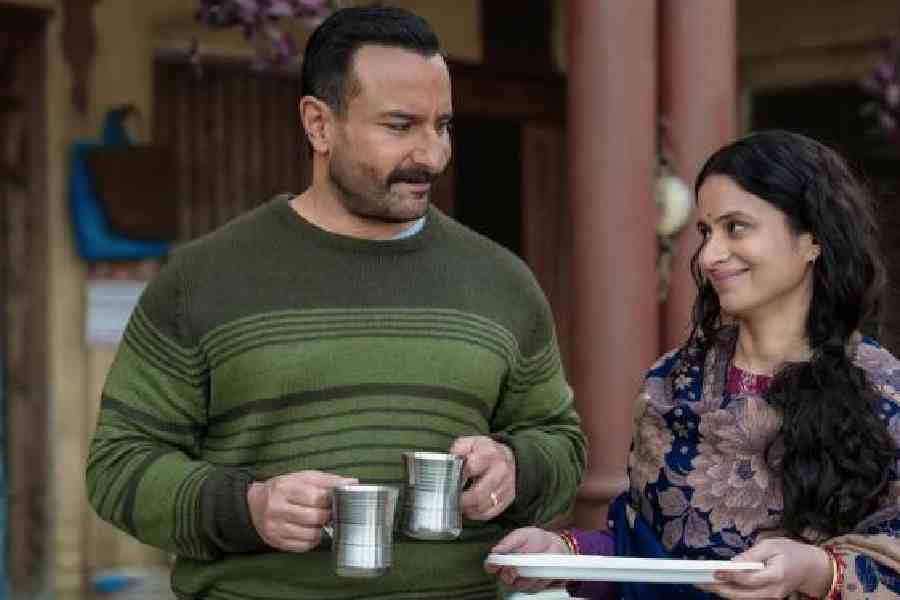
Kartavya, a Netflix film produced by Shah Rukh Khan’s Red Chillies Entertainment, has Saif Ali Khan playing a world-weary hinterland cop torn between duty, society and family. t2 caught up with the film’s director Pulkit post its release, for a chat.
How did the idea of Kartavya come to you?
While growing up, I always wondered that we ask so many questions as a son, a brother, a sister... but no tells you what your duty as a human is to the society in which you live. The larger context of Kartavya was basically this thought.
It also came from The Mahabharata where in the Kurukshetra war, Arjun faced a dilemma whether he should fight his guru Dronacharya. He was torn between his dharma as a warrior to fight against injustice, and his deep compassion and attachment to his teacher. But he ultimately fights for justice. This also finds a place in a dialogue in the film, delivered by Saif’s (Ali Khan, who plays Pawan) character.
Through this film, I wanted to say that what is wrong is wrong and as humans, it is our duty to fight against it. Of course, it will take a lifetime for most of us to figure out what our duty as a human is. This film is an attempt to steer thought in that direction.
Kartavya explores caste bias. We are all aware of it, but on a superficial level, belonging as we do to the privileged sections of society. Did your research throw up anything that shocked you the most?
My idea was not to make a film on caste. Kartavya does look at honour killing, but this is an act that sometimes may not happen because of caste differences, though it definitely is one of the reasons. Sometimes, there are wider and deeper reasons for honour killing. My attempt was to explore the thought of what makes a father kill his own son.
Caste does play a big role in the film, to the point where you name your principal characters ‘Pawan M’, ‘Ashok Y’ and so on, and don’t use their surnames...
That is because I didn’t want to bracket my characters into a particular caste. The idea was to show them more as humans on both sides of the right and wrong divide.
You prefer to be addressed mononymously yourself...
That is because I feel my name doesn’t sound good with my surname! That is the only reason.
You take Saif Ali Khan back to the rural hinterland, something that hasn’t been explored with him post his chameleonic turn in Omkara. What made you cast him and did he surprise you on set?
Omkara is a cult classic and we have all admired Saif in that film. I belong to a small town and my stories are generally from that space. I always wanted to cast Saif in a film like this. He understands nuance, diction, body language.... I have always felt that as an actor, he has remained under-utilised. Most people think he is more suitable for playing urban roles because he carries himself like that, but deep down, he is very desi.
He contributed a lot to Pawan. The character I initially had in mind was quite aggressive. The one major thing that Saif has got to the film is calmness. He made Pawan a person who never panics, he thinks deeply about what is happening around him and processes it.
Though they are not focused on love, your films have romance as a strong sidebar. Considering you grew up with a poster of Shah Rukh Khan plastered on your wall and have now had two of your films produced by him, is romance as a genre something you would like to explore more?
Definitely. For my films, I draw inspiration from my life, my experiences and my stories, as well as the stories I hear from others. Romance, for me, is just not about candlelight dinners and grand gestures. It is about a partner who supports you through thick and thin, and you get to see a lot of that in my films. I believe that a power that a man has doesn’t come from outside, it comes from within his family, specifically from his partner. Even in the film that I am making now, I am trying to explore that side of romance.
As far as Mr Shah Rukh Khan is concerned, he is not only the epitome of love, but even in real life, he has had a magical love story himself. He got married young, they (SRK and wife Gauri) struggled and then built a kingdom together, so to speak. They are an inspiration and I am fortunate to have them as the producer of my films.
Journalist Saurabh Dwivedi’s casting as the main antagonist in Kartavya has met with mixed reactions. What made you pick him?
Honestly, I wouldn’t call him the main antagonist of the film. His casting was very interesting and I still strongly believe in it. I am grateful he came on board. He has never been an actor. I used to watch his interviews on Lallantop and found his way of doing them very fascinating. That is why I wanted him to be a part of my film.