Time flies and we are already in March. If you haven’t focused enough on fitness in the last few months, here is how to get back on track — and get fitter than ever before.
STRENGTH
Train the kinetic chain, not individual muscles: Your body is a big, beautiful, interconnected sequence of muscles, bones, nerves, tendons and ligaments. This is called a kinetic chain. These muscles fire in a particular hierarchy — the beauty of a Bolt sprint or a Rory swing is evidence of muscles firing in the proper sequence and hierarchy.
Training the kinetic chain emphasises movement patterns that connect the entire body from the ground up, prioritising force transfer, stability and coordination over isolated muscle growth.
The average person with long working hours in a seated position under stressful conditions — or the average gym-goer using machines to target isolated muscles — often develops compromised movement patterns. The focus on “mirror muscles” such as the chest, quads and deltoids, which tend to become overactive, while neglecting muscles like the upper back, glutes and hamstrings, disrupts the harmonious working of the kinetic chain and predisposes the body to injury and pain.
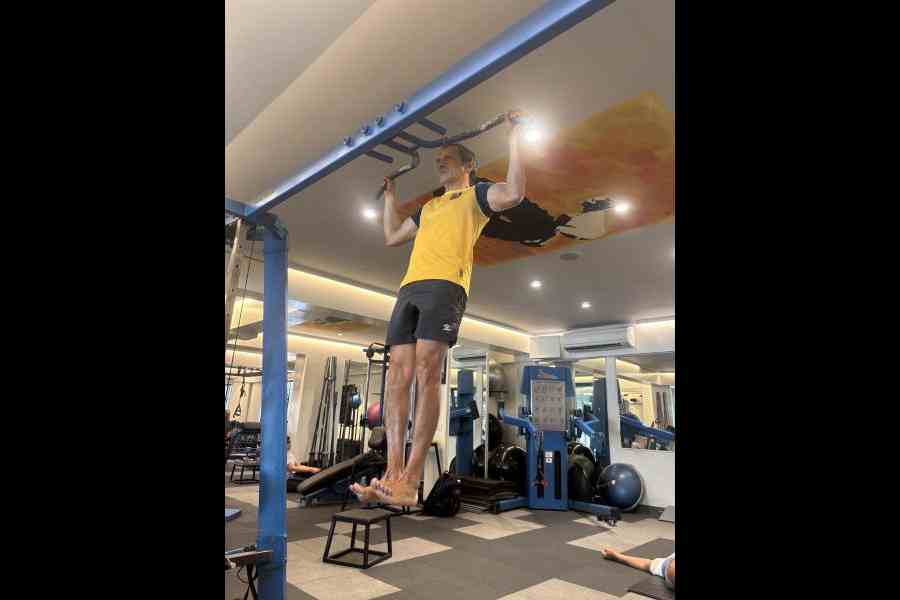
The goal of balanced strength training is to rediscover the proper pathway and sequence of muscle firing in the body. Strength training needs to be movement-based rather than muscle-based. The best way to do this is still the old-fashioned way — mastering primal movements such as squats, deadlifts, inverted rows, pull-ups, lunges and dips. These movements remain the gold standard of strength training.
The cardinal principle of this approach is that power originates from the feet and legs, transfers through the hips and core, and culminates in the upper body.
The endeavour to master these moves will expose muscle imbalances or dysfunctions. Addressing and correcting these deficits will lead to several benefits:
Increased power: When muscles fire in the correct sequence, they generate greater force.
Injury prevention: Correcting imbalances and dysfunctions (weak glutes, tight lower back, and so on) improves movement efficiency and reduces fatigue on muscles and joints.
Functional strength: This refers to the carry-over benefits into real-life activities and sport.
Learn to use your body weight as resistance: All strength exercises begin with body-weight efficiency. The push-up, pull-up, inverted row, squat and lunge — using only one’s body weight as resistance — are the first movements to master in the journey to strength and fitness.
Burpees and mountain climbers are also excellent body-weight exercises that involve almost every major joint and muscle in the body.
Lift, lift, lift
Thou shalt lift weights. It is not the eleventh commandment — but it probably should be.
Lifting weights does many good things for the body. It improves insulin sensitivity, builds strong bones, provides better joint support, enhances bone density, improves posture and develops stamina and endurance. And we haven’t even mentioned stronger muscles yet.
Focus on compound lifts. Athletes do not waste time developing isolated muscles; they focus on functional strength. They train movements that activate the kinetic chain — and so should you.
This year, make it a priority to improve your squats, deadlifts, swings, push presses and heavy rows. The icing on the cake would be mastering at least one Olympic lift such as the Clean, the Clean and Jerk, or the Snatch.
Abandon elaborate isolation-based routines and stop relying on uniplanar exercise machines. Human beings are made for three-dimensional movement, not for working out on fixed-path machines.
CARDIO
Have a heart: The aspect of fitness that has the greatest bearing on general health, clinical health and longevity is cardiovascular fitness — or VO₂ max.
Lack of flexibility, stability or strength may make life’s activities difficult, but it will not kill you. A weak heart might.
A strong heart, capable of pumping high volumes of blood when required, triggers positive endocrine responses in the body, including improved insulin sensitivity and the release of testosterone and growth hormone. The ability to sustain a higher heart rate without fatigue during physical stress also promotes autophagy.
Cardiovascular fitness also has a powerful positive impact on blood pressure, body fat levels, cholesterol and glucose tolerance.
But here’s the catch: do not expect to reap these benefits by simply ambling along or taking easy walks. True cardiovascular health comes from training at 60–80 per cent of your maximum heart rate. (This applies to asymptomatic individuals without life-threatening cardiac conditions.)
While sprinting creates the greatest growth hormone release, running at sub-maximal speeds is also highly beneficial for building cardiovascular efficiency. However, sub-maximal speed should still be above 75 per cent of your maximum speed.
Learn to train at maximum velocity and you will notice your sub-maximal speeds improving and your speed reserve expanding.
Sprinting is a specialised skill, but running enthusiasts should discover the benefits of speed training this year. One of the best ways to begin is to abandon long, slow cardio sessions and start training in intervals.
HIIT it
Long, steady cardio sessions — cycling, running or swimming — are useful for beginners developing basic aerobic fitness. However, for intermediate and advanced athletes, there is a far more time-efficient way to get more value from cardio without the risk of muscle loss: High-Intensity Interval Training (HIIT). HIIT involves alternating short bursts of intense effort with moderate or complete rest.
For example: A 60-second fast-tempo run followed by 90–120 seconds of rest, repeated 8–10 times, is a classic HIIT protocol. Work periods can be shorter too — even 10-second sprints with appropriate recovery intervals.
HIIT can also include active recovery. For instance, a 20-second sprint followed by a 40-second light jog, repeated multiple times.
Run right
Running is almost a magic bullet for good health. Run with proper form, technique and cadence and you may well have discovered the keys to the kingdom of fitness.
Run poorly, however, and you risk musculoskeletal trouble — with knees, ankles and the lower back often paying the highest price.
The good news is that everyone can learn proper running technique. Many cities now have specialised running schools and coaching camps where athletic trainers teach the fundamentals.
Serious running enthusiasts should seek out such coaching and invest in learning the right way to run. It will give you years of enjoyment — and help you avoid injuries later in life.
Your muscles gradually adapt to any stress placed on them, which means the efficiency of a workout diminishes over time. After years of training, gains may plateau as the body becomes accustomed to the stimulus.
You need to keep surprising your body to force adaptation. For example, if you only train with dumbbells and barbells, try kettlebells or cable resistance machines to change the stimulus and loading patterns. If swimming is your primary form of cardio, try running, cycling or rowing on an ergometer instead. Changing the stimulus forces the body to adapt again — and that is where progress begins.
Ranadeep Moitra is a strength and conditioning specialist and corrective eexercise coach