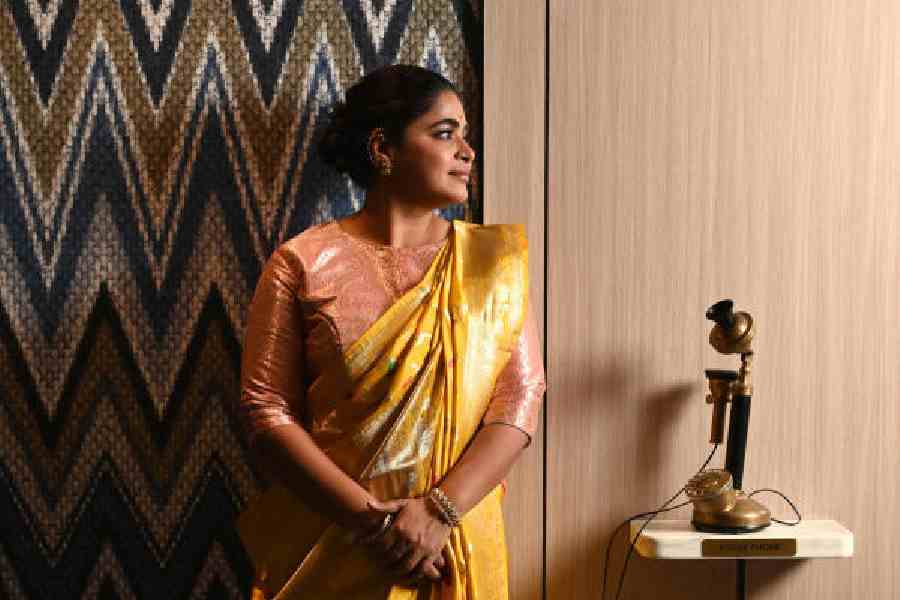
Ashwiny Iyer Tiwari is your everywoman. In the stories she tells, in the women she mirrors. In her kind eyes and her benevolent smile. Look closer, and you see a certain resilience and sharp mind. Intelligent, heartfelt and unedited, Ashwiny, who has made films like Panga, Nil Battey Sannata and Bareilly ki Barfi, is much like her films. Feel-good. In Calcutta recently on a personal quest, Ashwiny took some time out for a quick shoot and a candid conversation, only with t2. Excerpts.
Do you do this often, Ashwiny?
No, not at all. I’m very happy being behind the camera! For me, this is one of the first few times. And I’m also wearing a Bengali-style sari and absolutely loving it. I feel very artistic and rooted. And of course, I’m in Calcutta. The first sari is something which I usually wear, a jamdani. And it’s cotton, comfortable. And the styling of the blouse is really nice. I just feel that I’m a little overdressed right now. But yeah, I’ve never felt so important. And you just made me feel like a queen! I think it’s so important that all of us women feel like a queen, inside and out.
What memories do you have of Calcutta?
I love, love, love the city. I love the vibe of the city. I love the city for its artistic culture. I like it for its rootedness. I like the old lanes with the new metro. The city is very special to me because I shot Panga here. I stayed here for quite some time. I love the food, the art. And see, I have a tattoo also, which is in Bengali, my kids’ names.
This morning, while I was travelling, we went to have puri bhaji, and there was a woman just standing next to it, and she had a stall. The way she had worn her sari and, you know, with the alta, and she was just making some tea or something. That itself was so beautiful to see her that way. Very Calcutta.
That everyone is always... I’m not saying dressed for an occasion, but there is a culture. There is a conversation. The slight unhurriedness of the city, I really enjoyed that. I hope that sustains.
Is that like a stark difference you see when you come from a city like Mumbai, which is always running?
See, I love Mumbai. I love the vibe of the city. I think it’s a city definitely of dreams. And there are always people who are going to be there to help each other. It’s a city where you can travel late at night, and you don’t have to worry about anything.
For me, Calcutta gives you the vibe of Mumbai, but in a more laid-back fashion. And also, the art scene, the creative scene. I feel everyone is an artist in their own way. So, someone is a singer, someone is an artist, someone cooks really beautifully, and someone keeps their house very clean. There’s even the rangoli, which is put outside the houses. Even the kajal, which is put in the eyes. From a very woman’s point of view, I think there is so much Devi in everyone.
Do you have favourites?
I really like the begun bhaja at 6 Ballygunge Place (laughs). My other favourite is going shopping for saris. I love my jamdanis, and I would love to go to the local stores and pick up some saris.
Then, I like to go to the silver market and pick up those iron kadha bangles, which I really like. I buy them and I go and gift them back in Mumbai. Just walking on Park Street is a joy in itself. There is Flurys. And there’s another place that I really like, which is basically near the hospital lane, there is this 24x7 Maggi. They sell Maggi, and they sell chai there. I’ve never had such amazing Maggi in the middle of the night as I’ve had there! (Laughs)
The Indian Museum is beautiful. There are still a lot of sculptures there which are not seen anywhere else in India. I’m a big fan of archaeology and history. So, I really like going to that museum. And of course, film. I’m a fan of movies, obviously. And for me, I would love to make a film in Bengali someday, if I can.
Talking about saris, Ashwiny, how many cupboards do you have?
(Laughs) So, I had one cupboard of saris. And then when mom passed away last year, I inherited all her saris. And I then started thinking to myself that the collection of saris which our mothers have, I think it’s our responsibility as the next generation to preserve them and take care of them. And in some way, I know we don’t wear saris everyday like our mothers do, but it is very important for us to imbibe the idea of “sari not sorry”. And I’m so amazed and happy to see so many women of all age groups embracing the sari. And you know, having those hashtags of “sari not sorry, wear a sari every day”. I also know there are women who have sari groups.
We are the custodians of keeping our culture intact. And it’s very important that sari is a huge integral part of our being, right? And the sari doesn’t have any hierarchy. The sari is for all classes. And it’s worn as beautifully. It’s the most accessible form of material.
Is jamdani your favourite?
From Calcutta, yes, jamdanis. I really like jamdanis, and I like the soft mul cotton also. If I go East, Northeast, there’s something called the eri silk, very refined. It’s very refined, and the colours are beautiful. Eri silk is being made and woven by many young fashion designers right now, and textile designers who are creating the balance of eri silk mixed with cotton and khadi. Benarasi is beautiful, and I would love to own a nice cobalt blue Benarasi.
Tell us a little bit about your journey in films…
I think for me, I’ve always been a dreamer. And for me, when someone tells me that I cannot do this or you’re not good enough, then that makes me work hard even more. I just feel that it’s God’s grace, and somewhere the stories just keep coming in my head, and I keep writing and I keep telling that story. But your validation only comes from your audience. And when I meet people like you, and you say these are the movies you’ve seen, that’s what makes me happy.
I just feel that during Covid, the number of people who watched Bareilly Ki Barfi and have messaged me on social media to say how much they loved the film, how it made their day, how they just laughed a little, how it just reflected the goodness in life, makes me really happy. And the same goes for Nil Battey Sannata where a simple story could move so many individuals... that we, from a privileged space, can elevate and imbibe education to people who don’t have access to it.
And the same goes for Panga where we are all talking about women needing to go back to work, the need to empower women with children, who can still, with the support of their family, go to work. During Covid, the biggest eye-opener was to see so many women entrepreneurs, right from the spaces of their homes, working, and were cooking and doing YouTube videos, and that gave them a new lease of life. So, for me, I feel Panga is a very important film. Not everyone of course has the accessibility, there is a lot of social conditioning, there is a lot of pressure, there’s sometimes a guilt factor as women that when we have kids, who’s taking care of the kids, what is happening, we all go through that whole thing. But the one thing which I have learned is that it’s very important to just keep yourself busy in some way. It’s so important for women to feel good about themselves.
Are you organically drawn towards women-oriented roles?
Not consciously, but I think subconsciously, it has happened so. Although Bareilly ki Barfi was a comedy love story, there was a strong embodiment of Kriti’s character, which was about what she wants and what others believe. What’s her relationship with her father? I feel I have a responsibility as a filmmaker to imbibe, aspire, and inspire through my stories, something that men and women can take.
We are a young country, and we are moving towards a thought process which empowers each other. So for me, my stories need to do that in whatever form. And that is not through like telling directly that you need to do this. I’m not someone who needs to do that, but I’m a storyteller. With my stories, if I can inspire one person out there, even if they’re laughing, but something touches them, I think I have done my job as a filmmaker.
And for me, movies are archival. They need to remember my movies. Thanks to social media, thanks to the media, because of the way we can connect with our audience right now, people recognise not only the movies we make, but also recognise who the director is, who’s the writer. So I think that is something which is very important. And because then what happens is that when I see one young girl there whose parents are okay to make her a filmmaker because they’ve seen one who has no background in anything and is doing pretty okay.
Do you have a favourite Bengali film or a director that you really love?
Of course, Basu Chatterjee. Hrishikesh Mukherjee. There is one movie called Mahanagar (Satyajit Ray), which is one of my most, most favourite films. It just talks about migration. And it talks about what happens. And even today, after so many years, we are all at different stages of our lives, migrating. Migrating into various things, maybe not from city to city, because cities have become self-sufficient. But there are so many other things we are migrating towards. Towards thoughts, towards processes, towards living. And for me, Mahanagar is a very important film.
Styling: Sumit Sinha
Hair and make-up: Abhijit Paul
Assisted by: Sananda Mondal Laha
Location: Hyatt Centric Ballygunge Kolkata
Jewellery courtesy: Tribe by Amrapali, Forum Courtyard Mall