A computer engineer who’s also had a stint as a gym instructor, left home at 17, is trained in classical music, tabla and sitar, and is taking India to the world with her reinterpretation of traditional Indian textiles. Fashion designer Vaishali Shadangule, the woman behind the eponymous Vaishali S, who just celebrated the silver jubilee of her label in Mumbai. Vaishali became the first Indian woman designer to showcase at Paris Haute Couture Week in 2021 and is also the only from India to have a store in Paris.
In this recap chat, Vaishali goes back to her days in Vidisha in Madhya Pradesh, where she hails from, her initial years in fashion, and what kept her going despite the odds.
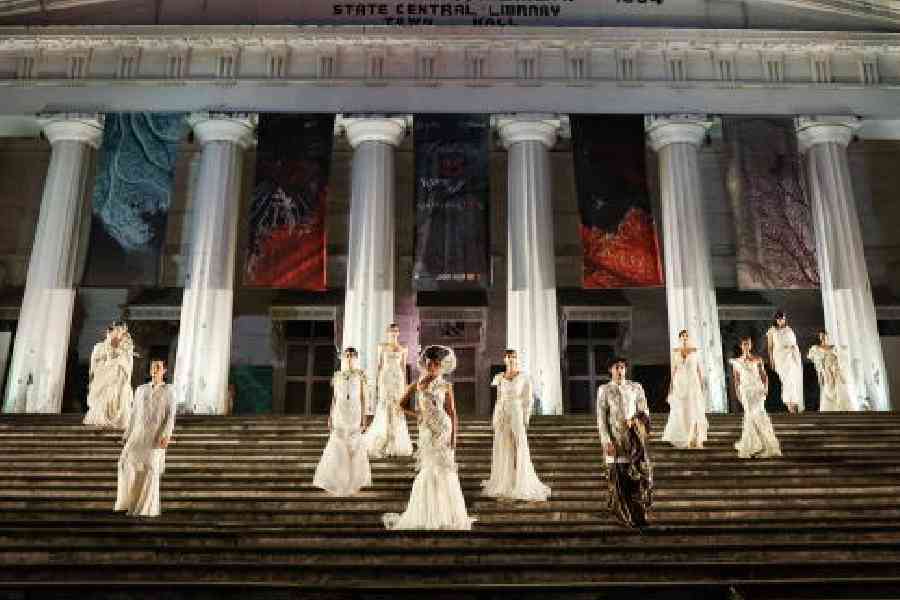
Congratulations on completing 25 eventful years in fashion! What was the idea behind staging the show on the steps of The Asiatic Society, Mumbai?
There are many solid reasons for trying hard and stubbornly to have my show at The Asiatic Society. First of all, it is majestically beautiful, and right between my Kala Ghoda store and my Ballard Estate atelier, a place I pass by every single day.
The Asiatic Society’s original scope was the “research and dissemination of Indian heritage culture”. My mission is the research of dying Indian hand-weaving techniques, and their recovery by showing them around the world in a modern design and context. You understand that it is just stunningly aligned.
Also, The Asiatic Society staircase grew into Mumbai’s first public stage, where elections were announced, scholars would talk from, and great achievements were celebrated. Just the only possible stage I would dream of having the Indian hand-weaves celebrated at a luxury standard, and where to announce the launch of my menswear line, again, my mission.
The Asiatic Society holds the only surviving copy of Bābul-i-Hind, an early Persian treatise on India’s flora and fauna. All my collections are inspired by India’s flora and fauna. It also holds one of the two oldest (14th century) manuscripts of Italian Dante Alighieri’s Divine Comedy, again, a very strong bridge to celebrate my connection with Italy.
How did you craft your menswear? It’s gorgeous, and we see you have given them a touch of femininity…
I have been thinking about menswear for several years now. I crafted it just like I crafted my womenswear. I first prepared the khadi materials that inspired me. I tried to infuse some modern edge, like, for example, the metallic threads interwoven in some of them. Then I literally draped them first, with a strong focus on heritage Indian men’s attire, giving them a more modern look. It might seem a bit feminine at first, because we are no more used to seeing them regularly, but this is just how men used to dress and how they still do in some villages.
It is fully in line with my general values of sourcing from the unique, beautiful Indian heritage and seamlessly updated with slightly more modern fabrics and silhouettes. And again, only handloom fabrics. It is a seamless development of my body of work and values.
The show had hints of your previous collections, too…
The collection overall was a celebration of my 25 years, with mostly new models but with hints and details of my past collections. While it is overall a couture collection, you may find these details that I have been carrying and developing along the path. I don’t like looking back at the past as such. I like taking from it and developing.
The last 25 years must have flown by, right? Can you believe it?
Honestly, I’m still in that mode, you know, ‘Oh my God, it’s already 25 years’, that means I started my brand when I was just 19 years old, imagine. I started my tiny 100sq ft store in Malad (in Mumbai).
How did it start for you?
I took a ₹50,000 loan from the bank. It was in a residential area, and there was a grocery store on one side and a restaurant on the other. That time too, I was working with handloom and making whatever I was imagining, though I was not a trained designer at that time. It was quite challenging, but of course, I’ve learned from that kind of madness and my experiments. From 2001 to now, it’s been quite a long learning journey.
What were the struggles like?
I think it’s not one, but that’s how I’ve learned from them. Imagine a 19-year-old girl without a fashion background, and I decided to open my store. So of course, the clients were treating me like a kid, and many used to dominate (laughs), and because I was learning from whatever I was doing, sometimes I would make mistakes. Of course, you learn from your mistakes, but you have to deal with them. Also, coming from a small town, you don’t have that kind of exposure and that kind of confidence to handle people and talk. I was not able to speak well. And so, from there, I’ve learned so much, and communication was also the issue, but I think I have managed to do things because at least I was confident about what I was doing, bringing out something unique and new. I’ve never done anything conventional, you know. Many of my clients from 2001 still come, and I’m still making clothes for them.
I have done various random jobs, and unknowingly, I used to style people. Someone told me I style well, and why don’t I take up fashion designing? Until then, I was not even aware of fashion design. I managed to attend one of the fashion institutes in Bhopal for a couple of days. That’s how I got exposure. I saw how to draw and how to explain to people. My drawing was good. I started enjoying, and then I was very curious about what it is….
I started searching for jobs in the fashion industry, and then I landed in Baroda, and then I came to Mumbai. I was working in an export house, and then I met with an accident, and there was a big gap. I was on bed rest for six months. I have also worked as a gym instructor. It was just about survival. There, I met a bank manager’s wife, and she helped me get a loan from the bank.
After 11 years of designing and running my business, I did my post-graduation from Delhi and a masters from Milan in fashion. That was another challenge. It gave me a lot of confidence because it gives you some kind of assurance about what you’re doing, and having technical knowledge helps you to explore more.
My mother used to wear Chanderi saris. So that was the fabric I felt I knew the closest. After the real journey started, I realised, oh, this is handmade. And then I went to Chanderi to explore how they made the fabric. Then I started exploring different villages for handmade fabrics. And that’s how that mission and the purpose came to be, to put it on the global map. And I think the real journey started from there, actually.
I feel I have lived five different lives. My daughter is 17 now, and I can’t even imagine that I left home when I was 17, in the middle of the night. I really feel like that was a past life, which I have the memory of, and you know, I’m living a different life.
What are the various clusters in India you work with?
So far, I think I’ve explored seven different states, of course, starting from Madhya Pradesh. In Madhya Pradesh, I’m working in Chanderi, Maheshwar. Then I found Guledagudda in 2012, which was not on the map, which is in Karnataka. The Khun weave comes from there. I did Paithani from Maharashtra. And then I’ve explored Kesapat and Northeast fabrics. Kesapat was also a very interesting story because I had to walk for four hours to reach the village where they used to make Kesapat. Then West Bengal and Rajasthan. In the South, I’ve recently explored Chettinad.
It’s always been a philosophy with you to be as sustainable as possible…
I’ve never thought about this, because from where I come from, it was a way of life. We have learned about sustainability in our house. My mother used to say don’t throw this, don’t waste water and reuse and not to touch plants after 6.30pm because they are sleeping. From Day One, I have followed this philosophy that I should not waste anything. I should reuse, redesign, and I should not do anything which can harm nature.
What were your initial designs like?
My inspiration has always been nature. I did my diving course in 2018-19, and I’m still exploring the underwater world. You see so many coral reefs in my collection.
I started with draping because pattern-making wasn’t in my introduction. Initially, when I started working with weavers, they were only making saris. I’m talking about 2001, 2002. I used to work with them, make saris and then create something, different silhouettes. It was still very unconventional.
When did you introduce cording?
I introduced the cording technique in my work in 2011. The whole idea was, you know, because Indian textiles are soft and flowy, I wanted to give them a shape. Cording is zero waste. You don’t waste fabric at all when you work with cording.
My concepts were really different. Initially, it was very, I must say, maybe controversial. There was a collection based on raga. I have learned classical music for 20 years, and I drew inspiration from how music waves play out when you listen to it. I was trying to relate that one swara, how you hear that swara. So those were the kind of silhouettes I wanted to create.
Do you think this has given the brand an international edge?
I think so, yes, because wherever I went, whether it is New York, Milan or Paris, you know, I just got one feedback from everyone. This is very unique, and we have never seen something like this. And more than that, I think it was original. It was fresh for everybody. When the Paris Couture Week happened, it was the same feedback from the Federation (Fédération de la Haute Couture et de la Mode). The feedback was like, ‘This is fresh for us’. This is really unique and different from what we see with Indian textiles. It’s very modern, and anyone can wear it around the world.
We must talk about Paris now. When you got that confirmation for your first Paris Couture Week showcase, what did it mean to you?
It was such a crazy time for everybody because it was Covid time, and I had very bad Covid. I was in the Maldives, trying to recover. I was not being able to walk. It was my birthday on April 29, when I got this call from the Federation. I was not able to digest. My weavers and my karigars were sitting in their houses, and their families were not allowing them to come back to Mumbai. Somehow, I managed. It took me 14 days to reach Paris. I crossed seven different countries. I can’t even explain that situation. I reached one day before the show. My show was on July 8, and finally, we did the show. It was so exciting, and it was such a dream come true because I always wanted to put Indian textiles on the global map, and this was the huge opportunity, but it was quite a story.
What was going on in your mind?
Honestly, you don’t realise when something is happening with you that is big. I think it takes a lot of time, and after that, you realise, oh my God! This was big. I also felt this was such a good thing for Indian designers, Indian women designers, you know, to open that door, that we can do it, and nothing is impossible. Vidisha is a very tiny village, and I’ve never thought about these things, but I just followed my heart.
Paris is where people come and appreciate original design and creativity. At my Paris store, most of the clients are from the Middle East and sometimes from Japan, the US and Europe.
What would you tell a budding designer about the importance of working with handlooms?
I would say connect with your roots. India is the most fashionable country, you talk about textile or silhouette or embroidery or craft… we have so many colours. There is so much inspiration, and I think you grow better if you appreciate what you have and are original.