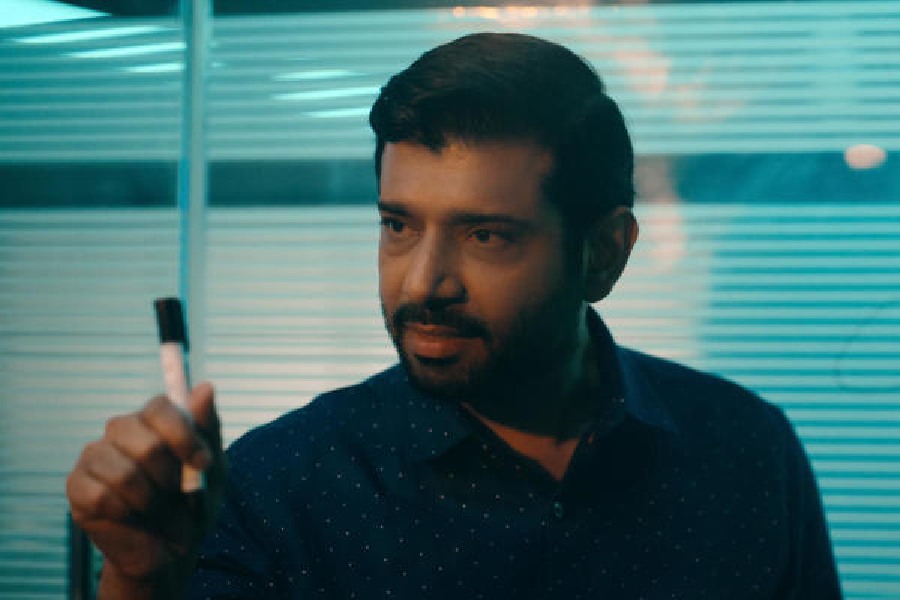
Netflix’s Hello Bachhon takes its roots from the real-life story of Alakh Pandey, a physics teacher who, through his popular platform Physics Wallah, set out to make quality education accessible to all students through online learning. The five-episode series, set to stream from March 6, stars Viineet Kumar Singh as Pandey and has a strong ensemble cast comprising Girija Oak and Vikram Kochhar, among others, and is produced by The Viral Factory (TVF). t2 chatted with Arunabh Kumar, founder of TVF, and Tanya Bami, series head, Netflix India, to know more.
Hello Bachhon is based on a remarkable real-life story that speaks of selflessness and resilience. Is there any one aspect of the story that immediately struck a chord with you?
Arunabh Kumar: This is a story I had known for some time. We sat down and wondered how best we could tell it. The journey of Alakh Pandey and of Physics Wallah is very different from that of any other ed-tech company. A series of startups happened during Covid-19, but what sets him apart is that he is a teacher first and a businessman later. I asked him what would happen if tomorrow all the funding and everything that has brought Physics Wallah to where it is today, disappears. His reply was: “Whatever happens, we will put the camera back on and I will start teaching with chalk on the board.” This is the kind of conviction and simplicity that makes this story what it is. He believes that teaching his students comes first and no one can stop him from doing so. I realised that he is not scared of anything, and that is what inspired me to tell this story.
Tanya Bami: After Kota Factory (also created by TVF), we had been wanting to build a really strong partnership and do many exciting things with TVF. With Hello Bachhon, they have done all the hard work... they thought of this amazing story and the amazing way in which to bring it together. For us, the most important thing always is how does a story make us feel. This story makes one feel very, very deeply on two counts. One is the hope that it embodies in the form of the stories of each and every student. Education is what will bring about progress, education is what will set you free, education is what will give you hope. This show embodies this ethos in a deep way and that was very exciting.
In this series, the lens of the storytelling is deeply emotional. You are being told more than two stories at a time and you connect with every child’s story and the circumstances that they are trying to rise above. As a viewer, you go on a journey with them, you cheer for Alakh and you support him in his quest to make education a birthright. Telling this differentiated story and invoking such deep emotions in the mind of the audience is what really resonated with me. It was an absolute must-do for us.
Arunabh: After Kota Factory, we were wondering how do we level up and tell something which is more than Kota Factory. I have realised that this is a very global story... it needs to be told not just for our country but it also resonates with students in the Latam countries as well, like Brazil. It is also true for Korea and some Southeast Asian countries. Many parents there are math obsessed, they want their children to do well, they want them to clear competitive exams and they represent students that want to build their career using academics.
Are you hoping this series will, in some way, evoke empathy in parents who push their children to excel in competitive exams without realising how much pressure they are creating on them?
Arunabh: This was actually one of the most important things we discussed. This is something that Alakh and the whole Physics Wallah culture believes in. Unfortunately, I have been witness to a friend of mine in my college taking his life and nobody knows the reason even now. Some institutes have crossed half a dozen suicides annually. Kota was going through its own thing and we addressed that beautifully in Kota Factory.
When we were developing the script of Hello Bachhon, the Netflix team said that we need to make it more contemporary rather than just romanticising one getting topper marks and clearing an exam. So this was a very, very conscious effort, and the entire finale of the show is about that. We wanted to say that if you want to learn, if you want to study, this is a good thing, but it doesn’t mean that it only has to lead to clearing of an exam, that it should only lead to the fulfilling of a desire that your parent or you have for yourself. That is not the end goal of this entire process. We have a very emotional final episode which deals with exactly what you are asking. It raises questions like: where do you stop? when do you not make this the be all-end all goal for your children? When will parents learn from this? What we are trying to establish is that it is good to dream but if sometimes the dream doesn’t come true, then it is not the end. Even Alakh, in the final episode, says that he himself failed to clear JEE.
Tanya: There is a saying that hope is a whisper that says tomorrow can be better. Alakh’s journey in this series is also about coming to terms with parental pressure. He rebelled in order to start Physics Wallah and become the teacher that he is today and the show illustrates the outcome of a channeled rebellion. That is very inspiring and motivating.
The journey of teachers is a big part of this story. We expect them to be selfless and teach and move mountains for our children, but they also have their own journey. I think it is that very unique sort of a triangle of a parent, a teacher and a child and how each life impacts the other, which comes through in Hello Bachhon. The series, in a way, brings each struggle to life in a very different way.
What made Viineet Kumar Singh the right actor to play Alakh Pandey?
Tanya: A deep understanding of human beings. He has owned this journey. We have something in common — his dad is a teacher and my mom is one too. Hence, his understanding of the journey of a teacher is very deep. He understands this role very well. He has seen it from close quarters and now he is portraying something which is probably more conflict-riddled than his own journey as an actor. He is such a fine actor, and also prolific in his thinking and he brings in a lot of nuance.
Arunabh: When we were discussing who to cast, we wanted somebody who could possibly supersede our expectations. We also hoped that the actor chosen would be able to master the dialect effortlessly and also get the innocence of the character right. Viineet himself has given the medical entrance exam (he is a certified medical practitioner). He has been in the shoes of Alakh as well as that of many other students. Alakh himself tried to get into IIT but he couldn’t. That was something which we found and he could relate to.
There is a father-son track in the show which is very special for me. I have spent some time with Alakh’s dad as well. Viineet also related very strongly to that because I think all of us belong to a generation where our fathers had borderline army personnel behaviour towards us. The show explores a father and son, who do not believe in each other, finally acknowledging each other’s journey and hard work. That is my favourite moment in the show. When I saw it in the rough edit, it made me well up. Viineet has seen that and lived that somewhere in his life and that is where the magic happened. I don’t think anyone else could have played it better.
Priyanka Roy