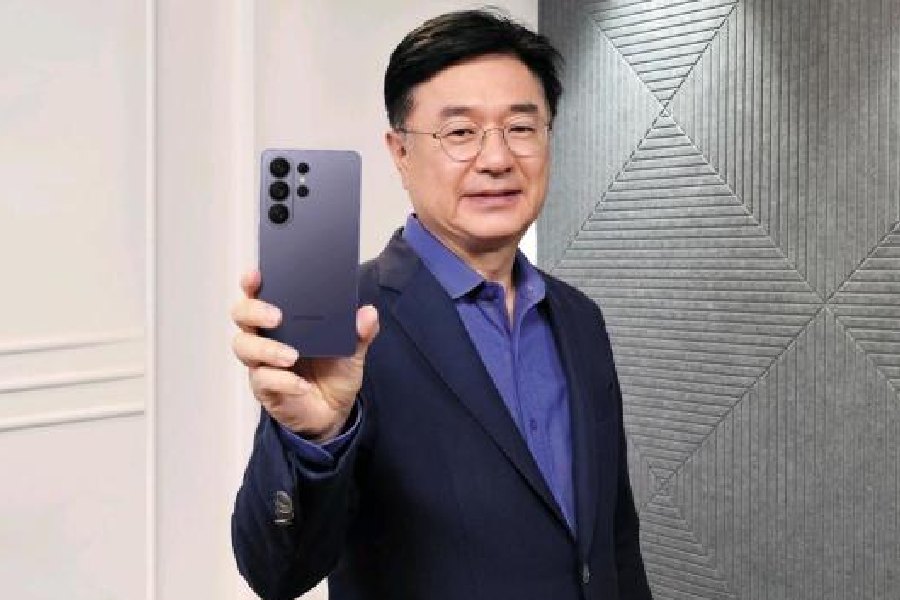
Most things in life are meant to be private. Yet the language of privacy is rapidly changing in the digital age. Today, it is about being able to define for ourselves who we are to the world — and on our own terms. That idea sits at the heart of Samsung’s latest offering, the Galaxy S26 series. The phone, after all, has become the repository of our most sensitive information, from government IDs and financial details to health metrics and work materials.
“One of the most significant innovations is Privacy Display on the Galaxy S26 Ultra. Unlike third-party filters, it’s integrated directly into the display, preserving the viewing experience in everyday use while limiting visibility from side angles. Users can limit privacy to specific parts of the screen or customise when it activates, making discreet protection feel seamless and intuitive,” said JB Park, president and CEO, Samsung Southwest Asia, when we met recently as part of a select group of journalists in San Francisco.
Privacy at the pixel level
Privacy Display is unlike anything we have seen on smartphones. It is a hardware feature at the pixel level rather than a film applied to screens. The new technology from Samsung uses narrow pixels and controls how they disperse light. Viewed straight on, the display functions exactly as it should; from the sides, however, it dims to the point that it may appear almost switched off.
“Galaxy S26 series also enhances on-device privacy with personal context processing that ensures sensitive data never leaves the device. While the S26 series offers an array of AI agents, users remain in control of exactly how and when their personal information is shared, maintaining full autonomy over their data. Even when interacting with partner AI agents through Samsung apps — including Samsung Notes, Calendar, Gallery, Reminder and Clock — users can control whether data is shared to train partner models or to profile users for targeted advertising,” said Park.
A couple of decades ago, it was often pointed out that maintaining privacy was integral to the Internet’s future because consumers needed to feel safe enough to participate. With artificial intelligence now embedded all around us, privacy has become an even more pressing concern.
Park also highlighted the importance of Privacy Alerts, which use intelligent monitoring to “proactively notify users when apps attempt to access device admin controls or sensitive data, such as precise location, call logs or contacts, helping users manage security permissions with greater clarity and control”. He added: “We ensure that AI follows your command and your will. We cannot let it spill out of your control and start generating things that are not authentic.”
The rise of agentic AI
Another notable aspect of the Galaxy S26 series is the implementation of agentic AI. In 2024, Samsung took a bold step by introducing a suite of AI features under the Galaxy AI banner. In just a couple of years, it has moved further ahead.
Consider using Gemini’s new agentic features while ordering a pizza for dinner from a busy family group chat. Users, of course, retain full control over what agentic AI can do, especially when it comes to making payments.
“User control and data protection are built into Galaxy AI from the start. When multiple AI agents are involved on S26, access to personal information is strictly limited to what’s needed to complete a specific task. All Galaxy AI experiences operate within Samsung’s Knox security framework, which applies consistent technical and policy safeguards across the device — even when partner services are involved. Personal data remains protected on-device, is shared only when required, and is not used for advertising purposes,” said Park.
Alongside Bixby, the Galaxy S26 series integrates a choice of agents, including Gemini and Perplexity. Once set up, tasks can be completed with a single button press or voice prompt. Galaxy S26 can also handle multi-step tasks in the background, streamlining processes on the user’s behalf.
Park added: “The agentic AI experience in Galaxy S26 is designed to understand user context, connect the right apps and functions automatically, and carry tasks through to completion. Users don’t need to think about which app to open. They can focus on what they want to get done, while the device quietly handles the steps in the background.”
Samsung enjoys a distinct advantage when it comes to implementing AI. Unlike many other companies, it manufactures not only smartphones but also televisions, refrigerators, air conditioners and a wide range of consumer electronics. That breadth allows AI features to extend well beyond the handset.
“We are not only a mobile company; we are an electronics company that builds consumer electronics — refrigerators, washing machines, ACs and televisions. All of these, along with our mobile ecosystem and wearables such as the ring I’m wearing, watches and buds, form a connected ecosystem. When we spoke at CES this year, TM (Roh) mentioned that we will have 800 million devices linked to AI, up from 400 million last year. That figure refers only to Galaxy devices.”
He explained that once Samsung equips its consumer electronics with smart functionality — “smart” meaning connected — the larger picture becomes clear. “Connected means devices can communicate with each other, you can control them, and they can adjust to your daily behaviour. The big picture is an ecosystem in which all consumer electronics are controlled by your handheld device or watch, whether you are at home, travelling to work or returning. Your home environment will adjust proactively according to your settings. We have Galaxy AI on smartphones, Vision AI on televisions and Bespoke AI for appliances, all linked in an ecosystem and orchestrated by AI technology so that you do not have to worry about changing settings every time.”
Samsung’s R&D operations are spread across several centres, making it difficult to pinpoint where a particular feature on the new phone has been developed.
“We have an R&D centre in Noida that codes for individual markets — perhaps 129 countries. Besides Korea engineering, the Noida R&D centre is the primary location handling configuration for localised global settings, from collaborating with telcos on frequency settings to product configurations — all of it is done in Noida,” said Park.
Samsung R&D Institute India in Bengaluru also plays a pivotal role. “In Bengaluru, they are central to developing the AI algorithms for our on-device AI. This functionality, especially focusing on the camera, is their area of specialisation.”
Circling back to privacy, many of the Galaxy S26’s protections are enabled by Knox, Samsung’s secure element embedded in its phones and other devices. Knox Vault, for instance, safeguards personal data and biometric information. So, regardless of which AI feature is in use, multiple layers of protection are in place to secure user data.